Metal Roofing Alliance Member
TVA Preferred Partners Network
10,000+ Metal Roof Jobs
Nashville, TN
Licensed & Insured
BBB A+

Open 8am–8pm
(615) 649-5002Schedule Your
Appointment
Appointment
✦ Reviewed by The Metal Roofers Technical Team
Most homeowners comparing metal roof quotes ask about gauge. Far fewer ask what the metal actually is.
Those are two different questions with two different failure modes.
Gauge is how thick the metal is. Substrate is what the metal is made of and what protects it from corrosion. A thick panel with the wrong substrate will still fail, and a correctly specified thinner panel can outlast it.
Nearly every residential metal roof in Middle Tennessee is one of three substrates: Galvalume-coated steel, galvanized steel, or aluminum. Copper is a fourth option in a different price class, covered in our copper roofing guide.
Here is how they actually differ.
Galvanized steel is carbon steel coated with zinc. It is the oldest of the three and the reason people associate metal roofing with old barns.
Zinc protects steel two ways. It forms a physical barrier, and it protects sacrificially. Sacrificial protection is the important one: when the coating is scratched or cut, the surrounding zinc corrodes preferentially and shields the exposed steel underneath. That is why galvanized performs well at cut edges, scratches, and fastener penetrations.
Coating weight is designated by a G-number. G60 and G90 are the common ones, and the number refers to the total ounces of zinc per square foot of sheet across both surfaces. G90 carries more zinc than G60 and lasts longer in the field.
The weakness is broad-surface longevity. Zinc corrodes at a fairly steady rate across the open panel, so galvanized generally does not match Galvalume for total service life on the flat.
Where it still makes sense: agricultural buildings, applications where cut-edge and penetration protection matters more than total lifespan, and situations where Galvalume is contraindicated.
Galvalume is carbon steel coated with an alloy of roughly 55% aluminum, 43% zinc, and a small amount of silicon. It was developed specifically to combine the aluminum's barrier durability with the zinc's sacrificial behavior.
Coating weight is designated AZ50 or AZ55, with AZ55 carrying more coating. AZ50 is common on painted residential panels because the paint system provides an additional barrier layer.
On the open field of the roof, Galvalume substantially outperforms galvanized. The aluminum-rich alloy forms a stable barrier that corrodes far more slowly than zinc alone. This is why it became the default substrate for architectural metal roofing.
The tradeoff is at the cut edge. Because there is less free zinc available, Galvalume provides less sacrificial protection where the panel is cut, drilled, or scratched down to bare steel. On a well-detailed roof with hemmed edges and proper trim this is a non-issue. On a sloppy install with raw cut edges sitting in standing water, it matters.
Galvalume also has hard incompatibilities. It should not be in direct contact with wet concrete or mortar, and it is not appropriate for animal confinement buildings where ammonia is present. Both attack the coating.
For a Nashville residential roof, painted Galvalume steel is the workhorse and the correct default. It is what sits under most of the standing seam and exposed fastener panels we install.
Aluminum is not coated steel. It is solid aluminum, and it does not rust at all. It forms a thin, self-repairing oxide layer that stops corrosion without any sacrificial coating.
That makes it the most corrosion-resistant of the three by a wide margin, and it is the standard choice in coastal salt-air environments. Middle Tennessee is not a coastal environment, which changes the calculation considerably.
Three things work against aluminum on a typical Nashville home.
Cost. Aluminum sits meaningfully above steel per square foot.
Softness. Aluminum dents more readily than steel of equivalent thickness. In a market that takes regular hail, that is a real consideration. It also shows oil canning more readily, because it is less rigid.
Thermal movement. Aluminum expands and contracts roughly twice as much as steel over the same temperature swing. On long panel runs that has to be engineered for, with appropriate clip design, panel length limits, and expansion detailing. It is manageable, but it is not something to hand to a crew that has not done it before.
Where aluminum genuinely earns its cost: homes with heavy tree cover and constant leaf litter holding moisture against the panel, roofs where galvanic compatibility with copper components matters, and homeowners who want the longest-life steel-free option short of copper.
This is the part that gets skipped in most sales conversations, and it wrecks more roofs than substrate choice does.
When two dissimilar metals contact each other in the presence of moisture, the more active metal corrodes rapidly. The same thing happens when runoff from one metal washes across another.
Practical rules for a Tennessee roof:
Copper runoff is destructive to both Galvalume and aluminum. If you have a copper gutter, copper chimney cap, copper flashing, or a copper accent roof above a steel or aluminum plane, water running off that copper will attack the metal below it. This has to be designed around, not discovered later.
Fasteners must be compatible with the panel. Mismatched fastener metallurgy creates a corrosion site at every screw. This is one of several reasons fastener selection matters so much, covered in our post on barn screws vs. ZAC screws.
Certain pressure-treated lumber chemistries are corrosive to steel and aluminum in direct contact. Separation or an appropriate barrier is required.
Direct contact with wet masonry attacks Galvalume specifically.
Substrate choice is not just about the panel. It is about everything the panel touches and everything that drains onto it.
Two separate things determine how a painted metal roof ages, and homeowners routinely conflate them.
The substrate determines whether the metal corrodes. The paint system determines whether the color holds.
A roof can have excellent Galvalume underneath and a cheap polyester paint that chalks and fades badly within a decade. It can also have an outstanding PVDF finish over a substrate specified too light for the application. These are independent decisions and independent warranties. Our guide to Kynar 500 vs. SMP finishes covers the paint side in detail.
When you review a quote, you should see both specified: the substrate and coating weight, and the paint system. If a proposal says only 26-gauge metal roof with no substrate, coating designation, or finish named, that proposal is incomplete.
These two specs work together, and neither substitutes for the other.
We install 26-gauge steel as our residential standard and 24-gauge as the upgrade. We do not offer 22-gauge for residential work. Our post on choosing between 24, 26, and 29 gauge covers when the heavier panel is worth specifying.
The important point is that they solve different problems. Heavier gauge buys stiffness, dent resistance, flatter appearance, and better performance under wind uplift. Substrate and coating weight buy corrosion life. A 24-gauge panel with a light coating will still corrode. A 26-gauge panel with proper Galvalume and a quality finish will not.
Specify both deliberately.
If you have an existing metal roof and want to know what it is, there are a few tells.
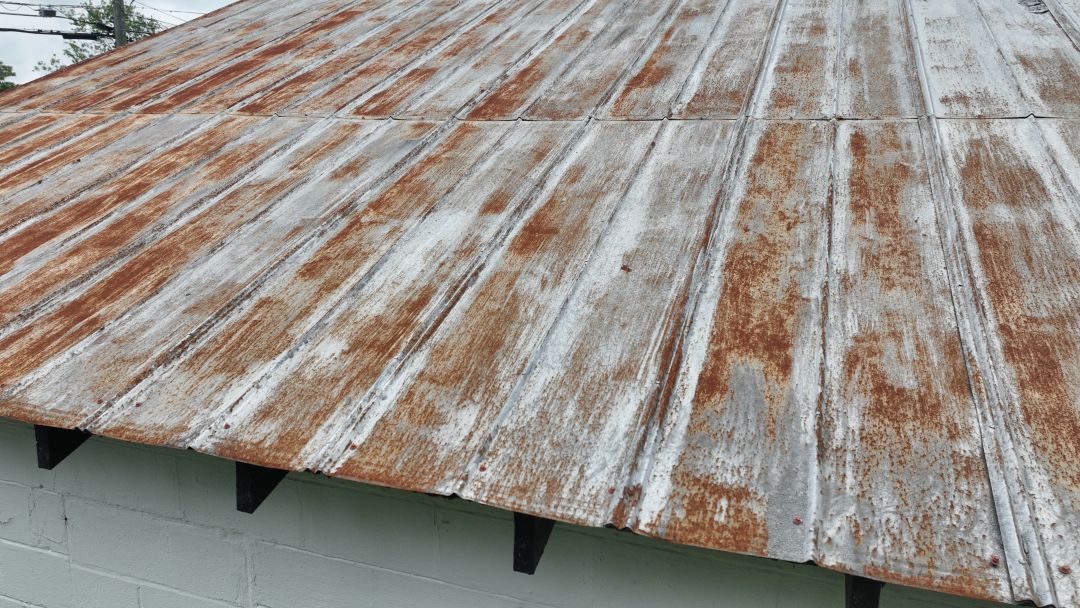
Unpainted galvanized develops a distinctive dull gray spangle pattern and eventually a chalky white surface oxide. Unpainted Galvalume weathers to a flatter gray and generally stays cleaner longer. Aluminum will not show any red rust anywhere, ever, including at cut edges and screw heads, which is the fastest field test there is.
Red rust bleeding from cut edges, fastener holes, or panel ends means you are looking at steel with a compromised coating. Whether that is a repair or a replacement conversation depends on how far it has progressed, which is what a metal roof inspection determines.
Manufacturers often print the substrate designation directly on the underside of the panel. If you have attic access and can see the panel back, the marking may still be legible.
For most Nashville-area homes, painted Galvalume steel at an appropriate coating weight is the right answer. It handles this climate well, the cost is reasonable, hail performance in 24 or 26 gauge is solid, and the detailing is well understood by every competent crew in the market.
Aluminum is worth pricing when the roof sits under heavy continuous tree cover, when copper components are already present in the assembly, or when a homeowner specifically wants a substrate that cannot rust under any circumstance.
Galvanized has a place on outbuildings, shops, and barns, particularly where cut-edge protection matters and the aesthetic is intentional.
Copper is a separate conversation about appearance, patina, and long-term value rather than a value-engineering decision. See our copper roofing guide.
All of these can be fabricated as standing seam, and steel substrates cover the Classic Panel and metal shingle profiles as well.
For open-field corrosion resistance on a residential roof, yes, and by a significant margin. Galvanized still holds an advantage at cut edges and penetrations because of stronger sacrificial protection. For most homes, Galvalume is the better overall choice.
The coating resists corrosion very effectively on the flat surface. Bare steel exposed at a cut edge, a drilled hole, or a deep scratch can develop rust, which is why edge detailing and hemming matter. Painted Galvalume adds another barrier layer on top.
No. Aluminum does not form red rust. It develops a stable oxide layer that protects the metal underneath.
Usually not, for a typical suburban roof. Nashville has no salt-air exposure, which is where aluminum's advantage is decisive. It becomes worth pricing under heavy tree cover, where copper components are present, or where a homeowner wants the corrosion question permanently closed.
Yes. Aluminum is softer, so at equivalent thickness it dents more readily from hail and impact. That matters in a hail-exposed market. See our post on how hail damage impacts Nashville roofs.
Galvalume should not be in direct contact with wet concrete or mortar. Where the roof meets masonry, the detail needs proper separation and flashing. This is standard practice for a competent crew and a red flag if a bidder waves it off.
You should not put copper where its runoff drains across Galvalume or aluminum. If copper components are required, the assembly has to be designed so drainage paths do not cross incompatible metal.
Substrate and coating designation, such as painted Galvalume AZ50. Gauge. Paint system. Panel profile. Fastener type and metallurgy. If any of those are missing, ask for them in writing before signing.
Gauge and substrate are separate specifications solving separate problems. Gauge buys stiffness and dent resistance. Substrate buys corrosion life.
For nearly every home in Middle Tennessee, painted Galvalume steel at 26 gauge, or 24 gauge where conditions warrant it, is the correct specification. Aluminum solves specific problems at a premium. Galvanized still belongs on outbuildings.
The bigger risk is not picking the wrong substrate. It is contact between incompatible metals, raw cut edges, mismatched fasteners, and masonry details done carelessly. Those turn a correctly specified roof into a warranty claim.
If you want to know what is on your roof now, or what belongs on it next, start with a metal roof inspection. For pricing across substrates and systems, see our metal roof cost guide, where residential work generally runs $8.50 to $16 per square foot installed depending on system, substrate, gauge, and complexity.
We serve Nashville and Middle Tennessee. See areas we service.

Choosing between 24, 26, and 29 gauge metal roofing in Nashville? Here's which gauge fits Middle Tennessee's wind, hail, and summer heat.
Thinking about a metal roof? This comprehensive guide covers everything you need to know about durability, cost, and benefits