Metal Roofing Alliance Member
TVA Preferred Partners Network
10,000+ Metal Roof Jobs
Nashville, TN
Licensed & Insured
BBB A+

Open 8am–8pm
(615) 649-5002Schedule Your
Appointment
Appointment

The Metal Roofers quoted full residential metal roof replacements in Nashville at $15,000 to $69,600 in 2026, depending on system and size, with tear-off, underlayment, flashings, and cleanup included. Most exposed fastener projects came in near $27,000 and most standing seam projects near $42,000. The exact number depends less on your ZIP code than on your roof's shape, detail count, system choice, decking condition, and how much custom flashing work the assembly requires.
Published Installed Pricing · Nashville & Middle Tennessee · June 2026
$11–$19
Standing Seam · Installed Per SF
$9–$15
Metal Shingles · Installed Per SF
$5–$9
Classic Panel · Installed Per SF
$15K–$69.6K
2026 Full Replacement Range
✦ Reviewed by The Metal Roofers Technical Team
Pricing on this page comes from our own Nashville job records and current material quotes, not national averages, and is revised when material prices move.
1,000+ metal roofs installed · 10,000+ repairs · Licensed and insured, TN Lic #75515 ·
Updated September 2026 · Reviewed September 2026
·
How we report and who reviews itLooking for repair pricing instead of a new roof? Most metal roof repairs we complete cost $150 to $1,000, with a $250 diagnostic visit. See the 2026 metal roof repair price list for Nashville.
Most roofing price pages give you one vague national average and ask for your phone number to learn anything more. This page works the other way. It publishes the same installed ranges we quote from, explains what moves a project toward the low or high end, and separates hard published numbers from items that can only be priced once your roof is measured and opened. A price you can plan around is worth more than a teaser, and an informed homeowner is a better customer. The figures on this page come from our own 2026 project data and the 1,000+ metal roofs we have installed across more than 30 Middle Tennessee cities, not from national averages.
The guide is organized around thirteen sections: current cost by system, the drivers that change the number most, common add-on costs, how metal compares with asphalt over a 50-year window, repair versus replace, insurance and financing, the Nashville HOA and historic-district realities that shape what gets approved, and straight answers to the questions we hear most. A square means 100 square feet of roof area, not floor area, and every whole-roof figure here is a budgeting example built from published per-square-foot ranges, not a quote.

I
.svg)
Full Replacement Budgets and Current Per Square Foot Ranges
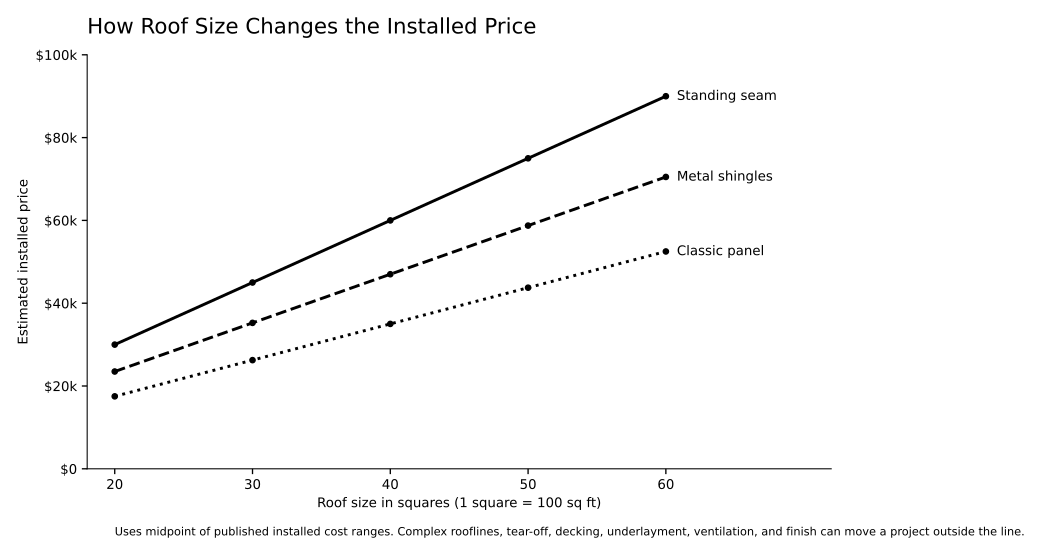
In current June 2026 pricing from The Metal Roofers, Nashville homeowners should budget about $11 to $19 per square foot installed for standing seam, $9 to $15 for metal shingles, $5 to $9 for classic exposed-fastener panel, $14 to $24 for zinc, and roughly the low $20s into the mid $30s per square foot for copper. By the roofing square, that translates to published installed pricing of $1,100 to $1,900 per square for standing seam, $850 to $1,500 for metal shingles, $800 to $950 for exposed fastener, and $350 to $650 per square for restoration coatings.
For a full residential replacement, our 2026 quotes ran $15,000 to $69,600 depending on system and size, with tear-off, underlayment, flashings, and cleanup included. Exposed fastener projects ran $15,000 to $48,500 and averaged about $27,000, while standing seam projects ran $22,600 to $69,600 and averaged about $42,000. Two roofs with the same square footage can still price very differently, which is why the sections below spend as much time on what changes the number as on the number itself.
Roofers measure in squares, and one square is 100 square feet of roof surface. On our current published schedules, standing seam runs $1,100 to $1,900 per square installed, metal shingles run $850 to $1,500, exposed-fastener panel runs $800 to $950, and roof restoration coatings run $350 to $650 per square. If a contractor quotes you by the square, these are the numbers to compare against.
Every written estimate we produce includes tear-off and disposal, a decking repair allowance, underlayment, the metal system itself, flashings, and cleanup. That matters when you compare quotes, because a low number that excludes tear-off or underlayment is not actually a lower price. It is a smaller scope.
A quick note on units, because roofers and homeowners often talk past each other here. A square is 100 square feet of roof surface, so a 2,000 square foot roof is 20 squares, and 20 squares at the standing seam schedule of $1,100 to $1,900 per square is exactly where the $22,000 to $38,000 typical range comes from. Roof surface is almost always larger than the home's floor plan once pitch and overhangs are counted, which is one reason online calculators that start from living area come in low.
Three questions shape almost every final number: which system you choose, how complex the roof geometry is, and what condition the decking is in once the old roof comes off. The sections below take those one at a time.
II
The Premium Steel Benchmark for Nashville Homes
Standing seam is the premium steel residential benchmark in Nashville because the fasteners are concealed, the seams sit above the water plane, and the system is designed to move with Middle Tennessee heat cycles. Current published pricing is $11 to $19 per square foot installed, with a 2,000 square foot roof often landing around $22,000 to $38,000 before heavy complexity pushes the number higher. On complex homes with dormers, valleys, multiple slope changes, wall transitions, or premium upgrades, a broader Nashville range of $28,000 to $42,500 is the better expectation. Our actual 2026 standing seam quotes ran from $22,600 to $69,575 across all home sizes and averaged about $42,000, so a large or detail-heavy roof can land well above the published examples.
The published component schedule for a 2,000 square foot standing seam roof breaks down to roughly $4.50 to $5.25 per square foot for panel and trim, $3.00 to $6.00 for labor, $1.00 to $3.00 for tear-off, and $0.75 to $1.50 for underlayment. A premium 24-gauge upgrade adds about $1 to $2 per square foot. Transition work and detail density are where complexity really changes the number.
Notice what that component schedule says: on many projects the labor line is as large as the material line, and on complex roofs it is larger. Standing seam is a fabricated, mechanically detailed system. Panels are formed to length, seams are locked or mechanically seamed, and every hip, valley, ridge, penetration, and wall transition gets custom-bent flashing. You are not paying a premium for the metal so much as for the hands and hours that make the metal permanent.
Gauge is the other lever. Our residential standard is 26-gauge steel, with 24-gauge available as a premium upgrade at about $1 to $2 more per square foot. The heavier panel sits flatter, shrugs off foot traffic and hail better, and is the common specification on high-end homes and low-slope roofs where the panel field is highly visible.
Profile construction is the other upgrade conversation. Mechanically seamed profiles sit at the top of the range because the seams are crimped closed on the roof, which takes more labor than snap-lock but produces the tightest assembly, and it is the same construction our commercial standing seam work uses.
Where the range really widens is detail work. Every valley, dormer, chimney saddle, and wall transition is custom-fabricated flashing that has to be formed, fitted, and sealed by hand. A simple gable roof lives near the bottom of $11 to $19. A roof with a dozen planes lives near the top, and that difference is labor you can see in the finished lines of the roof.
III
Traditional Streetscape Fit With Metal Performance
Metal shingles are usually the best match when the house needs a more traditional streetscape fit, especially in HOA-regulated or character-heavy neighborhoods. Published pricing is $9 to $15 per square foot installed, and a typical 2,000 square foot Nashville home runs about $18,000 to $28,000, with higher numbers possible on more complex roofs or premium systems.
Stamped metal shingle and shake systems from manufacturers like DECRA, ProVia, and Worthouse are engineered to read as architectural shingles, shakes, or slate from the street while performing like metal underneath. That is what makes them the default answer in HOA-governed neighborhoods and traditional streetscapes where a standing seam profile would be turned down at review.
The pricing lands between classic panel and standing seam for a structural reason. Interlocking shingle panels are smaller, which means more pieces, more fastening, and more trim work per square than a through-fastened panel, but less custom fabrication than a mechanically seamed roof. You get concealed fasteners and metal performance without paying full standing seam labor.
The spread inside $9 to $15 comes from the profile and the roof itself. Stamped shake and slate-look profiles from the manufacturers we install, including DECRA, ProVia, Worthouse, and Modern Metal, carry different panel costs and coating systems, and a cut-up roof with many hips and valleys uses more material and more labor per square than a simple one.
Metal shingles also solve an approval problem money cannot always solve otherwise: in neighborhoods where a review board or HOA will not sign off on vertical panels, a dimensional metal shingle usually reads as a traditional roof from the street while keeping metal's service life, so the premium over asphalt buys both performance and a yes.
IV
The Budget-Friendly Metal Option
Classic exposed-fastener panel is the budget-friendly metal option, best suited to simpler rooflines, shops, garages, ADUs, and outbuildings rather than intricate heated living-space roofs. The current published range is $5 to $9 per square foot installed. Smaller and simpler buildings often land around $10,000 to $18,000, while our full residential exposed fastener quotes in 2026 ran from $14,980 to $48,520 and averaged about $27,000.
The trade-off for the lower price is exposed fasteners. Thousands of gasketed screws hold the panels down, and those gaskets weather as the roof ages, so the system benefits from periodic fastener checks and selective replacement over its life. On a shop, barn, or garage that is a reasonable bargain. On a complex primary residence, concealed-fastener systems usually earn their premium. On 2026 homes we priced both ways, standing seam ran 29 to 55 percent more than exposed fastener, about 44 percent more on average, which is the real-world size of that premium.
Classic panel is also the fastest metal system to install on simple geometry, which is part of why the published range sits where it does. Long panels, straight runs, and minimal flashing detail keep labor hours down, and labor is the largest variable in any roof price.
V
The Premium Metals, Priced as Long-Horizon Investments
Zinc sits in the premium tier between painted steel and copper. Current published pricing is $14 to $24 per square foot installed for standing seam zinc, with a typical full zinc roof around $24,000 to $48,000 and service life in the 80 to 100+ year range.
Copper is a separate category and a long-horizon investment rather than a price-per-panel commodity decision. Detailed ranges place copper at roughly $22 to $35 per square foot installed, with a typical full copper roof around $40,000 to $70,000 and many accents priced individually by feature. Because copper is a traded commodity, quotes move with the market.
Both metals are chosen for lifespan and for the living finish. Zinc develops a self-healing patina that dulls scratches and scuffs over the years, and copper moves from bright penny through brown toward verdigris over decades. Neither needs paint, and both show up most often on architect-led projects, historic work, and accent roofs such as bays, porches, and turrets where the material is meant to be seen.
Copper deserves one practical note: it is a traded commodity, so a copper quote has a shelf life. We price copper projects against the current market at the time of the written estimate, and accent work such as bay roofs, chimney caps, and copper half-round gutter systems, published at about $3,400 to $7,000, is typically priced individually by feature.
What that premium buys is time measured in generations. Zinc develops a self-protecting patina that heals minor scratches chemically, which is how it reaches 80 to 100+ years of service life, and copper is the only roof on the menu routinely detailed into bay windows, porch roofs, and accent features priced individually by feature rather than by the whole roof.
One honest caveat on copper: because it is a traded commodity, the number on a copper quote tracks the metals market at the time it is written. A quote from last year is not a quote for this year, so we date copper pricing and hold it for a defined window rather than pretending the market stands still.
VI
Replacement Systems and Restoration Economics
For commercial roofs, current June 2026 published ranges are $11 to $19 per square foot for mechanically seamed standing seam, $8.75 to $9.75 for PBR exposed-fastener metal, $8 to $12 for TPO or EPDM, $9 to $17 for PVC, and $6 to $15 for modified bitumen.
Roof coatings run far less than replacement. The broad restoration range is about $2 to $5 per square foot, with a chemistry-specific commercial breakdown of roughly $3.75 to $5.75 for acrylic and $4.76 to $6.75 for silicone. On our 2026 projects where we quoted the same roof both ways, the coating typically ran 40 to 51 percent of replacement cost, a savings of 49 to 60 percent, with coating quotes running $2.50 to $6.85 per square foot and most landing between $3.30 and $4.50.
Restoration coatings only make sense on a roof that is still fundamentally sound: seams tight enough to repair, decking dry, and the membrane or metal within its serviceable life. On those roofs, a fluid-applied system at roughly $3.75 to $5.75 per square foot for acrylic or $4.76 to $6.75 for silicone buys years of service for about 40 to 51 percent of what a replacement costs, based on our 2026 projects quoted both ways. On a saturated or structurally compromised roof, a coating is money painted over a problem, and the inspection report will say so rather than sell it.
For full commercial replacement, mechanically seamed standing seam at $11 to $19 per square foot remains the long-horizon benchmark. PBR panel at $8.75 to $9.75 is the workhorse exposed-fastener option, and single-ply and built-up systems, TPO and EPDM at $8 to $12, PVC at $9 to $17, and modified bitumen at $6 to $15, fill out the range depending on membrane and detail scope.
The gate for coating is condition, not age. A roof qualifies for restoration when the panels and seams are fundamentally sound and the insulation below is dry, and a real inspection makes that call before anyone prices anything. When a roof passes that gate, restoration at roughly 40 to 51 percent of replacement cost, a savings of 49 to 60 percent on our 2026 projects, is usually the right money. When it fails the gate, coating over a wet or failed assembly just buries the problem, and we will say so.
For budgeting by the square on metal roofs, our published coating schedule runs $350 to $650 per square installed, with acrylic at the economical end and silicone carrying a premium for its standing-water tolerance on the flattest sections.
VII
Geometry and Detail Density Beat ZIP Code Every Time
Roof size matters, but roof geometry matters more. Valleys, dormers, chimneys, skylights, penetrations, wall transitions, pitch, access, tear-off, deck repair, underlayment, ventilation, finish level, and approval requirements are the main reasons two roofs with the same square footage carry very different prices. A clean low-pitch ranch is often straightforward. A cut-up two-story in Green Hills, Belle Meade, or 12 South can require far more custom trim and flashing labor, and that labor is exactly where roofs are won or lost over decades.
This is also why a quote can come in above an online average without anything being wrong. The averages describe simple roofs. Yours is priced from its actual measurements, its actual details, and the condition of the deck underneath.
Pitch changes both safety setup and production speed. Access determines whether material moves by conveyor or by hand. Tear-off depth matters because a second layer of old roofing means more labor and more disposal. Deck condition is the honest unknown on every roof, which is why it is carried as an allowance. Penetrations, skylights, and chimneys each add custom flashing hours. Finish level, from standard painted steel up through designer colors and the 24-gauge upgrade, moves the material line.
Approval requirements belong on this list too. An HOA architectural review or a historic overlay does not just add paperwork. It constrains profile, seam height, finish, and sometimes color, and those constraints get engineered into the quote before the first panel is ordered.
Pitch and access matter more than most homeowners expect. A steep roof slows every task and adds staging and safety setup, a roof with tight lot access changes how material gets loaded, and a second-story tear-off costs more to execute cleanly than a walkable ranch. None of that shows up in a satellite-measurement quote, and all of it shows up on the actual job.
The last driver is what the tear-off reveals. Decking condition cannot be priced from the street, which is why written estimates carry a decking repair allowance instead of a guess, and why the difference between a roof that opens up clean and one that needs sheathing replaced is the most common reason a final invoice moves from the estimate.
VIII
Published Ranges Versus Budget Allowances
Some scope items carry published numbers: tear-off and disposal at about $1 to $3 per square foot, underlayment at about $0.75 to $1.50, a 24-gauge or premium upgrade at about $1 to $2, and copper half-round gutter systems published at about $3,400 to $7,000.
Other items are budget allowances until the roof is measured and opened: decking repair, ventilation corrections, skylight reflashing and curb work, standard gutters and downspouts, snow guards, and permit fees. Written estimates include tear-off, disposal, a decking repair allowance, underlayment, the metal system, flashings, and cleanup, so the allowance items are line-itemed rather than hidden. Treating them as fixed menu prices before anyone has seen the deck would be guessing, and we do not publish guesses.
It would be easy to put a number next to decking repair or ventilation correction and make this page look more complete. It would also be a guess. Nobody knows what a deck needs until the old roof is off, and a ventilation fix depends on what the attic actually does, not what a table says. The honest structure is the one we use: hard published ranges for the items we control, and clearly labeled allowances for the items the roof decides.
The reason those items stay allowances is simple: nobody can see them yet. Decking is priced by the sheet after tear-off exposes it, ventilation is calculated to the attic it serves, skylights are quoted by the unit and the condition of the curb, and permits follow the jurisdiction the house sits in. A contractor who quotes those as fixed menu prices sight-unseen is either padding the number or planning a change order.
IX
The Comparison That Actually Decides the Question
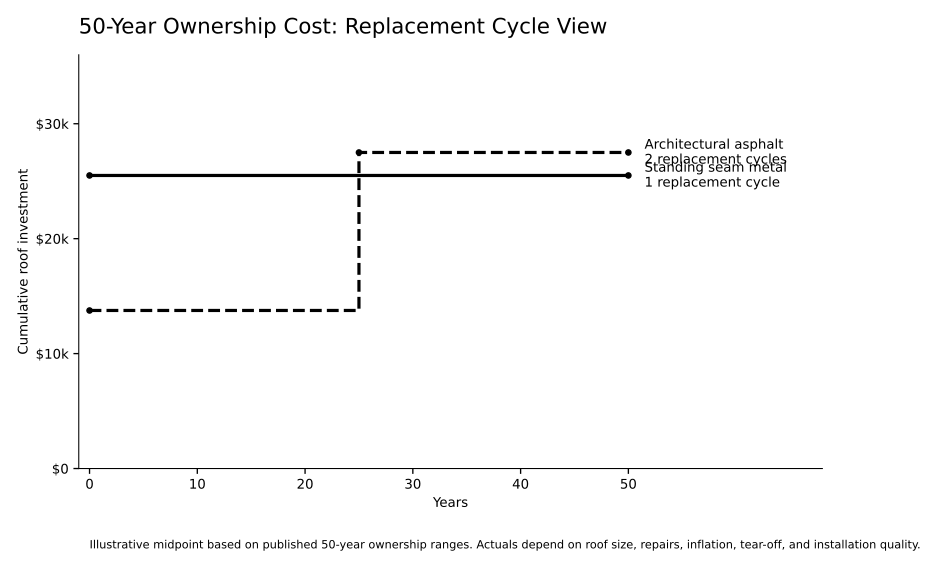
If you only compare the first invoice, asphalt usually wins. If you compare one ownership window, metal often does better. Our published 50-year comparison for a 2,000 square foot home estimates roughly $10,000 at installation for architectural shingles, $16,000 for metal shingles, and $22,000 for standing seam, with Tennessee lifespan assumptions of 20 to 25 years for asphalt, 40 to 60 for metal shingles, and 50 to 60+ for standing seam.
Over 50 years, that comparison estimates total roofing cost around $25,000 to $35,000 for architectural shingles versus $16,000 to $20,000 for metal shingles and about $22,000 for standing seam, before any energy or insurance effects. Those savings illustrations are approximate and not guaranteed: actual results depend on the property, the carrier, product class ratings, system design, and future labor and material inflation.
Two effects sit outside that table and both favor metal. Reflective metal roofing reduces summer cooling load compared with dark asphalt, and Class 4 impact-rated systems can qualify for insurance premium credits with some carriers. We leave both out of the published totals deliberately: energy savings depend on the house and insurance credits depend on the carrier and policy, so they belong in your math as upside rather than in ours as a promise.
The other cost the table understates is disruption. Fifty years of asphalt ownership on a Tennessee roof, at a 20 to 25 year lifespan, means two or three full replacement projects, each with tear-off, dumpsters, and a week of crews on the property. A standing seam roof installed once is a decision you likely never revisit.
The mechanism behind the flip is replacement count. At Tennessee lifespans of 20 to 25 years, an asphalt roof gets replaced two or even three times inside a 50-year window, and every replacement is billed at that future year's labor and material prices. A standing seam roof installed once at $22,000 is, in this comparison, still the same roof at year 50. Metal shingles split the difference with one roof, sometimes at the very edge of a second, over the same window.
X
When a Targeted Fix Beats a New Roof, and When It Does Not
Choose repair when the problem is local and the roof is fundamentally sound: a failed pipe boot, a piece of flashing, a limited seam problem, or targeted storm damage. Metal roofs usually leak at details, not in the panel body, so the right first step is often a real inspection rather than guessing. Across our 2026 service work, most metal roof repairs ran $150 to $1,000, with a median around $500.
Choose replacement when failures are widespread, the deck is compromised, the roof has reached the end of its useful life, or the cost of chasing detail failures starts to equal the value of a clean new assembly.
This is where an inspection earns its keep. A metal roof inspection maps every detail on the roof, documents which ones are failing and which are sound, and prices the targeted fix against the roof's remaining life. That turns repair versus replace from a sales conversation into an arithmetic problem, which is how it should be decided.
One pattern worth knowing: on exposed-fastener roofs the most common repair is fastener and gasket service, and on standing seam the most common repairs are at penetrations and terminations. The panel field itself almost never leaks. If a contractor tells you the whole roof has failed without walking those details, get a second opinion.
There is also a middle path worth pricing before either extreme: if the roof is metal or low-slope commercial and passes a condition inspection, restoration coating from Section VI buys years of service at a fraction of replacement. The order of operations that protects your money is inspect first, repair what is local, coat what qualifies, and replace only what has genuinely reached the end.
XI
RCV, ACV, and Who Does the Paperwork
If storm damage is involved, your insurer may cover all or part of the replacement. Replacement Cost Value policies generally release withheld depreciation after completion and documentation, while Actual Cash Value policies permanently subtract depreciation and increase your out-of-pocket cost, and some carriers switch older roofs to ACV as they age.
The contractor side of the process is documentation and follow-through: inspect and photograph the damage, review the estimate line by line, supplement missing scope items such as kickout flashing or permit costs, meet the adjuster, and provide completion paperwork to release recoverable depreciation. Insurance generally pays for the storm-damaged equivalent scope your policy allows; if you upgrade from shingles to metal, you typically pay the deductible plus the upgrade difference. Financing is the non-claim path for spreading the remaining balance over time.
On the claim side, the sequence matters: document before anything is disturbed, review the carrier's estimate line by line, meet the adjuster on the roof, supplement scope items the first estimate missed such as code-required kickout flashing or permit costs, and file completion paperwork promptly, because on an RCV policy that paperwork is what releases the withheld depreciation check.
When there is no claim, or the claim covers only part of the scope, financing spreads the remaining balance into a monthly payment. We offer financing options on approved credit and will run the numbers alongside the estimate so you can compare paying cash, financing, or phasing the work. Our standard payment schedule is a 50 percent deposit, 45 percent at material delivery, and the final 5 percent at completion. Current financing runs 10.99 percent APR over 10 years, and a recent project financed on those terms came to $247.95 per month.
Two practical notes from the claims we handle. First, adjuster estimates routinely miss code-required scope like kickout flashing, drip edge, or permit costs, and supplementing those line items correctly is the difference between a claim that funds the roof and one that leaves you short. Second, your deductible is yours in either policy type, so the honest way to think about an upgrade to metal is deductible plus the documented difference between the covered asphalt scope and the metal system you actually want.
XII
What Gets Approved, and Where
Nashville weather argues for metal on its own: a 115 mph wind baseline, Class 4 hail testing, and about 50.51 inches of annual precipitation. Neighborhood fit decides the profile. Standing seam carries places like Green Hills, 12 South, Sylvan Park, Belle Meade, East Nashville, and Brentwood, while metal shingles are the usual answer for Belmont, Oak Hill, Franklin, and other traditional or HOA-sensitive streetscapes.
In Metro historic overlays and neighborhood conservation zoning, the historic-zoning framework includes a metal roofing supplement. Restrained standing seam profiles and certain lower-profile metal forms are much easier to justify than tall-seam snap-lock or metal designed to imitate slate, tile, or wood. Approval requirements are also a real cost driver: they shape profile, finish, and detailing before the first panel is ordered.
The practical translation for Nashville homeowners: bring the approval question to the estimate appointment, not after it. We carry profiles and finishes that pass architectural review in most HOA communities, and for Metro historic overlays we quote systems consistent with the historic-zoning metal roofing supplement, which favors restrained standing seam over tall snap-lock seams and over metal made to imitate slate, tile, or wood.
If your house sits in an overlay, the sequence that saves weeks is to lock profile, seam height, and finish with the reviewing body before panels are ordered, because those three decisions are what the guidelines actually regulate. Approval constraints are also a quiet cost driver: they can rule out the most economical profile for your roof, and that is a number worth knowing before you fall in love with a quote built on a panel the district will not approve.
XIII
Straight Answers Before the Estimate
Most full residential projects are best budgeted in the high teens to low forty-thousands, with many landing around $25,000 to $36,000 depending on system, size, and complexity.
Classic exposed-fastener panel is the lowest-cost metal option on our published schedules, usually around $5 to $9 per square foot installed.
Standing seam. Concealed fasteners, better movement handling, and fewer exposed maintenance points make it the long-term premium choice for homes you plan to keep.
Insurance generally pays for the storm-damaged equivalent scope your policy allows. If you upgrade from shingles to metal, you typically pay the deductible plus any upgrade difference not covered by the claim.
On current published schedules: $1,100 to $1,900 per square for standing seam, $850 to $1,500 for metal shingles, $800 to $950 for exposed-fastener classic panel, and $350 to $650 per square for restoration coatings. A square is 100 square feet of roof surface, not floor area.
Usually around $22,000 to $38,000 installed, with complex or premium projects better budgeted at $28,000 to $42,500. The published component schedule runs roughly $4.50 to $5.25 per square foot for panel and trim, $3.00 to $6.00 for labor, $1.00 to $3.00 for tear-off, and $0.75 to $1.50 for underlayment, with a 24-gauge upgrade adding about $1 to $2.
Substantially, when the roof qualifies. On our 2026 projects quoted both ways, restoration coatings ran $2.50 to $6.85 per square foot, most between $3.30 and $4.50, which came to roughly 40 to 51 percent of replacement cost, a savings of 49 to 60 percent. The catch is qualification: coatings belong on fundamentally sound roofs, not on saturated or failing ones.
Standing seam zinc is published at $14 to $24 per square foot installed, with typical full roofs around $24,000 to $48,000 and service life in the 80 to 100+ year range. Copper runs roughly $22 to $35 or more per square foot, typically $40,000 to $70,000 for a full roof, and is quoted against the current metals market.
Because online averages describe simple roofs. Valleys, dormers, chimneys, skylights, wall transitions, steep pitch, tight access, and deck repair all add labor, and labor is where roof pricing actually lives. Your quote is built from your roof's measurements and details, not from a national table.
Over a 50-year window on a 2,000 square foot home, our published comparison estimates $25,000 to $35,000 in total roofing cost for architectural shingles versus $16,000 to $20,000 for metal shingles and about $22,000 for standing seam, before any energy or insurance effects. Those illustrations are approximate and not guaranteed, but the direction is consistent: asphalt is cheaper on day one and more expensive by decade three.
Tear-off and disposal, a decking repair allowance, underlayment, the metal system, flashings, and cleanup, with allowance items line-itemed rather than hidden. If a competing quote is lower, check whether it covers the same scope before comparing the numbers.
$11 to $19 per square foot installed
$9 to $15 per square foot installed
$5 to $9 per square foot installed
$2 to $5 per square foot installed
$14 to $24 per square foot installed
$2 to $5 per square foot applied

Call The Metal Roofers at (615) 649-5002 or schedule a free on-site assessment, and we will give you a real number for your exact Nashville roof in a written quote. Eighty-plus years of protection. Engineered for Nashville storms. Lower energy bills. Higher home value. One investment instead of three or four replacements. The math works. The science works. The material works. The only question left is whether it works for your specific home.
Monday – Friday · 7:00 AM – 5:00 PM · Saturday by Appointment
Pricing is half the decision. To pick the system behind the number, compare standing seam and metal shingles, then check the commercial roof coating in Nashville to confirm your slope supports the panel you want. If a replacement is on the table, metal roof installation in Nashville covers the process end to end, a free inspection confirms whether the old roof is really done, and financing options spread the cost into monthly payments.
Full guide: How Tariffs May Increase Metal Roofing Prices for Tennessee Homeowners and Business Owners
Full guide: What Is the Average Cost of a Metal Roof in Tennessee?
Full guide: Do Tennessee insurance companies give discounts for metal roofs?
Full guide: Do metal roofs increase home value in Tennesseee?
Full guide: How to Finance Your Metal Roof: Options for Every Budget
Full guide: Is Metal Roofing Worth the Investment?