Metal Roofing Alliance Member
TVA Preferred Partners Network
10,000+ Metal Roof Jobs
Nashville, TN
Licensed & Insured
BBB A+

Open 8am–8pm
(615) 649-5002Schedule Your
Appointment
Appointment
The Metal Roofers installs standing seam metal roofs, stamped metal shingles, copper, and historic-home roofing across downtown Franklin, Westhaven, Leiper's Fork, and all of Williamson County, backed by a lifetime workmanship warranty. We are headquartered in Nashville, Tennessee, twenty minutes up I-65 from Franklin, and work throughout Fieldstone Farms, McKay's Mill, and the Leiper's Fork corridor. No asphalt. No subcontracted installation.
✦ Reviewed by The Metal Roofers Technical Team
.avif)
Franklin preserved its historic downtown but reroofs it with asphalt rated for 15 to 20 years, though most of its historic buildings were originally roofed in metal. Franklin is one of the few American towns that can claim its downtown nearly intact. The Public Square, the 1858 Williamson County Courthouse, the Hincheyville and Lewisburg Avenue historic districts, the Carter House, Carnton, the Lotz House, the Franklin Theatre. Block after block of Victorian, Italianate, and Greek Revival architecture, much of it pre-1900, all of it standing because generations of residents refused to let it come down. The Heritage Foundation of Williamson County has been organized since 1967. The Historic Zoning Commission reviews every exterior change inside the district. The Main Street program has won the Great American Main Street Award. The town is, by any measure, exceptional at preservation.
And yet, when it comes time to replace a roof on a Franklin home or commercial structure, the default is the same petroleum-based asphalt shingle installed on tract houses in every unremarkable suburb in America. The same product rated for 15 to 20 years in manufacturer literature. The same material that begins losing granules within three years and reaches the end of its useful life before most Franklin homeowners have finished paying off the house it sits on. A 175-year-old building, capped with a 15-year roof.
Metal roofing is the answer the architecture was originally built for. Most of Franklin's historic buildings were roofed in metal (terne plate, tin shingles, standing seam in Victorian dark green and oxide red) long before asphalt became the path of least resistance. The work we do is a return to that standard. Slate-stamped metal shingles in period-correct profiles. Standing seam in heritage colors. Copper details where the architecture warrants them. Star-cut cresting where the ridgeline calls for ornament. The same logic the original builders used, with materials and finishes engineered to outlast everything currently installed beneath them.
The Metal Roofers restored the Dan German Hospital roof in downtown Franklin with slate-stamped metal shingles in Victorian-era dark green and star-cut ridge cresting, beside the Williamson County Courthouse.
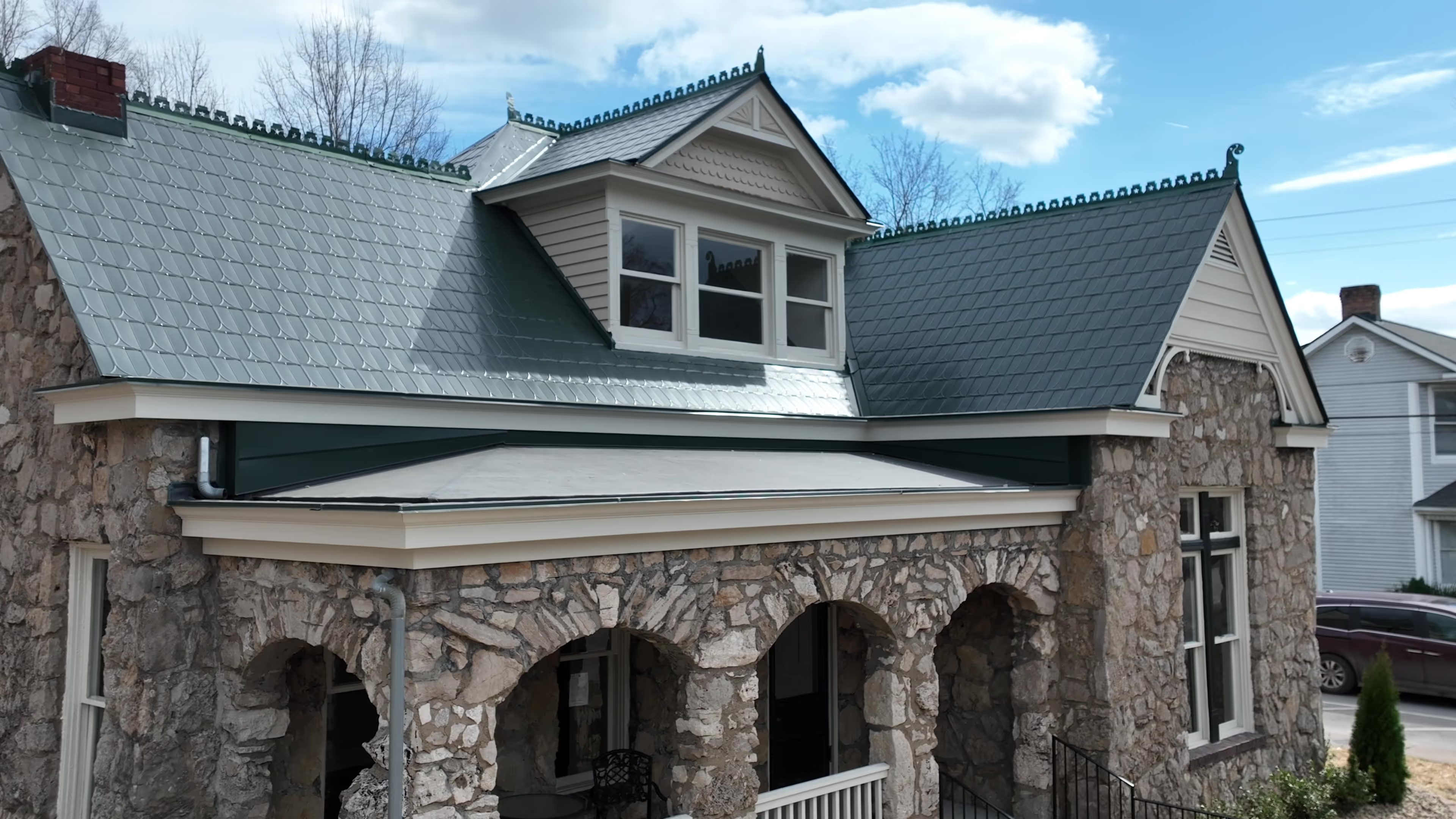
This building doesn't ask to be noticed, it holds its place through details. The rough-cut stone walls do the heavy lifting: weight, texture, permanence. Above that, the roofline is where the craftsmanship meets the sky. The new dark green metal shingles sit in historic courses, each row catching light just enough to show the pattern without turning glossy or modern. It's a finish that feels period-correct, deep, quiet, and sympathetic to the masonry beneath it.
Along the ridges, the ornament is the signature: a line of star-cut cresting that turns the roof edge into a silhouette.
This roof does that. A dark green metal shingle system that reinforces the building's original character and holds the roofline with the kind of restraint that reads as authenticity.
Franklin roofs face tornado-corridor winds, spring hail, 160°F roof surfaces, and 53 inches of annual rain, and metal roofing answers with 140 to 180 mph wind ratings and Class 4 impact resistance. Williamson County sits in the heart of Middle Tennessee's tornado corridor, exposed to the same Gulf-driven severe weather that probes every roofline from Nashville south to the Alabama border. The record below is the case for material that lasts longer than the next storm.
Williamson County sits in the lower Cumberland Plateau-to-Highland Rim transition that funnels Gulf moisture and Plains air masses into Middle Tennessee's most active tornado corridor. The county sees damaging wind events in nearly every active spring and a documented history of nighttime tornadoes that arrive with little visual warning.
Franklin's mature canopy of oaks, maples, hackberries, and walnuts, the same canopy that defines the historic district aesthetic, becomes a secondary projectile hazard during straight-line wind events.
A long-tracked EF-3 swept through Montgomery and Dickson Counties on the afternoon of December 9, 2023, killing six and damaging thousands of structures. Williamson County was placed under tornado warning during the same event. The outbreak demonstrated, again, that Middle Tennessee's tornado corridors are not seasonal. They are conditional, and the conditions arrive on no schedule.
Williamson County receives damaging hail most frequently between March and June, with May the single most active month. Hailstones crack, dent, and compromise asphalt shingles on impact, and the damage often goes unnoticed until leaks develop months later. On homes valued at $700,000 and above, undetected roof damage cascades into interior damage claims that can reach six figures before the source is found. Standing seam and stamped metal shingle systems shed hail impact across an interlocking surface rather than absorbing it at granular points of failure.
Franklin's humid subtropical climate routinely pushes summer air temperatures above 95°F, with roof surface temperatures exceeding 160°F. Asphalt petroleum binders degrade under sustained UV exposure, losing granule adhesion and turning brittle through thousands of daily thermal expansion-contraction cycles. Metal roofing with Kynar/PVDF coatings reflects up to 70% of solar radiation, reduces attic temperatures, and lowers cooling loads on the larger Franklin homes by 20–30%.
Franklin averages 53 inches of annual rainfall, with the Harpeth River corridor running through the heart of the city and elevating local humidity for properties nearby. The 2010 Nashville flood crested the Harpeth at record levels, closing roads across Franklin. The historic district's many complex rooflines, with their multiple valleys, dormers, and hip intersections, channel water into concentrated flow paths that probe every seam, fastener, and flashing joint. Standing seam roofing eliminates exposed fasteners on the field of the roof and uses hidden clip attachment to absorb thermal movement without compromising the watertight envelope.
Metal roofing matches Franklin's historic buildings because terne plate, tin shingles, and copper standing seam were the roofing of the period, and modern standing seam lasts 50 to 70 years. Franklin's historic core was built by people who chose permanence on every decision. Limestone foundations. Heart-pine framing. Brick laid in lime mortar. The roofing materials of the period were chosen for the same reason. When asphalt arrived in the mid-twentieth century as a cheaper alternative, the trade-off was always known: lower upfront cost, much shorter service life, ongoing replacement cycles every fifteen to twenty years. On most of Franklin's buildings, that math has never made sense.
Metal roofing is the return to the original logic. Standing seam metal carries documented service life of 50 to 70 years. Slate-stamped metal shingles, the profile we installed on the Dan German Hospital, hold their pattern and color for decades while remaining indistinguishable from natural slate at street level. Both options carry the wind, hail, and fire ratings that the Heritage Foundation and Williamson County's modern building codes look for. Both qualify for substantial insurance reductions.
| Factor | Asphalt Shingle | Standing Seam Metal |
|---|---|---|
| Initial Installation | $15,000 – $24,000 | $28,000 – $48,000 |
| Expected Lifespan | 15 – 20 years | 50 – 70 years |
| Replacements Over 50 Years | 2 – 3 full tear-offs | 0 |
| 50-Year Total Outlay | $45,000 – $72,000 | $28,000 – $48,000 |
| Insurance Discount | Baseline | Up to 35% reduction |
| Energy Savings | None | 20 – 30% cooling reduction |
| Resale Value Impact | Neutral to negative | +3% to +6% home value |
| Wind Rating | 60 – 110 mph | 140 – 180 mph |
On Franklin's median home, a 3-to-6% resale increase represents $26,000 to $52,000 in recovered equity, before insurance savings, energy reduction, or the elimination of two to three future tear-off cycles. The math works on a tract home in Berry Farms and it works on a Hincheyville Victorian. The buildings are different. The conclusion is the same.
The Metal Roofers matches the profile to each Franklin neighborhood: slate-stamped shingles downtown, HOA-friendly metal shingles in Westhaven and Fieldstone Farms, and standing seam in Leiper's Fork and Cool Springs. Franklin's residential character spans nearly two and a half centuries, from pre-Civil War homes inside the original town grid to thousand-acre New Urbanist communities laid out in the last twenty years. Each neighborhood has its own architectural vocabulary, review process, and roofline conditions.
The 16-block downtown historic district radiates out from the Public Square and the 1858 Williamson County Courthouse, surrounded by the Hincheyville and Lewisburg Avenue Historic Districts. Architecture is Victorian, Italianate, Greek Revival, and Queen Anne, with the oldest residential structures dating to the 1820s. The Heritage Foundation reviews exterior changes within the district.
Slate-stamped metal shingles in dark green, weathered copper, charcoal, or oxide red: the colors the original builders worked in. Standing seam on secondary roof planes. Star-cut cresting and copper accents where the building's character warrants ornament. We manage the full Heritage Foundation submission.
Westhaven is the largest master-planned New Urbanist community in Tennessee, designed around walkable streets, deep front porches, and a deliberately period-correct architectural vocabulary: Craftsman, Colonial Revival, Greek Revival, Lowcountry. Strict design guidelines govern facade materials, roof pitch, dormer treatment, and exterior color. The ARC evaluates every exterior change.
Metal shingles in slate, shake, or tile profile for HOA compatibility. Standing seam on porches, dormers, and accent gables, an approved Westhaven detail. Colors: weathered charcoal, aged bronze, dark green. We provide the physical samples and specification packages the ARC requires.
One of Franklin's largest established communities, Fieldstone Farms covers more than 1,400 acres west of Hillsboro Road with thousands of homes built primarily between the early 1990s and 2010. Architecture is brick traditional and Colonial Revival, with one of the densest residential canopies in the city. Many original asphalt roofs are now on their second or third replacement cycle, the inflection point where the long-term math of metal becomes obvious.
Metal shingles in slate or architectural profile for HOA compatibility and visual consistency with neighboring homes. Class 4 hail rating given canopy exposure. Colors that complement red and brown brick: dark bronze, weathered slate, charcoal.
The Cool Springs corridor along I-65 is Franklin's modern commercial spine, with surrounding communities (McKay's Mill, the Governor's Club, Founder's Pointe, Berry Farms) covering the spectrum from established family neighborhoods to newer New Urbanist developments. Berry Farms features town center planning and architectural standards approaching Westhaven's discipline. Homes here benefit from modern building codes but face the same severe weather exposure as the historic core.
Standing seam for homeowners ready to differentiate, metal shingles for HOA-compatible replacement. Contemporary palettes work well: matte black, graphite, cool slate. Solar-ready clamp-mount substrate where appropriate.
The countryside west and south of Franklin (Leiper's Fork, Boyd Mill Pike, Old Hillsboro Road, the Natchez Trace corridor) remains some of the most picturesque rural land in Middle Tennessee. Estates often include the main residence plus working barns, equipment buildings, stables, and guest houses. Many older farmhouses date to the late 1800s. The roofing on these properties almost always tells the truth about the rest of the structure.
Standing seam in country palettes (barn red, dark green, galvalume, weathered black) for both the main house and outbuildings. Metal shingles where the architecture is Victorian or Queen Anne. The same material on the house and the barn reads as intentional.
Median Home Value: $880,000+. Williamson County consistently ranks among the wealthiest counties in Tennessee and the United States. At Franklin's price point, the math on metal roofing tips strongly in metal's favor, both because the resale premium is calculated on a larger base and because insurance premiums on these homes already run above state averages.
Heritage Foundation & Historic Zoning: Properties inside the downtown historic district require review through the City of Franklin Historic Zoning Commission, with input from the Heritage Foundation on more sensitive projects. We prepare every submission with the documentation the commission asks for: physical samples, profile cross-sections, manufacturer wind and impact certifications, and photographs of comparable historic restorations.
HOA & Architectural Review: Westhaven, Fieldstone Farms, McKay's Mill, the Governor's Club, Berry Farms, and most newer Franklin communities operate through architectural review committees. Most committees that initially resist metal roofing approve our submissions after reviewing the actual profiles, finishes, and installed photos.
The Metal Roofers matches four profiles to Franklin architecture: slate-stamped metal shingles for Victorians, standing seam for Greek Revival and Westhaven homes, Classic Tennessee Panel for farmhouses, and copper for estate properties. A Hincheyville Victorian asks for textured metal shingles. A Westhaven Greek Revival asks for clean standing seam. A Leiper's Fork farmhouse asks for traditional Tennessee Panel with the agricultural honesty that fits a working property. We carry the full range, and we recommend the profile that matches the building, not the one that's easiest to install.
The Metal Roofers provides standing seam, metal shingles, historic restoration, copper roofing, seamless gutters, metal siding, roof coatings, roof repairs, and solar integration for Franklin properties. We are a metal-only contractor: we do not install asphalt, and we do not subcontract our installation crews. Every Franklin project, from a Hincheyville restoration to a Westhaven new-roof to a Leiper's Fork barn, is managed and installed by our own team.
Franklin metal roof colors follow the architecture: dark green on downtown Victorians, matte black on Greek Revival homes, dark bronze on brick traditionals, and barn red or galvalume on rural estates. The roof color must be chosen for the specific period and material context of the building beneath it. We carry physical samples in every finish, photograph each color against a range of brick, stone, and siding, and recommend the option that reads as native to the structure rather than imposed on it.
Dark green (the Victorian-era palette used on the Dan German Hospital), weathered slate, oxide red, and aged bronze are the historically defensible options. These colors were used on terne plate and tin shingle roofs throughout the late 1800s and early 1900s, and the modern metal versions read as period-correct rather than period-imitation. Star-cut cresting, finials, and copper accents at dormers extend the language.
The cleaner, more formal architecture of Greek Revival and Colonial Revival benefits from quieter roofing colors that defer to the facade: matte black, dark charcoal, weathered slate, and aged bronze. Standing seam reads as appropriate on these buildings because the original metal roofs of the period were often standing seam in dark, recessive colors.
Franklin's red-brick traditional homes from the 1990s and 2000s integrate best with weathered slate, dark bronze, charcoal, and Roman brown. These colors complement the warm masonry without competing with it. For painted-brick renovations, an increasingly common Franklin update, matte black creates the editorial contrast that elevates the whole facade.
Working buildings call for honest colors: dark green, barn red, galvalume, and weathered black. The look should not pretend the building is something it isn't. Standing seam in galvalume on a Leiper's Fork barn is correct in a way that a stained shingle imitation never will be.
A Franklin metal roof runs $28,000 to $65,000 for standing seam or $22,000 to $48,000 for metal shingles, installs in 5 to 12 days, and saves $800 to $2,400 a year on insurance. Pricing varies with the home's size, complexity, historic-district status, the chosen profile, and the level of custom detail work involved. What is consistent is the return calculation: at Franklin's property values, insurance premiums, and energy loads, the long-term math on metal roofing is favorable on essentially every house in the city.
The Metal Roofers services every neighborhood inside the City of Franklin and across Williamson County, including Brentwood, Nolensville, Thompson's Station, Spring Hill, College Grove, Bethesda, Arrington, and Leiper's Fork. Our crews work in Franklin's historic core, the master-planned communities west and south of the city, the established family neighborhoods along Hillsboro and Mack Hatcher, and the rural estates running out through Leiper's Fork, Bethesda, and College Grove.
Inside the City of Franklin: Downtown Historic District, Hincheyville, Lewisburg Avenue, Westhaven, Fieldstone Farms, McKay's Mill, Cool Springs, Berry Farms, Founder's Pointe, Polk Place, Carlisle, the Governor's Club, and all neighborhoods inside city limits.
Williamson County: Brentwood, Nolensville, Thompson's Station, Spring Hill, College Grove, Bethesda, Arrington, Leiper's Fork, and the unincorporated communities of the Natchez Trace corridor.
Adjacent Counties: Davidson County (Belle Meade, Forest Hills, Green Hills, all of Nashville), Maury County (Spring Hill, Columbia), and Rutherford County (Murfreesboro, Smyrna).
The Metal Roofers is a metal roofing and solar company based in Nashville, serving Franklin and all of Williamson County with the same craft standard the Heritage Foundation applies to its preservation work. We do not install asphalt. We do not subcontract installation. We do not cut gauges, skip flashings, or send representatives to estimate jobs they aren't qualified to spec.
In Franklin specifically, we bring experience navigating the Historic Zoning Commission, the Heritage Foundation of Williamson County, and the architectural review committees that govern Westhaven, Fieldstone Farms, McKay's Mill, the Governor's Club, Berry Farms, and the city's other significant HOAs. The Dan German Hospital restoration is one example of what that work looks like when it is done right: period-correct material, period-correct detail, period-correct color, installed beside the courthouse in full public view.
Franklin is the kind of town where the building you put a roof on will still be standing in another century. We install material that will still be performing then. Request your free Franklin metal roofing estimate. We provide detailed proposals with material specifications, color options with physical samples, Heritage Foundation or HOA submission packages, and full insurance documentation.
Yes, when the profile and color are chosen correctly. The City of Franklin Historic Zoning Commission reviews exterior changes inside the downtown historic district, and the Heritage Foundation of Williamson County is often consulted on more significant projects. We have managed multiple restorations through this process, the Dan German Hospital being one, and we prepare every submission with the documentation the commission asks for: physical samples, profile cross-sections, manufacturer wind and impact certifications, and photographs of comparable installations. Most denials happen when the wrong profile or color is proposed. We do not propose the wrong profile or color.
At street level and from the sidewalk across the square, yes. Stamped slate-profile metal shingles read as slate to anyone not specifically inspecting the roof up close. The Dan German Hospital roof on the Public Square is the demonstration: it sits in full public view beside the courthouse, in historic courses with star-cut cresting, and the finish reads as period-correct slate. The advantage of metal is everything underneath the visual: significantly lighter weight (no structural reinforcement needed), much better impact resistance, and a service life that meets or exceeds natural slate without the brittleness, cracking, or fall hazards.
In nearly every case we have worked, yes, once the architectural review committee sees the actual product. Most initial resistance comes from imagining agricultural exposed-fastener panels, which are not what we install on residential roofs. We provide each ARC with physical color samples, manufacturer spec sheets, profile cross-sections, and photos of comparable installations in Franklin. We manage the submission process from initial inquiry through final approval.
No. Modern metal roofing is installed over solid decking with synthetic underlayment, and the assembly sounds no different from any other roof during rain events. The loud-metal-roof association comes from agricultural pole barns where metal is installed directly over open purlins with no decking and no insulation, a completely different application. Franklin's older homes with solid plank decking and plaster ceilings provide additional sound dampening that newer construction does not have.
The Dan German Hospital is downtown Franklin, beside the courthouse, across from Generations Church, a building that sits in full public view and that any resident or visitor can walk past and inspect. We installed a slate-stamped metal shingle system in Victorian-era dark green, with star-cut cresting along the ridges, in historic courses sympathetic to the rough-cut stone walls underneath. The work was done to read as period-correct, not period-imitation. The building was already there. The new roof reinforces what the building already was.
Significantly better than asphalt. Standing seam's smooth continuous surface sheds leaves, walnuts, and organic debris that accumulate on textured asphalt shingles and foster moss, algae, and moisture retention. Under heavy canopy, common across Hincheyville, Fieldstone Farms, and the Hillsboro Pike corridor, conventional shingles lose 30 to 40% of their rated service life to biological degradation. Metal is impervious to it. The canopy that makes the historic district beautiful is the same canopy that destroys asphalt roofing prematurely.
Tennessee insurers typically offer 20 to 35% premium reductions for Class 4 impact-rated metal roofing. Franklin's higher property values mean correspondingly higher premiums, often $3,500 to $7,500 annually on the larger homes. A 25% reduction on a $5,000 policy saves $1,250 per year, compounding into substantial money over the roof's life. We provide documentation formatted for your insurer's discount application process, including manufacturer wind and impact certifications.
Standing seam is the best solar substrate available. Clamp-mount racking systems attach directly to the raised seams without any holes drilled through the roof. No sealant failures, no warranty conflicts, no compromise to the watertight envelope. When Franklin homeowners decide to add solar, they will find that metal makes the installation cleaner, faster, and cheaper than any alternative substrate.
Most Franklin residential projects complete in five to twelve business days from material delivery. Historic restorations and projects with extensive copper detail work extend that window. We schedule around historic district review meetings and HOA architectural review dates, and we coordinate with neighboring properties to minimize disruption during the installation.
Yes. We work across all of Williamson County and the surrounding counties: Brentwood, Nolensville, Thompson's Station, Spring Hill, College Grove, Bethesda, Leiper's Fork, and out through the Natchez Trace corridor. Our service territory extends through Middle Tennessee, with offices in Nashville and Alabama.
Standing seam is 26-gauge standard, with 24-gauge upgrade available. Classic Tennessee Panel is 29-gauge standard with a 26-gauge upgrade option. Wave Panel comes in 29-gauge only and is our preferred Tennessee Panel profile because the corrugated wave shape hides and prevents the oil canning that other 29-gauge profiles can show. Every Metal Roofers installation carries our lifetime non-prorated workmanship warranty on labor, transferable once within ten years with thirty-day written notice. Final payment registers the warranty.
Yes. We handle all permit applications, code compliance documentation, and inspections through the City of Franklin building department. For properties inside the historic district, we manage the Historic Zoning Commission submission as part of the permit process. The Franklin permitting process is well-organized and works efficiently when handled by a contractor familiar with it.