Metal Roofing Alliance Member
TVA Preferred Partners Network
10,000+ Metal Roof Jobs
Nashville, TN
Licensed & Insured
BBB A+

Open 8am–8pm
(615) 649-5002Schedule Your
Appointment
Appointment

The Metal Roofers installs metal soffit and fascia across Nashville and Middle Tennessee: aluminum fascia wrap, custom-bent steel and copper trim, and vented metal soffit, all fabricated to match your roof. We fix the water first, then build a roof edge that never needs paint. One company. One warranty. One call.
✦ Reviewed by The Metal Roofers Technical Team
he simplest way to understand the difference is to stand under the eave and look up. The soffit is the finished underside you see. The fascia is the vertical face at the outer roof edge, where the gutters usually attach. Together they do far more than finish the roofline.
Soffit and fascia affect attic heat, paint life, mold risk, gutter stability, pest entry, and curb appeal. The same logic applies to offices, churches, retail, and multifamily buildings with vented eaves. On low-slope or parapet buildings the equivalent is edge metal or coping, but the job is identical: protect the edge, drain the water, keep moisture out.
The finished underside of the roof overhang. In vented assemblies it is the intake side of your attic ventilation: screened openings pull outside air in at the eave while ridge vents exhaust it. It also protects the vulnerable gap under the eave from moisture, fire, and pests.
The vertical trim board or metal-wrapped edge at the roofline. It connects the roof edge to the soffit beneath it, protects rafter tails and framing from water, and carries your gutters. When fascia fails, the framing behind it usually starts failing next.

Soffit and fascia are not a cosmetic detail in Middle Tennessee, where roof edges take 50.5 inches of rain a year and normal July highs of 90.9 degrees. Nashville roof edges live a hard life, and the numbers explain why paint fails, wood rots, and fasteners back out at the eave faster here than the brochures promise.
Metro Nashville adopted the 2024 International Codes with local amendments effective July 16, 2025. Permit and inspection questions in Davidson County should be checked against current Metro Codes requirements, and surrounding counties have their own schedules. We handle that homework as part of the project.
Before work begins, whoever you hire should be able to walk you through how the project handles ventilation, flashing, drip edge, gutter tie-in, attic baffles, material clearances, and worker safety. If those answers are vague, the finished work usually is too.
Soffit and fascia come in wood, vinyl, aluminum, or fiber cement, and aluminum is The Metal Roofers' workhorse for fascia wrap, vented soffit, and gutter-adjacent trim. Material choice should be driven by your building's architecture, your maintenance tolerance, fire expectations, and exposure to water, sun, and pests, not by whatever the crew has on the truck. Here is how the four common options actually compare.
The traditional choice for historic homes and stained or elevated architectural eaves. Natural appearance and easy to custom-fabricate.
Best where appearance rules and upkeep is committed.
The budget-conscious pick for residential soffits and wrapped trim systems. Low-maintenance and corrosion-resistant, commonly available in vented panels.
Best when budget leads and the eave design is simple.
Our workhorse for fascia wrap, vented soffit, and gutter-adjacent trim. Durable, light, corrosion-resistant, and ideal for wrapping existing wood fascia.
Best all-around value, and it pairs naturally with seamless gutters.
The premium option where durability and fire performance matter. Moisture-resistant, dimensionally stable, with noncombustible options from manufacturers like James Hardie.
Best for premium builds and anywhere fire resilience is a priority.
The Metal Roofers is a metal-only roofing company, and that focus runs all the way down to the trim. We fabricate and install metal fascia, aluminum fascia wrap, and vented metal soffit as part of the same roof-edge system we build every day. For most Nashville homes, metal fascia is the best long-term answer: it shrugs off 50 inches of annual rain, it never needs a repaint cycle, and carpenter bees cannot bore into it.
Aluminum fascia wrap is custom brake-bent on site to fit your exact fascia boards, covering sound wood with a weatherproof factory-finished skin that does not need painting. One honest caveat most companies skip: wrapping rotten wood just hides the problem while it keeps rotting. We probe every board first, replace anything soft, and then wrap. Wrap over sound wood is a 30-plus-year detail. Wrap over rot is an expensive bandage.
For standing seam homes and premium builds, we fabricate fascia, drip edge, and gutter apron from the same coil stock as your roof trim, in matching PVDF (Kynar) finishes, so the whole roof edge reads as one continuous line. Copper fascia and accents are available for historic and high-end homes, where the natural patina becomes part of the architecture. Because we bend profiles in-house, your fascia matches your drip edge and gutter apron exactly instead of approximately.
Drip edge, fascia, gutter apron, soffit venting, and seamless gutters are one connected water-management detail, and they perform best when one crew designs and installs them together. That is the practical advantage of hiring a metal roofing company for fascia work in Nashville: the people bending your trim are the same people who understand how water actually moves off your roof.
Straight answer for homeowners comparing options: if your fascia is wood and you are tired of painting it, aluminum wrap over sound boards is usually the best value in Nashville. If you have or are planning a standing seam metal roof, color-matched steel fascia is the detail that makes the whole roofline look intentional.
Soffit vents only help when the intake path into the attic is open, the exhaust path at the ridge is real, and the roof edge is flashed correctly. This is where trim work connects to the roof system, and where cheap jobs go wrong.
Code uses a 1:150 ratio of net free vent area to attic area, with a path to 1:300 when the system is configured correctly, and vent openings must be protected against birds and pests. Balance matters more than hole count: intake at the soffit has to match exhaust at the ridge.
Baffles are chutes that hold roughly a 2-inch air gap under the roof deck so insulation can't choke off the intake. Energy code requires baffles at soffit and eave vents to maintain an opening at least as large as the vent itself. Blocked baffles are one of the most common problems we find.
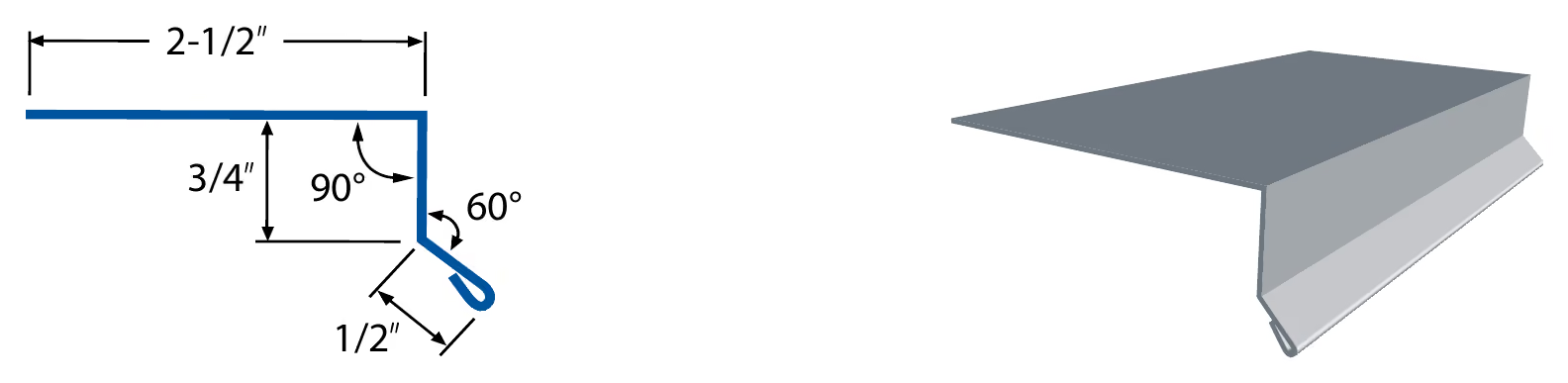
Code requires drip edge at eaves and rakes, lapped and extended to kick water clear of the sheathing and fascia. A failed drip edge or bad gutter tie-in often shows up as "soffit rot" when the real problem is roof-edge water curling behind the metal.
EPA guidance ties attic air leakage and moisture movement to mold and material damage, and proper attic ventilation lowers attic temperatures and removes excess moisture. Done right, this work shows up on your energy bill, not just your roofline.
Soffit and fascia in Middle Tennessee usually fail from water rather than age: overflowing gutters, failed drip edge, and open joints, not anything mysterious.
Overflowing gutters, failed drip edge, open joints, and backflow behind the gutter apron wet the fascia repeatedly until coatings and wood fail. USDA guidance on exterior wood is blunt: keeping wood dry is the key to long service life. A soffit and fascia project should never be sold as "trim only" if the gutter, drip edge, or roof edge is the actual leak source. We fix the source first.
.avif)
The roof edge is one connected system: drip edge, fascia, gutter, and soffit either work together or fail together.
University of Tennessee Extension notes that carpenter bees prefer unpainted or weathered softwoods and can cause extensive damage as galleries grow season after season. Loose soffit panels and open fascia returns also invite wasps, birds, and squirrels looking for protected nesting space.
Hot summers warp vinyl, chalk finishes, and loosen fasteners through thermal cycling. Severe-thunderstorm winds rattle panels loose and drive rain into places it should never reach. After every major storm season, we find soffit panels hanging by a single fastener.
Insulation shoved into the eaves blocks intake and traps heat and moisture. Ice dams are less common here than up north, but Nashville still gets freezing weather, and attic moisture raises condensation risk. The fix is usually air sealing and clear soffit-to-ridge airflow rather than simply adding more vents.
Repair soffit and fascia when damage is localized and the substrate is solid, and replace the run when the failure is systemic and patching means paying twice. The answer depends on three questions: is the damage localized, is the water management working, and does the ventilation path actually function? Here is the decision logic we use on every eave we inspect.
Damage is localized, the substrate is still solid, the venting strategy is correct, and the roof edge isn't leaking behind the metal.
The failure is systemic, and patching it means paying twice.
If we have to pull the gutter, repair the drip edge, correct blocked baffles, and rebuild multiple framing pockets, it is usually smarter to replace the affected run so the new work performs as one assembly. And if gutters, drip edge, or flashing are failing, we correct the water problem first. Many projects land in a hybrid scope: selective replacement plus stabilization of the rest.
Aluminum soffit and fascia runs $12 to $24 per linear foot, vinyl $9 to $18, wood $10 to $20, and fiber cement $12 to $22, as planning ranges rather than quotes. For Nashville bids, access and height, gutter removal and reinstallation, scaffold needs, paint scope, and hidden rafter-tail repairs move the number materially. Whole-project eave work commonly lands around $9 to $34 per linear foot nationally, with soffit-only or fascia-only work lower.
Lifespan follows the same order as maintenance: wood lasts decades only with faithful repaint cycles, vinyl and aluminum carry lifetime-style product warranties with modest upkeep, and James Hardie fiber cement carries a 30-year non-prorated warranty.
Run this once a year and after major storms. A maintenance rhythm matters more than the material label.
Already on our roof maintenance program? Soffit, fascia, and gutter checks are part of the same annual visit.

Aluminum fascia wrap in the Nashville area typically runs $12 to $24 per linear foot installed, with $18 being a common midpoint on straightforward single-story homes. Custom-bent steel fascia in PVDF finishes matched to a standing seam roof usually prices above that range, and copper is a premium detail quoted per project. The variables that actually move a Nashville fascia bid are height and access, whether gutters have to come down and go back up, how many boards need replacement before wrapping, and paint scope on adjacent trim. Whole-project eave work, meaning soffit and fascia together, commonly lands around $9 to $34 per linear foot nationally. We give a fixed written number after measuring, not a per-foot guess over the phone.
Aluminum wrap over sound wood is one of the best-value details in Nashville: it ends the repaint cycle permanently, sheds our 50 inches of annual rain, and closes off the bare softwood that carpenter bees love. The trap is wrapping wood that is already soft. Metal over rot does not stop the rot, it hides it, and the fascia keeps decaying behind a skin that makes the damage invisible until the gutter starts pulling away. The right sequence, and the one we follow on every job, is to probe every board, replace anything compromised, correct the drip edge or gutter problem that caused the rot, and only then wrap. Done in that order, wrapped fascia is a 30-plus-year detail.
Yes. We fabricate fascia, drip edge, and gutter apron from the same coil stock used for standing seam roof trim, in the same PVDF (Kynar) finish colors, so the roofline reads as one continuous system rather than a roof with mismatched trim tacked on. Because the profiles are brake-bent in-house, the fascia, drip edge, and gutter apron are made to fit each other exactly. This is the detail that separates a metal roofing company doing fascia from a general contractor buying stock trim at a supply house, and it matters most on standing seam homes where the trim lines are part of the architecture.
Aluminum cannot rust, which is why it is the default choice for fascia wrap and vented soffit panels in Middle Tennessee. Steel fascia is protected by the same Galvalume substrate and PVDF paint systems used on metal roofs, which carry decades-long finish warranties, and Tennessee's inland climate is far gentler on coated steel than coastal salt air. Copper does not rust at all; it weathers to a brown and eventually green patina that many owners consider the whole point. The realistic long-term concerns with metal trim here are denting from ladders and hail, finish chalking after decades of UV, and fasteners loosening from thermal movement, all of which are inspection items rather than failures.
No. Buildings can use vented or unvented roof strategies depending on how the assembly is designed, and some modern homes with conditioned attics are deliberately unvented. But if your roof is designed as a vented attic, which describes the large majority of Nashville homes, the soffit intake and the ridge or upper exhaust have to work together as a system. Code sizes that system around a 1:150 ratio of net free vent area to attic area, with a path to 1:300 when the layout qualifies. Punching more holes in the soffit without baffles behind them or a working exhaust path above them is not ventilation, it is decoration. During an estimate we check what your attic actually needs before recommending vented panels.
Water, not age. The most common sequence we find on Nashville homes is an overflowing or back-pitched gutter, a failed or missing drip edge, or an open joint at the roof edge wetting the fascia over and over until the paint fails and the wood follows. Nashville averages about 50.5 inches of rain per year, roughly 30 percent above the national average, so a detail that would limp along for years in a drier market fails fast here. That is also why we will not quote a trim-only fix when the gutter or drip edge is the real problem: replacing fascia under an active leak just schedules the same repair again in a few years. Fix the water first, then the trim lasts.
A straightforward fascia wrap or soffit panel replacement on a typical single-story Nashville home is usually a one to two day project. Add gutter removal and reinstallation, scattered board replacement, or blocked-baffle correction in the attic and most homes land at two to three days. Two-story homes, steep or complex rooflines, and jobs that uncover hidden rafter-tail damage run longer, and we tell you that the day we find it rather than at the final bill. Weather is the other honest variable: we do not wrap fascia in the rain, so spring scheduling in Middle Tennessee sometimes shifts a day.
Yes, especially on steep-slope and mixed-use buildings with vented eaves: offices, churches, retail strips, and multifamily properties follow the same physics as houses, just at a larger scale with more complex staging. On low-slope and parapet commercial buildings the functional equivalent of soffit and fascia is edge metal and coping, and the water-management logic is identical: protect the edge, drain the water, keep moisture out of the assembly. We handle both, and on commercial projects we coordinate access, tenant impact, and safety planning as part of the scope. See our commercial roofing services for larger properties.
Fiber-cement soffit products are marketed as noncombustible, and James Hardie specifically recommends noncombustible soffit for improved fire resilience, because the eave is one of the most vulnerable points for ember entry on any building. Some fiber-cement products are also approved for use in one-hour fire-rated exterior soffit assemblies where a rating is required. Metal soffit is likewise noncombustible, which is one more reason metal trim systems make sense beyond weather performance. Vinyl and wood are the combustible options in the lineup, which is worth weighing for detached garages, shops, and rural properties where embers and brush are realistic concerns.
Ask how they will verify the attic ventilation calculation instead of guessing, whether baffles will be checked or added behind the soffit vents, how they will flash the roof edge and tie the gutter back in, what substrate replacement is included in the price versus billed as an extra, whether they follow the manufacturer's installation details for the specific product being installed, and how they handle fall protection and silica dust controls if fiber cement is cut on site. Then ask the question that filters the field fastest in Nashville: what happens to the water that caused the damage you are fixing? A contractor who cannot walk you through drip edge, gutter pitch, and overflow paths is going to replace your trim without fixing why it failed. Good contractors can answer all of it without flinching.
Soffit and fascia work usually travels with the rest of the roof edge: seamless gutters, trim and flashing, roof and storm damage repair, metal siding, and ongoing maintenance.
Sources for the facts on this page include Metro Nashville Codes, NOAA climate normals for Nashville, ICC code excerpts on ventilation and drip edge, DOE and Building America attic guidance, EPA moisture guidance, USDA wood-finish research, UT Extension carpenter-bee guidance, OSHA safety rules, and manufacturer literature from James Hardie, LP, CertainTeed, and Ply Gem. Cost ranges are planning figures from national cost databases.
Call The Metal Roofers at (615) 649-5002 or request a free estimate, and we will measure your eaves, check your fascia, and give you a real number the same week. No pressure.