Metal Roofing Alliance Member
TVA Preferred Partners Network
10,000+ Metal Roof Jobs
Nashville, TN
Licensed & Insured
BBB A+

Open 8am–8pm
(615) 649-5002Schedule Your
Appointment
Appointment
✦ Reviewed by The Metal Roofers Technical Team
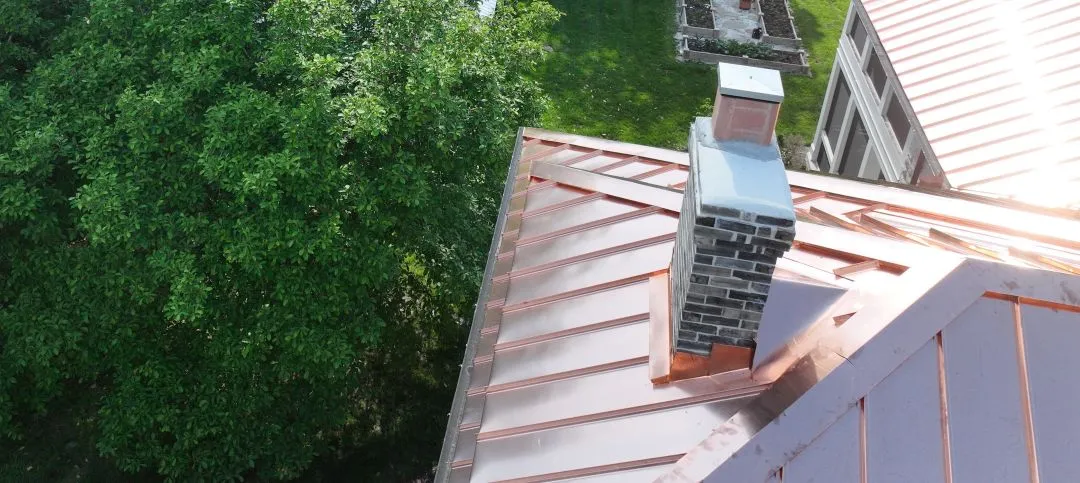
Copper is the premium metal roof. It is also one of the few roofing materials that becomes more beautiful as it ages.
Most roofs are designed to resist time. Copper is designed to work with it. A new copper roof begins with a bright penny-colored finish, darkens into warm bronze and brown, then slowly develops the green-blue patina seen on landmark buildings, churches, courthouses, historic homes, and estate properties.
For Nashville homeowners, copper is not usually the cheapest roofing choice. It is the architectural choice. It is the material for bay windows, porch roofs, dormers, chimneys, cupolas, turrets, gutters, and full roofs where permanence matters.
This guide explains what copper roofing costs in Nashville, how copper patina works, where copper makes sense, what 16 oz and 20 oz copper mean, and what homeowners should know before investing in a copper roof or copper accent.
Copper roofing is worth considering when the homeowner wants:
Copper is usually not the right choice when the main priority is the cheapest possible roof replacement.
According to The Metal Roofers’ copper roofing guide, copper roofing in Nashville generally runs $20–$35 per square foot installed, with full copper roofs commonly around $40,000–$70,000 and copper accent applications often around $3,000–$12,000 depending on scope.
Best use:
Full roofs, porch roofs, bay windows, dormers, chimneys, cupolas, gutters, and historic homes.
Installed cost in Nashville:
$20–$35 per sq. ft. for many copper roof systems.
Full roof planning range:
Often $40,000–$70,000+.
Accent planning range:
Often $3,000–$12,000 per feature or package.
Common copper weights:
16 oz and 20 oz architectural copper.
Service life:
100+ years when properly installed.
Appearance:
Bright copper, then bronze, then brown, then brown-green, then verdigris.
Biggest installation concern:
Galvanic corrosion with incompatible metals.
Best Nashville fit:
Belle Meade, Green Hills, Oak Hill, Franklin, Brentwood, Germantown, 12 South, Lockeland Springs, historic homes, churches, and estates.
Copper is different because it protects itself.
Painted steel relies on a factory coating. Asphalt shingles rely on granules. Wood relies on treatment and maintenance. Copper forms its own protective surface layer through natural oxidation and patination.
The Copper Development Association explains that copper’s green patina develops through oxidation and atmospheric exposure, with patina formation affected by moisture and local atmospheric conditions.
That means copper is not just “old-looking metal.” It is a living exterior material.
It does not:
Instead, copper:
Copper patina is one of the main reasons homeowners choose copper.
A new copper roof does not stay shiny forever. It changes. That change is normal, expected, and desirable.
The Metal Roofers describes Nashville’s copper patina progression as moving from bright copper to bronze, then dark brown, then brown-green tones, and finally the blue-green verdigris associated with historic copper roofs. In Nashville’s humid climate, green tones may begin appearing around 5–15 years, while a more mature verdigris can develop around 15–30+ years depending on orientation and exposure.
New copper: Day one to first weeks. Bright penny / salmon-pink metallic copper.
→ Bronze: Months 1–6. Warm bronze, less reflective.
→ Dark brown: Years 1–5. Chocolate brown, aged leather tone.
→ Brown-green transition: Years 5–15. Mottled brown, olive, and green tones.
→ Verdigris: Years 15–30+. Blue-green landmark copper patina.
Copper patina does not develop at the same speed on every roof.
Patina changes faster or slower depending on:
The green tones usually appear first where moisture lingers or water moves more often, such as:
This is why copper rarely changes color evenly all at once. It ages like a natural material, not like factory paint.
Technically, yes. Practically, it is usually a bad idea.
Clear coatings can slow copper oxidation and preserve bright copper color for a period of time, but the Copper Development Association notes that clear coatings degrade over time and eventually require stripping and replacement.
For most Nashville homes, the better recommendation is simple:
Let copper patina naturally.
Trying to freeze copper in its shiny stage usually creates more maintenance, more uneven appearance, and less of the historic character people choose copper for in the first place.
For homeowners who love the copper color but do not want natural patina, copper-colored painted steel may be a better fit.
Copper is the most expensive common roofing material used on residential homes.
The Metal Roofers lists Nashville copper roofing at $20–$35 per square foot installed, with full copper roofs often around $40,000–$70,000 and copper accents often around $3,000–$12,000 depending on the feature.
Standing seam copper:
$22–$35 per sq. ft. installed.
Best for full roofs, porch roofs, and premium roof planes.
Flat seam copper:
$22–$35 per sq. ft. installed.
Best for bay windows, low slopes, porticos, and detailed areas.
Batten seam copper:
$24–$36 per sq. ft. installed.
Best for historic homes, estates, churches, and formal architecture.
Copper shingles:
$16–$26 per sq. ft. installed.
Best for turrets, cupolas, dormers, and ornamental accents.
Copper accents:
$3,000–$12,000 per feature or package.
Best for bay caps, porch roofs, dormers, chimneys, and gutters.
The Metal Roofers also compares real copper with copper-colored painted steel, noting that real copper may run $22–$35 per sq. ft. installed, while copper-colored steel may run $9–$16 per sq. ft. installed.
These examples use a broad $22–$35 per square foot installed planning range for full standing seam or flat seam copper.
Copper Roof Cost by Measured Roof Area
1,000 sq. ft. roof:
$22,000 at $22 per sq. ft.
$28,000 at $28 per sq. ft.
$35,000 at $35 per sq. ft.
1,500 sq. ft. roof:
$33,000 at $22 per sq. ft.
$42,000 at $28 per sq. ft.
$52,500 at $35 per sq. ft.
2,000 sq. ft. roof:
$44,000 at $22 per sq. ft.
$56,000 at $28 per sq. ft.
$70,000 at $35 per sq. ft.
2,500 sq. ft. roof:
$55,000 at $22 per sq. ft.
$70,000 at $28 per sq. ft.
$87,500 at $35 per sq. ft.
3,000 sq. ft. roof:
$66,000 at $22 per sq. ft.
$84,000 at $28 per sq. ft.
$105,000 at $35 per sq. ft.
These are planning examples, not quotes.
The final price depends on:
Copper costs more because both the material and the labor are premium.
A copper roof is not just a sheet metal roof with a different color. It requires specialized fabrication and detailing.
A low-cost copper roof is usually a warning sign. Copper rewards careful craftsmanship and punishes shortcuts.
Copper can be installed in several different roofing systems. The right system depends on roof slope, architecture, visibility, and detail requirements.
Standing seam copper uses long copper panels with raised seams running vertically from eave to ridge.
The fasteners are concealed, and the seams create a clean architectural rhythm.
The Metal Roofers lists standing seam copper at $22–$35 per square foot installed in Nashville.
Flat seam copper is made from smaller copper pans with folded, locked, and often soldered seams.
The Copper Development Association describes flat seam copper roofing as rectangular copper sheets with folded edges that interlock longitudinally and transversely, using copper cleats in the seams.
The Metal Roofers lists flat seam copper at $22–$35 per square foot installed, noting that it is often more labor-intensive.
Batten seam copper uses raised battens beneath the seams, creating a more dimensional and traditional look.
The Copper Development Association’s batten seam guidance notes that 16 oz copper is used for certain pan widths, while 20 oz copper is used for wider pans.
Copper shingles are individual copper pieces installed in overlapping patterns. They may be rectangular, diamond-shaped, hexagonal, or fish-scale.
The Metal Roofers describes copper shingles and diamond panels as among the most labor-intensive copper applications, often used on turrets, dormers, cupolas, and accent roofs.
Copper thickness is measured differently from steel.
Steel roofing is usually described by gauge. Copper roofing is usually described by ounces per square foot.
The two most common architectural copper weights are:
The Metal Roofers explains that 16 oz copper is about 0.0216 inches thick and weighs 1.0 lb per square foot, while 20 oz copper is about 0.027 inches thick and weighs 1.25 lbs per square foot.
→ 16 oz copper
Approx. thickness: 0.0216 in.
Weight: 1.0 lb/sq. ft.
Rigidity: Standard
Formability: Easier to form and solder
Hail resistance: Good
Cost: Standard
Best use: Most residential copper work
→ 20 oz copper
Approx. thickness: 0.027 in.
Weight: 1.25 lbs/sq. ft.
Rigidity: Stiffer
Formability: Slightly harder to work
Hail resistance: Better
Cost: Usually 10–15% more
Best use: Premium, high-exposure, wider pans, hail-sensitive areas
For most Nashville homeowners, 16 oz copper is the standard. For homeowners investing in the top specification, 20 oz copper is the premium upgrade.
Copper can be soldered in the field. This is one of the reasons it is so valuable for detailed roof work.
Soldering creates metal-to-metal joints. It is not caulk. It is not a gasket. It is not a temporary sealant.
The Metal Roofers explains that soldered joints are one of the reasons copper is so useful for complex architectural details, including bay window tops, turret caps, cupolas, chimney caps, dormer cheeks, and curved surfaces.
Detail typeHow it worksLong-term concernSoldered copperMetal is bonded to metalRequires skilled copper craftsmanSealant-only detailRelies on caulk or sealantSealant dries, shrinks, cracks, or failsRubber boot detailRelies on rubber gasketRubber fails before copper doesMechanical seamRelies on folded geometryMust be designed for movement and slope
A copper roof is only as good as its seams, flashings, and transitions.
Copper is compatible with some metals and very incompatible with others.
Galvanic corrosion happens when dissimilar metals interact in the presence of moisture. Copper is a noble metal, which means it can accelerate corrosion of less noble metals when they touch or when copper runoff drains over them.
The Copper Development Association explains that when dissimilar metals are in contact in the presence of oxygen and moisture, the more noble metal can corrode the less noble metal, and that copper should be separated from less noble metals.
The Metal Construction Association also warns that copper has a severe corrosive effect on steel, aluminum, and zinc.
Galvanic corrosion is not only about direct contact.
Copper runoff can also stain or corrode incompatible materials downstream. That means rainwater flowing off copper can become a problem if it drains onto:
The Metal Roofers specifically warns that Nashville mixed-metal roofs need careful transition details when copper accents are used with steel standing seam or metal shingles. Diverter flashings, separation barriers, and compatible transition materials help prevent copper runoff from damaging steel or other metals.
Copper-colored steel is not copper.
It can look similar on installation day, but the two materials age very differently.
FeatureReal copperCopper-colored steelMaterial99.9% copper sheetPainted steelColorChanges naturallyStays mostly the same until paint agesPatinaDevelops living patinaNo natural patinaScratchesRe-patinate naturallyMay expose steelSolderingCan be solderedNot solderable like copperService life100+ years possiblePaint-system dependentCostHigherLowerBest forLegacy roofs and architectural accentsCopper look on a tighter budget
The Metal Roofers notes that copper-colored PVDF-coated steel can cost 60–75% less than real copper, but it does not patina, self-heal, or age like copper.
Copper does not belong on every roof. It belongs where it will be seen, appreciated, and detailed properly.
The Metal Roofers identifies strong Nashville copper fits in Belle Meade, Green Hills, Oak Hill, Brentwood, Franklin, Williamson County, Germantown, 12 South, and historic neighborhoods, especially on estate homes, custom homes, churches, institutional buildings, and historically appropriate restoration work.
Most Nashville homeowners do not install a full copper roof. They use copper as an architectural accent.
The Metal Roofers describes copper accents as the gateway to copper and lists common applications such as bay window caps, porch roof covers, dormer cheeks and roofs, chimney caps and cricket flashings, cupolas, turrets, copper gutters, and downspouts.
For many Nashville homes, the best copper upgrades are:
These features are visible, architectural, and small enough to make copper realistic without the cost of a full roof.
Copper is very low maintenance, but it is not “never inspect it.”
The Metal Roofers describes copper as close to zero-maintenance because it does not rust, does not need painting, does not need coating, and develops a self-forming patina. Their maintenance guidance includes keeping gutters and valleys clear, inspecting solder joints every 10–15 years on flat seam systems, checking pipe boot flashings, avoiding unnecessary foot traffic, and not pressure washing copper.
Do:
Do not:
Copper will not stay bright. It will darken, brown, and eventually turn green.
Copper runoff can damage steel, aluminum, zinc, and galvanized components if transitions are not designed properly.
Copper roofing is architectural sheet metal work. It requires soldering, forming, seam layout, and drainage planning.
Sealant is not a substitute for proper copper joinery.
Standing seam, flat seam, and soldered systems all have different slope requirements and applications.
Real copper is a premium material. Painted steel may be a better value when the homeowner wants the color but not the patina or cost.
A copper chimney cap, gutter, dormer, or bay roof can affect the materials below it.
Before approving a copper roofing proposal, ask:
A vague “copper roof” quote is not enough. A copper quote should describe the system, weight, seams, soldering, fasteners, underlayment, flashing, drainage, and compatibility plan.
The Metal Roofers lists copper roofing at $20–$35 per square foot installed, with full copper roofs commonly around $40,000–$70,000 and copper accents commonly around $3,000–$12,000 depending on the scope.
A properly installed copper roof can last 100+ years. The Metal Roofers lists copper as a 100+ year roofing material, and copper’s long service life is one of the reasons it is used on landmark buildings and historic architecture.
Yes, eventually. In Nashville’s climate, copper usually darkens first, then turns brown, then begins showing green tones over time. The Metal Roofers describes green tones as often appearing around 5–15 years, with a more mature verdigris around 15–30+ years depending on exposure.
Clear coatings can slow oxidation, but they require maintenance and eventual replacement. The Copper Development Association notes that clear coatings degrade over time and need stripping and replacement.
For most residential copper roofing and accents, 16 oz copper is the standard. 20 oz copper is thicker, stiffer, more impact-resistant, and usually costs more. The Metal Roofers lists 20 oz copper as about 10–15% more than 16 oz.
Yes, but the transition must be designed carefully. Copper runoff should not drain onto steel, aluminum, zinc, or galvanized materials without proper separation and drainage planning.
No. Copper-colored steel is painted steel. It may look similar at first, but it will not patina, solder, self-heal, or age like real copper.
For most homes, the best copper features are bay window caps, porch roofs, dormers, chimney caps, and copper gutters. These areas are visible, architectural, and small enough to make copper practical.
Copper roofing is not for every Nashville home. It is for homes where architecture, longevity, and craftsmanship matter.
A full copper roof is a legacy investment. A copper accent is a more practical way to bring the same beauty and permanence to a specific part of the home. Bay windows, porch roofs, dormers, chimney caps, cupolas, turrets, and gutters are often the best places to use copper because they are visible, detailed, and architecturally important.
Copper costs more upfront, but it offers something ordinary roof materials do not: natural patina, soldered detail work, historic character, and a service life measured in generations.
The rule is simple: use copper where it can be seen, respected, drained correctly, and installed by someone who understands the material. Request a free estimate to talk through copper options for your home.

What do metal shingles cost in Nashville? Installed price ranges, cost per roofing square, and what drives a Tennessee roof quote.
How much does an exposed fastener metal roof cost in Nashville? 2026 Tennessee pricing, cost per square, and when a screw-down roof makes sense.
In this article, we’ll break down the costs of metal roofing, explore what contributes to itsprice, and explain why many homeowners find it’s worth every penny.