Metal Roofing Alliance Member
TVA Preferred Partners Network
10,000+ Metal Roof Jobs
Nashville, TN
Licensed & Insured
BBB A+

Open 8am–8pm
(615) 649-5002Schedule Your
Appointment
Appointment
✦ Reviewed by The Metal Roofers Technical Team
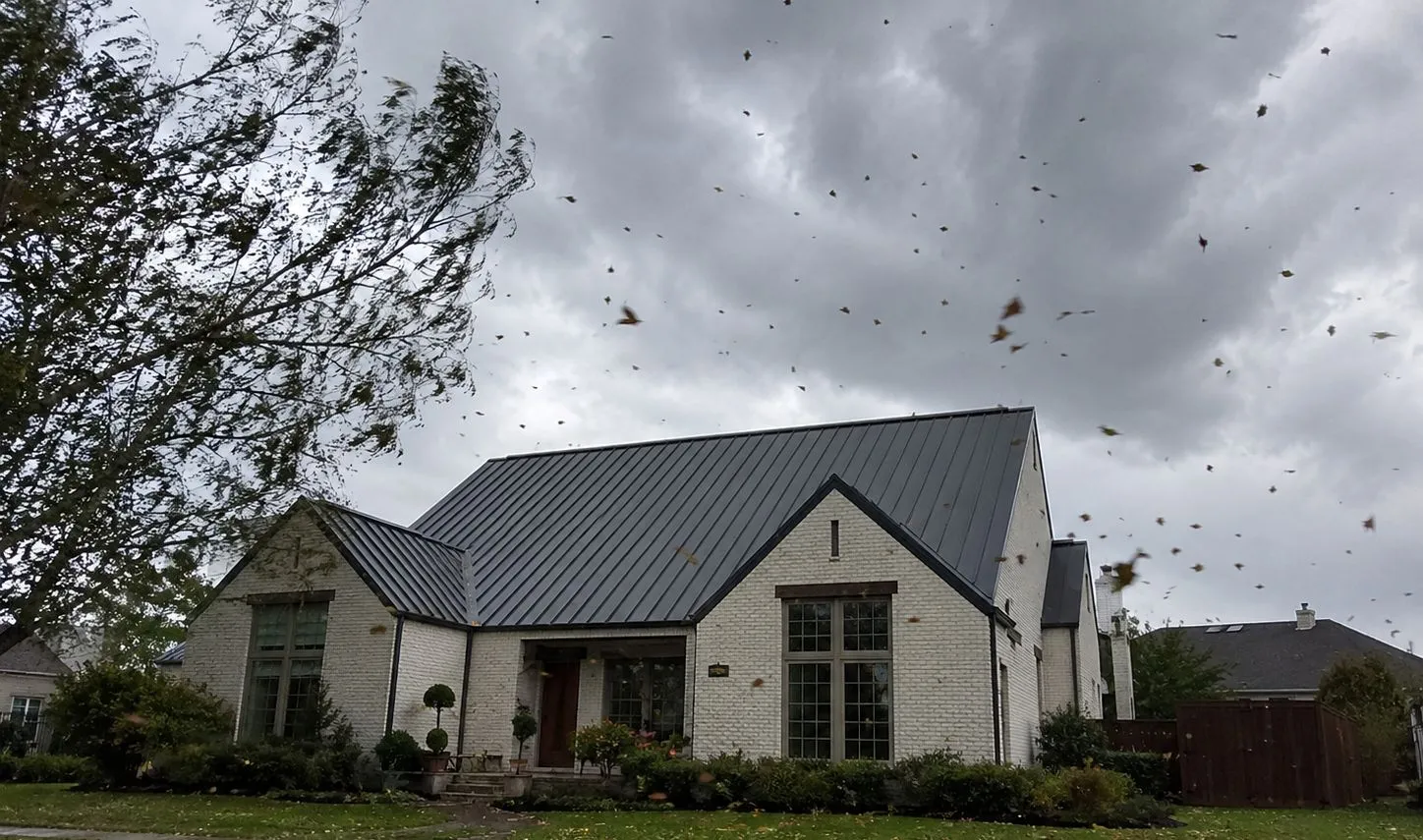
Wind is one of the most misunderstood parts of roofing. Homeowners often ask whether a metal roof is “rated for Nashville wind,” whether standing seam is stronger than shingles, or whether a roof can survive tornadoes. The accurate answer is more technical: a roof does not resist wind because of the metal alone. It resists wind because the entire roof assembly is designed, tested, fastened, and installed to resist uplift forces.
For Nashville and Middle Tennessee, wind resistance matters. The region is not a coastal hurricane zone, but it is exposed to severe thunderstorms, straight-line winds, tornado-producing storms, and rapid pressure changes. A roof in Nashville must be able to handle more than ordinary rain. It must be attached well enough to stay on the house when wind tries to pull it upward.
This guide explains Nashville wind ratings, the 115 mph design speed, roof uplift, metal roof testing, and the installation details that matter most for Tennessee homes.
Metro Nashville’s current residential code criteria list a wind design speed of 115 mph. Metro has adopted the 2024 International Building Code and 2024 International Residential Code with local amendments, and the 2024 I-Codes went into effect in Nashville and Davidson County on July 16, 2025, with a 180-day grace period for qualifying projects with preliminary designs under the 2018 IBC.
The 115 mph number is not a marketing slogan, a warranty promise, or a tornado-proof rating. It is a design input used with building code and ASCE 7 methods to determine wind pressures on the roof. The actual roof uplift pressures depend on the building height, roof shape, roof slope, exposure category, roof zones, openings, attachment method, and product testing.
A metal roof performs well in wind only when the roof system is matched to the wind design requirements and installed according to the manufacturer’s tested assembly. The panel, clips, fasteners, deck, edge metal, underlayment, ridge, eave, rake, and penetrations all matter.
Wind damage is not limited to hurricanes. Middle Tennessee regularly experiences severe thunderstorms and high wind events. National Weather Service data for Nashville International Airport includes measured gusts of 94 mph on April 1, 1974, 86 mph on April 27, 1958, 78 mph on December 11, 2021, and 69 mph on September 24, 2024.
NWS Nashville also maintains a long list of past weather events for Middle Tennessee, including tornado outbreaks, severe storms, high winds, and wind damage events.
Those records do not mean every roof sees the same wind. A wind gust measured at an airport does not describe every ridge, valley, subdivision, lakefront, hilltop, or downtown corridor. But the records do show why roof attachment matters in Nashville.
Metro Nashville’s adopted code list includes the 2024 International Building Code, 2024 International Residential Code, 2024 International Existing Building Code, and related 2024 codes.
In the 2024 Nashville building code ordinance, the residential criteria table lists a ground snow load of 10 pounds and a wind design speed of 115 mph. It also lists “Topographic effects” as “No” and “Special Wind Region” as “No.”
For a typical one- or two-family home, 115 mph is the local starting point for wind design. It does not mean the whole roof experiences one uniform load. Wind pressures are calculated differently for different roof areas and building conditions.
A roof corner often sees more uplift than the middle of the roof. A rake edge may see more force than an interior field area. A tall house on open terrain may see higher pressures than a shorter house surrounded by other houses and trees. A partially enclosed structure can experience higher internal pressures than a fully enclosed structure.
Wind pressure increases roughly with the square of wind speed. That is one reason design wind speed changes matter so much. All else equal, 115 mph wind creates about 63 percent more velocity pressure than 90 mph wind, because 115² divided by 90² is about 1.63.
ASCE wind calculations use velocity pressure formulas that include wind speed, exposure, topography, height, and other factors. The ASCE Hazard Tool is a standard resource for looking up site design parameters, including wind, tornado, seismic, ice, rain, flood, and snow information under ASCE 7.
For a homeowner, the practical lesson is simple: do not shop by wind speed alone. Shop by tested assembly, engineering, and installation quality.
Roof uplift is the upward pulling force created when wind moves around and over a building. As wind passes over the roof, it can create suction on the roof surface. At the same time, wind entering the building through broken windows, garage doors, vents, soffits, or other openings can increase internal pressure. The roof can then be pushed upward from below and pulled upward from above.
This is why roof damage often begins at edges, corners, ridges, eaves, rakes, and weak transitions. Once a small portion of the roof covering lifts, wind can get under the material and progressively peel back more of the roof.
In a metal roof, uplift resistance depends on several connected parts:
The metal panel or shingle
The seam or lap
The clip or fastener
The screw type and embedment
The roof deck
The underlayment
The eave and rake details
The ridge or hip detail
The spacing of attachments
The condition of the framing below
A strong metal panel attached poorly is not a strong roof. A tested standing seam profile installed with the wrong clips or clip spacing may not perform like the tested assembly. An exposed-fastener panel installed with under-driven, over-driven, misaligned, or incorrectly spaced screws can be vulnerable even if the panel itself is good.
Wind does not load a roof evenly. The roof field is the central area. Edges and corners are more vulnerable because wind accelerates and separates at building transitions. Corners commonly receive the highest uplift pressures.
This matters because some roof systems require closer fastener spacing or stronger attachment in perimeter and corner zones. On a standing seam roof, that may mean different clip spacing. On an exposed-fastener roof, that may mean tighter screw patterns at eaves, rakes, corners, and ridges. On a metal shingle roof, it may mean specific fastening schedules and starter/edge details.
A proper Nashville metal roof estimate should not treat every square foot as identical. The roof geometry and wind zones should guide the attachment method.
Exposure category is a major factor in wind design. Exposure B generally refers to urban, suburban, wooded, or otherwise obstructed terrain with many closely spaced obstructions the size of single-family homes or larger. Exposure C refers to open terrain with scattered obstructions, including open country, grasslands, and similar areas. Exposure D is associated with flat unobstructed areas exposed to wind over open water for a significant distance.
Many urban and suburban Nashville homes will resemble Exposure B conditions. But not every Middle Tennessee home does. A house on open acreage in Williamson County, a hilltop in rural Davidson County, a farm property in Robertson County, or an exposed site near a large open field may behave more like Exposure C. That can increase design pressures.
This is one reason a “standard Nashville installation” should be treated with caution. The right attachment schedule can vary by site.
Metro’s residential code criteria list “Topographic effects” as “No,” but site-specific topography can still matter for engineered buildings, unusual sites, or exposed locations. Wind can accelerate over hills, ridges, and escarpments, which is why ASCE 7 includes a topographic factor in wind design.
In Middle Tennessee, this matters most for exposed ridgelines, bluff-like terrain, and homes near abrupt elevation changes. A roof on a sheltered street in Sylvan Park is not the same as a roof on an open hilltop outside Nashville.
Metal roofing is not one product. Different systems resist uplift in different ways.
Standing seam roofs use vertical seams and concealed clips or fasteners. In a properly designed system, the clips attach the panel to the deck or framing while allowing thermal movement. This can be a strong wind-resistant system when the panel profile, clip type, fastener type, and clip spacing match the design pressures.
For Nashville homes, standing seam is often the premium wind-performance choice because it avoids exposed fastener heads in the water plane and uses continuous vertical seams. But it must be installed as a tested system. A standing seam roof is not automatically high-wind-rated just because the fasteners are hidden.
Exposed-fastener panels are attached through the face of the panel with screws and sealing washers. These systems can perform well when installed correctly, especially on barns, porches, garages, sheds, and certain residential applications. They are also more sensitive to screw quality, screw angle, washer compression, fastener spacing, and maintenance.
In wind, the fasteners are critical. Screws must be installed straight, not over-driven, not under-driven, and not placed randomly. The screw pattern must match manufacturer instructions and local wind requirements.
Metal shingles are smaller interlocking or overlapping units that often resemble conventional roofing modules. In non-historic neighborhoods, they can be useful where a homeowner wants metal performance without the look of standing seam. Their wind performance depends on the interlock, fastening method, starter details, and edge securement.
For Nashville historic districts, homeowners should be careful. Metro’s metal roofing supplement identifies metal that looks like another material, such as wood, slate, or tile, as unapproved in that review context.
Several test standards are used to evaluate metal roof systems. Homeowners do not need to memorize them, but they should know enough to ask good questions.
For metal panel roof systems applied to a solid or closely fitted deck, code-related guidance commonly references testing such as FM 4474, UL 580, or UL 1897. For structural standing seam metal panel roof systems, ASTM E1592 or FM 4474 are commonly referenced; for structural through-fastened metal panel systems, ASTM E1592, FM 4474, or UL 580 may be used.
ASTM E1592 is especially important for standing seam and structural metal panel systems because it evaluates structural performance under uniform static air pressure. FEMA guidance for metal roof systems in high-wind regions has recommended specifying ASTM E1592 testing for standing seam systems because it better represents system uplift performance capability.
UL 580 is also commonly discussed, but homeowners should not confuse a UL 90 classification with “rated for 90 mph.” UL 580 classifications are pressure-based test classifications, not miles-per-hour roof warranties. McElroy Metal explains that UL 580 testing uses pressure increments and classifications such as Class 15, 30, 60, and 90, and that the 90 psf stage includes oscillating pressure up to 105 psf.
The practical question is not “Does this roof have a wind rating?” The better question is:
“What tested assembly are you installing, what design pressure does it meet, and does that match my house, roof zones, and Nashville code requirements?”
A metal roof is only as strong as what it is attached to. If the roof deck is deteriorated, delaminated, rotten, too thin, poorly fastened, or damaged by old leaks, the panel fasteners or clips may not achieve proper pull-out resistance.
Before installing a wind-resistant metal roof, the contractor should evaluate the deck. Any soft decking should be replaced. Fastener embedment should be appropriate. If the roof has plank decking with gaps, skip sheathing, or older boards, the installer may need to verify compatibility with the chosen metal roof system.
In Nashville’s older homes, deck conditions vary widely. A 1920s home in East Nashville may have different decking than a 1990s suburban home in Bellevue or a new custom home in Williamson County. That difference can affect the installation method.
Wind failures often begin at roof edges. That makes edge detailing critical.
At the eave, the metal roof needs a secure starter condition. At the rake, trim must resist wind trying to lift the roof edge. At the ridge and hips, caps must be fastened according to the system requirements. At valleys, panels and flashing must be secured while still allowing water to drain correctly. At penetrations, boots, curbs, and flashings must not become weak points.
A roof can have excellent panels and still fail because the edge trim was treated as decorative rather than structural. In high-wind detailing, trim is part of the roof system.
Fasteners are small, but they carry the load path. In a wind event, uplift force travels from the panel to the clip or screw, from the clip or screw into the deck or framing, and from there into the roof structure.
For standing seam, important questions include clip type, clip spacing, fastener type, fastener length, substrate, and whether different roof zones need different spacing. For exposed-fastener panels, important questions include screw diameter, washer quality, screw pattern, substrate, and whether screws are placed in the high rib or flat depending on the manufacturer’s instructions.
Fastener mistakes are common and serious. Over-driven screws can deform washers. Under-driven screws may not seal. Angled screws can leave gaps. Screws that miss solid wood do not provide the intended resistance. Incorrect clip spacing can reduce uplift capacity.
No. A metal roof is not tornado-proof, and no conventional roof covering should be sold that way.
The National Weather Service Enhanced Fujita Scale assigns tornado ratings based on estimated wind speeds and damage. EF2 tornado winds are listed in the 111–135 mph range, EF3 winds in the 136–165 mph range, and EF4 winds in the 166–200 mph range.
Those speeds can exceed ordinary residential roof design assumptions, especially when debris impact and structural damage are involved. A well-installed metal roof can improve wind resistance, but tornado resilience is a whole-building issue involving roof-to-wall connections, wall bracing, garage doors, openings, foundation anchorage, and shelter planning.
The honest claim is this: a properly installed, code-compliant metal roof can be a strong wind-resistant roof system for Nashville’s severe thunderstorm environment, but it is not a storm shelter.
Before approving a metal roof estimate, ask these questions:
What wind design speed and code basis are you using for my property?
Is my site Exposure B, Exposure C, or something else?
Is this panel installed over solid decking or open framing?
What tested assembly supports this installation?
What uplift pressures does the assembly meet?
Are clip spacing or fastener patterns different at corners and edges?
What fasteners will be used, and how deep will they embed?
Will damaged decking be replaced before installation?
How will eaves, rakes, ridges, valleys, and penetrations be secured?
Is the installation consistent with the manufacturer’s written instructions?
Will the roof still comply if solar panels are added later?
A contractor who can answer these questions clearly is more likely to install a roof that performs well.
Not exactly. The 115 mph value is a design input. Actual roof pressures depend on site and building factors.
No. UL 90 is a pressure classification within UL 580 testing, not a 90 mph wind-speed promise.
Metal roofs can be excellent in wind, but performance depends on the complete tested assembly and installation.
Edges and corners often experience higher uplift pressures than the field. Good perimeter detailing is essential.
A warranty and code compliance are different. A warranty may cover finish, corrosion, or weathertightness under specific conditions. Code compliance depends on the installed assembly meeting local requirements.
Choose a system appropriate for the home, not just the lowest price.
Use manufacturer-approved clips, screws, and trim.
Verify deck condition before installation.
Follow tested fastening patterns.
Pay special attention to eaves, rakes, ridges, hips, and valleys.
Use lower-profile, historically appropriate panels where required by Metro Historic Zoning.
Avoid substituting parts from different systems without manufacturer approval.
Document the installation with product data and photos.
Ask for a clear written scope of work.
Nashville’s 115 mph residential wind design speed is an important number, but it is only the beginning of the conversation. A wind-resistant metal roof is not defined by one rating. It is defined by the roof system, the tested assembly, the building site, the roof geometry, the attachment schedule, and the quality of installation.
For Middle Tennessee homeowners, the best roof is one that is selected for the home, approved where required, installed over a sound deck, fastened according to the correct wind requirements, and detailed carefully at every edge and penetration.
A metal roof can be one of the strongest roofing choices for Nashville, but only when it is treated as an engineered roof assembly rather than just a sheet of metal on a house. Learn more about our standing seam systems, or contact us to talk through wind requirements for your roof.

Metal roofs are engineered to withstand extreme wind conditions, making them ideal roofing solutions for Middle Tennessee homeowners.
Learn how Nashville metal roof storm repairs address wind, hail, and uplift and when replacement, not repair, is the safer choice for Tennessee homes.