Metal Roofing Alliance Member
TVA Preferred Partners Network
10,000+ Metal Roof Jobs
Nashville, TN
Licensed & Insured
BBB A+

Open 8am–8pm
(615) 649-5002Schedule Your
Appointment
Appointment
✦ Reviewed by The Metal Roofers Technical Team
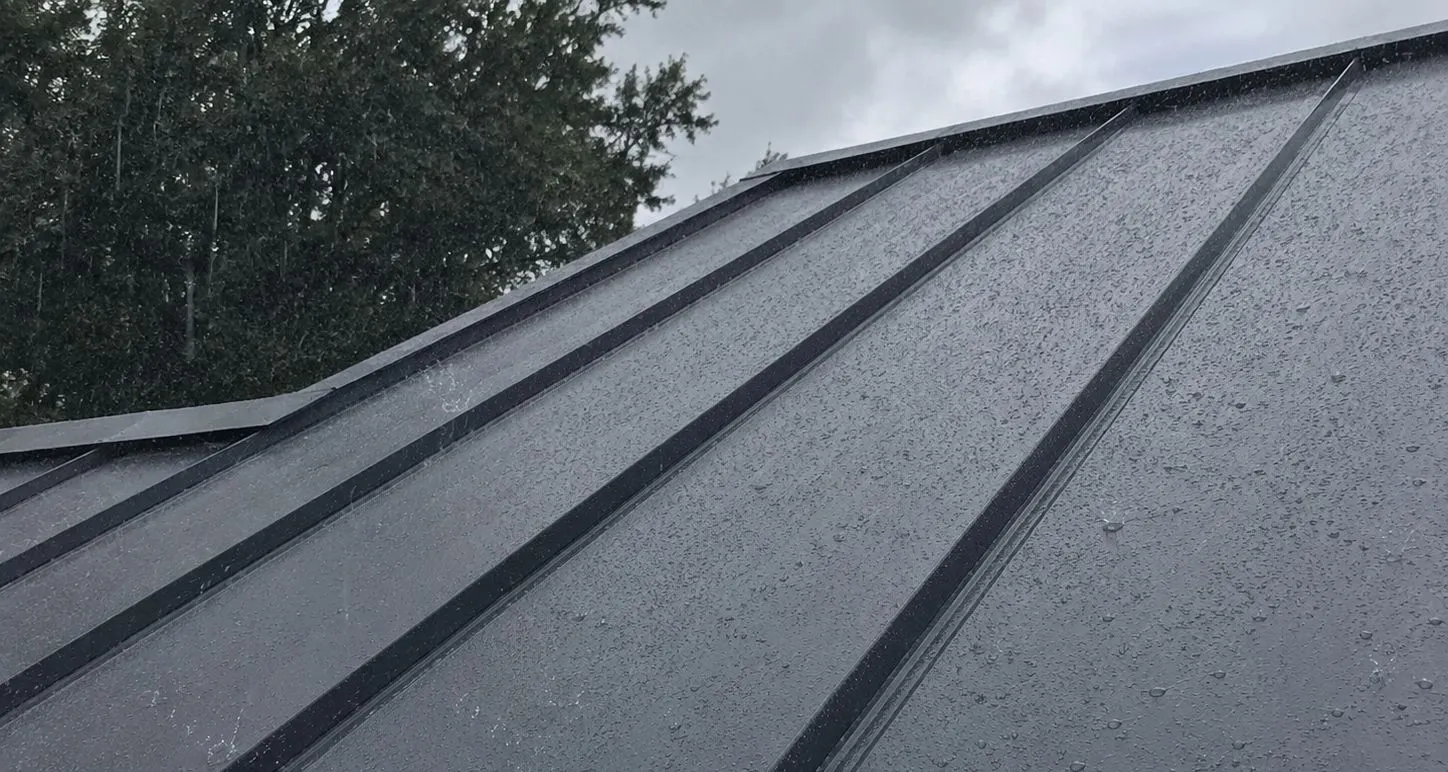
Metal roofs in Nashville are not loud, since rain on a metal roof over solid decking measures about 52 dBA compared with about 46 dBA on asphalt shingles. One of the most common questions Nashville homeowners ask about metal roofing is simple: “Will it be loud when it rains?”
The honest answer is: not if it is installed as a modern residential roof assembly. A metal roof over a barn, shed, carport, open porch, or agricultural building can be loud because there may be little or nothing below the metal panel to absorb sound. A metal roof on a Nashville home is different. It is typically installed over solid roof decking, underlayment, attic air space, insulation, drywall, and interior finishes. Those layers change the sound dramatically.
That distinction matters in Middle Tennessee, where heavy rain, hail, thunderstorms, falling branches, and temperature swings are part of normal roof life. The question is not simply whether the roof covering is metal. The better question is: what is underneath the metal?
This guide explains how metal roof noise actually works, what the real dBA numbers mean, why some metal roofs sound louder than others, and what Nashville homeowners can do to keep a metal roof quiet.
A complete residential metal roof is usually only modestly louder than an asphalt shingle roof during rainfall. A widely cited sound comparison shows rain on asphalt shingles at about 46 dBA, rain on a metal roof over solid decking at about 52 dBA, and rain on a metal roof over open framing at about 61 dBA. Normal conversation is commonly around 60 to 70 dBA, and the National Institute on Deafness and Other Communication Disorders says sounds at or below 70 dBA are generally considered safe, while long or repeated exposure at or above 85 dBA can cause hearing loss.
That does not mean every metal roof sounds the same. A standing seam roof on an insulated Nashville home will not sound like a metal panel over a pole barn. A porch roof will not sound like a conditioned living space. A vaulted ceiling with little insulation may sound different from a vented attic with deep blown-in insulation. Roof assembly, not just roof material, controls the experience.
The noisy-metal-roof reputation comes mostly from buildings that are not built like houses.
Many people first hear rain on metal while standing inside a barn, pavilion, shed, warehouse, lean-to, carport, or covered porch. In those situations, the metal may be attached directly to framing with little or no solid deck, no attic, no ceiling insulation, and no drywall. The panel vibrates, the rain impact is easy to hear, and the open space below the roof acts like a sound chamber.
That is not how most residential metal roofs are installed in Nashville, Brentwood, Franklin, Hendersonville, Mount Juliet, Gallatin, Lebanon, Murfreesboro, Nolensville, or the rest of Middle Tennessee. On a house, the roof is normally part of a layered system. The roof covering sits over decking. The decking sits over rafters or trusses. Beneath that may be an attic, insulation, an air space, drywall, and finished living space. Each layer reduces sound before it reaches the room below.
Industry sound guidance makes this same point: the old “metal roofs are noisy” idea is usually based on open-framed structures, not finished residential roof assemblies.
dBA means A-weighted decibels, a sound measurement adjusted to reflect how the human ear responds to different frequencies. Noise is usually measured in decibels, abbreviated dB. For human hearing, sound levels are often reported as dBA, or A-weighted decibels. A-weighting adjusts the measurement to better reflect how the human ear responds to different frequencies. OSHA describes dBA as an A-weighted sound level that approximates human loudness perception, and notes that the decibel scale is logarithmic rather than linear.
That logarithmic scale is important. A small change in dBA does not behave like a small change in inches, pounds, or dollars. A 6 dBA difference is measurable, but it is not the same as saying something is “twice as loud” in normal everyday terms. Human perception of sound depends on frequency, room acoustics, duration, background noise, and the listener.
For homeowners, the practical takeaway is simple: dBA numbers help compare roof assemblies, but they do not tell the whole story. A roof that measures a few dBA higher may still feel normal indoors if the home has a good deck, underlayment, attic, and insulation.
Rain measures about 46 dBA on asphalt shingles, 52 dBA on metal over solid decking, and 61 dBA on metal over open framing. The most useful numbers for homeowners are comparative. The question is not “does a metal roof make any sound?” All roofs make sound in rain. The question is how a complete metal roof compares with other familiar sounds.
Sound or roof conditionApproximate sound levelRain on asphalt shingles46 dBARain on metal roof over solid decking52 dBARain on metal roof over open framing61 dBANormal conversation60–70 dBALevel generally considered safe by NIDCDAt or below 70 dBALong or repeated exposure that may cause hearing lossAt or above 85 dBA
The key comparison is between asphalt shingles and a metal roof over a solid residential deck. The difference shown in the cited roof-sound comparison is about 6 dBA: roughly 46 dBA for asphalt shingles and 52 dBA for metal roofing over solid decking. The much louder example is the open-framing metal roof at about 61 dBA.
That is why a barn roof sounds like a barn roof. It is not just because it is metal. It is because it is often metal with very little below it.
Asphalt shingles are quieter than metal in direct rainfall comparisons, but the difference on a finished home is often smaller than homeowners expect.
Asphalt shingles have texture, mass, and a granular surface. Those characteristics help break up the sound of raindrops. Metal panels are harder and smoother, so the impact sound can be sharper at the roof surface. But once the roof covering is installed over solid decking and a complete attic or ceiling assembly, the difference inside the house is reduced.
That is why the real-world question is not whether asphalt shingles are quieter at the roof surface. They generally are. The question is whether the difference is large enough to matter inside a Nashville home. In many properly insulated homes, the answer is no.
A homeowner sitting in a living room under a vented attic may hear more rain noise from skylights, thin porch ceilings, bathroom fan penetrations, or poorly insulated vaulted sections than from the main metal roof itself. Roof geometry and interior construction can matter as much as the roof covering.
A metal roof over open framing is louder because the panel takes direct rain impact with little mass below it and nothing to absorb the sound. A metal roof over open framing has three noise disadvantages.
First, the panel receives direct raindrop impact with little mass below it. Second, the panel can vibrate more freely. Third, the open space below the roof does little to absorb sound.
This is why metal carports, barns, sheds, detached pavilions, agricultural buildings, and some porch roofs sound louder than metal roofing over conditioned living space. They are not just roofs; they are exposed sound surfaces.
In Nashville, this distinction matters for detached garages, covered patios, screened porches, pool houses, and farm structures. A homeowner may love the sound of rain on a porch roof but not want that sound in a bedroom. That is normal. The solution is to design the roof assembly for the space below it.
A quiet metal roof is not created by the panel alone. It is created by the assembly.
The most important sound-control layers are:
Solid roof decking. Plywood or OSB decking adds mass and reduces panel vibration. It also separates the living space from direct panel impact.
Underlayment. Synthetic underlayment, self-adhered membrane, and other approved underlayments create a separation layer between the metal and the deck. They also contribute to the overall damping effect of the roof system.
Attic air space. A vented attic creates distance between the roof deck and the finished ceiling. Air space helps reduce direct sound transfer.
Insulation. Blown-in fiberglass, cellulose, spray foam, mineral wool, and other insulation systems can reduce sound transmission. Attic insulation is one of the biggest reasons a metal roof over a living space sounds different from a metal roof over a barn.
Ceiling drywall. Interior drywall adds mass and creates another barrier between the roof and the room.
Metal roofing industry guidance consistently points to decking, underlayment, and insulation as the reasons a residential metal roof is much quieter than an open-framed metal roof.
The same metal roof sounds different from room to room because attic depth, insulation, and ceiling construction vary within a house. A metal roof may sound different from one part of a house to another. That is especially true in older Nashville homes, additions, bonus rooms, and converted attic spaces.
A 1920s bungalow in East Nashville may have a different roof deck, attic depth, and insulation level than a newer home in Nolensville. A Green Hills ranch may have broad vented attic space over most rooms but thinner insulation over an addition. A Germantown or Lockeland Springs renovation may include vaulted ceilings where the roof deck is much closer to the interior drywall. A Brentwood or Franklin home may have dormers, porches, bonus rooms, and steep roof planes that create several different sound conditions under one roof.
The quietest rooms are usually those with a full attic and good insulation between the roof and the ceiling. The loudest areas are often vaulted ceilings, low-slope porch roofs, skylight wells, sunrooms, bonus rooms over garages, and spaces where insulation is thin or missing.
Every roof gets louder in heavy rain, including asphalt shingles, slate, tile, metal shingles, standing seam metal, and exposed-fastener panels. Middle Tennessee rain is not always gentle. Nashville gets pop-up storms, long soaking rains, severe thunderstorms, and intense downpours.
Metal can make rain sound sharper at the roof surface because raindrops strike a hard material. But inside a complete residential assembly, the sound is filtered by the roof deck and ceiling system. During severe rain, the homeowner may notice the storm, but that is not the same thing as the roof being disruptive.
It is also worth remembering that thunder, wind, gutters, downspouts, tree movement, windows, and skylights can be louder than the roof covering itself. In a Nashville thunderstorm, the soundscape is not just rain hitting panels.
Hail sounds sharper than rain on a metal roof, and on every other roof, because hailstones are harder, larger, and heavier than raindrops. Metal roofs, asphalt shingles, slate, clay tile, and synthetic roofing will all sound different during hail.
There is no single honest dBA number for “hail on a metal roof” because hail noise depends on hail size, hail density, wind speed, roof slope, roof panel type, roof deck, underlayment, attic insulation, ceiling assembly, room shape, and whether the homeowner is under a vaulted ceiling or a full attic. A small hail event may sound like loud rain. Large hail can sound startling on almost any roof.
For Nashville homeowners, the better question is not whether hail is audible. It will be. The better question is whether the roof system is designed to resist damage and whether the attic/ceiling assembly is built well enough to reduce impact noise inside the house.
Metal shingles and stone-coated steel products can sometimes soften impact sound compared with smooth panels because texture interrupts direct raindrop impact, but the full assembly still matters more than the surface alone.
Metal shingles and standing seam panels can both be installed as quiet residential roof systems, but they create sound differently.
Standing seam panels are larger, continuous panels running from eave to ridge. Their smooth surface can produce a crisp rain sound at the roof surface, especially on uninsulated or open-framed areas. On a complete residential assembly, that sound is usually reduced significantly.
Metal shingles are smaller modular pieces. Many have stamped shapes, interlocks, coatings, or surface texture. The smaller modules and textured profiles can break up raindrop impact differently than a smooth standing seam panel. Some stone-coated steel systems add another surface layer that can further soften rain impact.
That does not mean metal shingles are automatically silent or standing seam is automatically loud. Either can be quiet when installed over solid decking with underlayment and insulation. Either can be loud if installed over open framing.
Exposed-fastener metal roofs sound louder mainly because many are installed on open framing or lighter assemblies, not because of the panel type itself. Exposed-fastener panels are often associated with agricultural, utility, and budget residential roofing. They can be perfectly appropriate on barns, workshops, detached garages, porches, sheds, and some homes. But because many exposed-fastener systems are installed on open framing or lighter assemblies, people often associate them with louder rain noise.
On a house with solid decking and insulation, an exposed-fastener roof can be much quieter than an open barn roof. Still, the panel profile, rib height, fastening pattern, deck condition, and insulation level all affect sound.
For occupied living spaces in Nashville, homeowners who are especially sensitive to noise usually prefer a concealed-fastener system over solid decking, such as standing seam or metal shingles. For porches, garages, and outbuildings, exposed-fastener panels may be a cost-effective choice where a more audible rain sound is acceptable or even desirable.
Metal roofs make occasional ticking, popping, or creaking sounds as temperatures change, a normal effect called thermal movement. Rain noise is not the only sound homeowners ask about. Metal roofs can also make occasional ticking, popping, or creaking sounds as temperatures change. This is called thermal movement.
Metal expands when heated and contracts when cooled. In Tennessee, a roof can experience strong temperature swings: cold mornings, sunny afternoons, summer heat, and fast cooling after storms. Metal panels respond to those changes.
A properly designed metal roof allows for movement. Standing seam systems commonly use clips that let panels expand and contract. Good detailing avoids locking long panels rigidly at both ends. PAC-CLAD explains that thermal movement depends on the metal type, panel length, and temperature change, and that proper design uses floating clips, slip joints, and movement-friendly details rather than rigidly fixing the roof. MBCI similarly warns that fastening both ends of standing seam panels is a serious mistake because the roof needs room to move.
Some minor thermal sound is normal in many metal systems, especially during the first seasons after installation. Loud, frequent, or sharp popping may suggest restricted movement, overtightened fasteners, long panel runs without proper detailing, or trim conditions that need review.
A Nashville homeowner who wants the quietest possible metal roof should focus on the assembly, not just the panel.
The most important steps are:
Install over solid decking. Avoid open-framing installations above conditioned living spaces.
Use proper underlayment. Follow manufacturer requirements for underlayment, ice and water protection where needed, and separation layers.
Improve attic insulation. A well-insulated attic helps with comfort, energy performance, and sound reduction.
Pay attention to vaulted ceilings. Vaulted rooms need careful insulation and ventilation design because there is less space between the roof deck and the interior ceiling.
Use compatible clips and fasteners. Proper attachment reduces unnecessary vibration and movement noise.
Detail penetrations correctly. Skylights, pipe boots, chimneys, bathroom vents, and roof curbs can become sound weak points if poorly flashed or insulated.
Consider textured metal shingles or stone-coated steel. These may be attractive for homeowners who want a less panel-like rain sound, though product selection must also consider cost, aesthetics, historic rules, and installation requirements.
A quiet metal roof is rarely about adding one magic soundproofing product. It is usually about building the whole roof correctly.
Many homeowners who think they are hearing the metal roof are actually hearing skylights.
Skylights create a direct sound path. Rain hits glass or acrylic, the sound travels through the skylight well, and the room below hears the impact clearly. That can happen regardless of whether the surrounding roof is asphalt, metal, slate, or tile.
For Nashville homes with skylights, the metal roof may not be the loudest part of the roof during rain. The skylight may be. Good skylight flashing, insulated light wells, laminated glass options, and proper interior finishing can matter.
Porches are the exception many homeowners notice first.
A metal porch roof can be noticeably louder than the main house roof because porch ceilings may be thinner, uninsulated, or open. A covered front porch in East Nashville, a screened porch in Franklin, or a back patio roof in Mount Juliet may have metal panels over framing with less sound control than the main house.
That does not make metal a bad porch material. Many people like the sound of rain on a porch roof. But the homeowner should not judge the sound of the whole house by standing under an open porch.
Older Nashville homes often have inconsistent attic insulation. Some have older blown-in insulation that has settled. Some have renovations where sections of the attic were disturbed. Some have knee-wall areas, bonus rooms, low roof slopes, or additions that were never insulated as well as the original house.
If a homeowner is replacing the roof and is concerned about noise, it is a good time to look at attic insulation. The roofing contractor, insulation contractor, or energy auditor can identify weak areas. Improving attic insulation may reduce roof noise, improve comfort, and help with heating and cooling performance.
Homeowners can use sound meter tools to get a rough sense of indoor noise, but measurements should be treated carefully. The phone location, room size, storm intensity, microphone quality, and background noise all affect the reading.
NIOSH offers a Sound Level Meter app for iOS that was developed by acoustics engineers and tested for accuracy within plus or minus 2 dBA under its technical specifications. NIOSH also notes that the app is available only for iOS devices because Android devices were not verified in the same way.
For homeowners, a sound meter can be useful for comparison. For example, measure the room during light rain, heavy rain, and normal conversation. The result will not be a laboratory test, but it can help put roof noise in context.
False. Barns are usually louder because they often lack solid decking, attic insulation, drywall, and conditioned ceiling assemblies.
A complete residential metal roof is commonly cited around 52 dBA during rainfall, which is below normal conversation and well below the 85 dBA level associated with long or repeated noise exposure concerns.
False. Asphalt shingles make noise in rain too. They are often quieter at the roof surface, but no roof covering is silent in a storm.
Not necessarily. Product type matters, but roof deck, underlayment, attic insulation, and ceiling construction usually matter more.
Not necessarily. Porches are often less insulated and less enclosed than the main house.
Before choosing a metal roof, homeowners concerned about noise should ask:
Will the metal roof be installed over solid decking?
What underlayment will be used?
Will the old roof be removed or recovered?
Are there vaulted ceiling areas that need special attention?
What attic insulation is currently in place?
Will the system allow for thermal expansion and contraction?
Are skylights, chimneys, and penetrations being reflashed?
Is this roof assembly different from an open-framing barn or porch roof?
Can you show examples of similar Nashville homes with this product?
A good contractor should be able to explain the difference between a metal roof panel and a complete residential roof assembly.
Metal roofs are not automatically noisy. Open-framed metal roofs are noisy. Poorly insulated roof assemblies can be noisy. Thin porch roofs can be noisy. But a modern residential metal roof over solid decking, underlayment, attic space, insulation, and drywall is much quieter than the old barn-roof stereotype suggests.
For Nashville and Middle Tennessee homeowners, the key is to choose the right roof system for the building. A standing seam roof, metal shingle roof, or other residential metal system can perform well in Tennessee storms without making the inside of the home feel like a shed.
The best way to think about metal roof sound is simple: you are not buying just metal. You are buying the whole roof assembly. Compare standing seam and metal shingles for your home, or contact us with questions.

Learn how Nashville metal roof storm repairs address wind, hail, and uplift and when replacement, not repair, is the safer choice for Tennessee homes.
Live in a tornado-prone area? Discover why metal roofing is ideal for high-wind zones, from wind ratings to insurance perks.