Metal Roofing Alliance Member
TVA Preferred Partners Network
10,000+ Metal Roof Jobs
Nashville, TN
Licensed & Insured
BBB A+

Open 8am–8pm
(615) 649-5002Schedule Your
Appointment
Appointment
✦ Reviewed by The Metal Roofers Technical Team
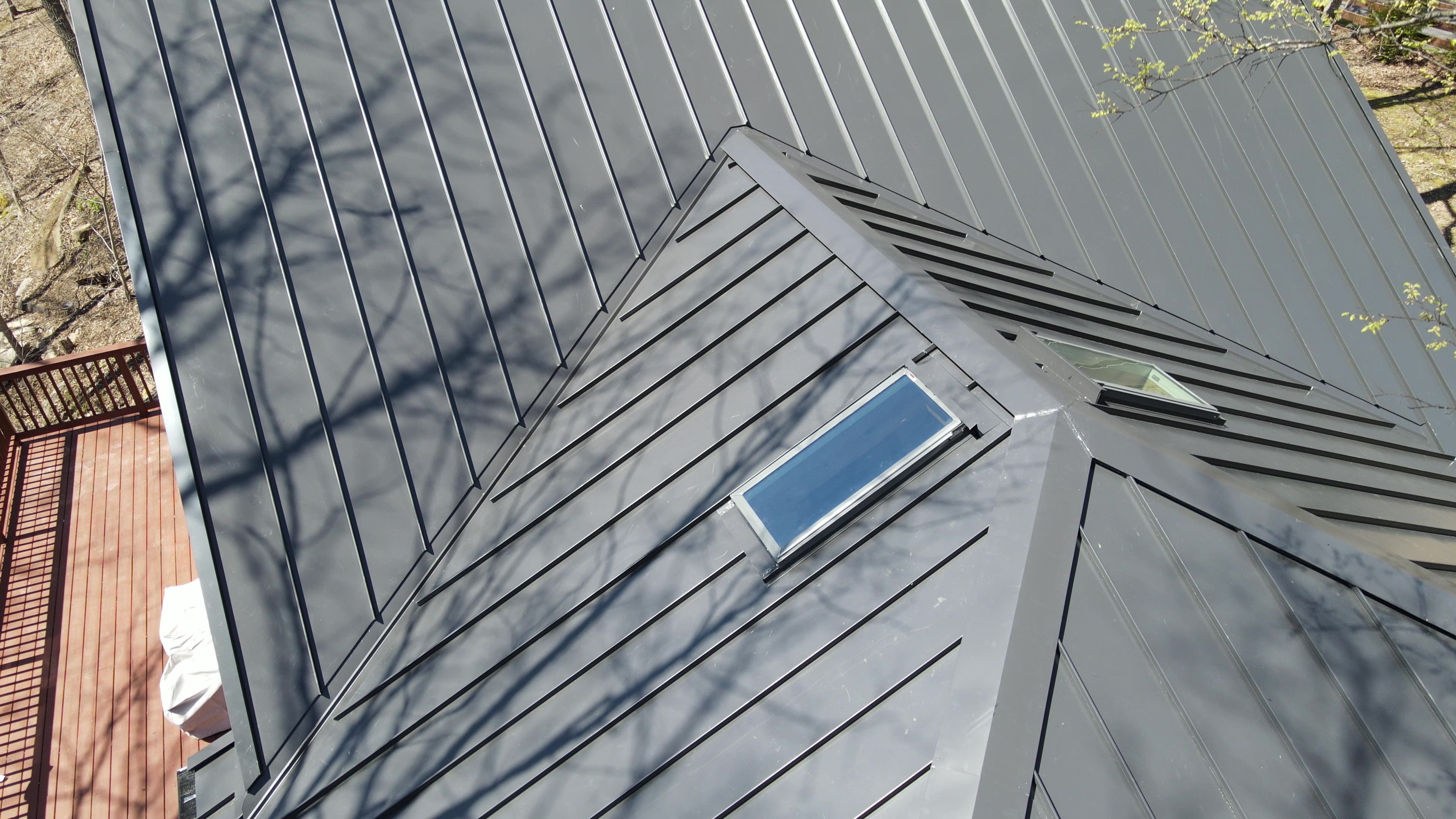
A metal roof usually does not leak because the metal panel itself failed. It leaks where the roof system is interrupted.
A skylight is one of the biggest interruptions that can be cut into a roof. It creates a hole through the roof deck, a curb or frame that rises above the roof plane, a glass unit, a flashing system, an underlayment tie-in, fasteners, trim, sealants, an interior light shaft, and a place where water has to be redirected around an obstacle instead of flowing naturally down the panel.
That is why skylight leaks are so common, even on roofs that are otherwise in good condition.
A skylight leak on a metal roof is usually not a “glass problem.” It is a transition problem. Water is getting behind, under, around, or through the skylight assembly because the curb, flashing, underlayment, panel profile, or condensation control detail is not doing its job.
The core rule is simple: water must be managed down and out. The U.S. Department of Energy’s Building America guidance explains that flashing exists because drainage planes are interrupted at openings and penetrations, and the flashing must direct water outward rather than into the assembly. Building Science Corporation describes rain control as a layered strategy of deflection, drainage, storage, and drying, not a single bead of caulk.
For homeowners in Nashville and Middle Tennessee, this matters because skylights see wind-driven rain, heat, humidity, pollen, leaves, storm debris, thermal movement, and seasonal expansion and contraction. If the skylight curb or flashing was installed like a shingle-roof detail instead of a metal-roof detail, the leak may not appear immediately. It may show up months or years later as a ceiling stain, a damp skylight shaft, peeling paint, wet insulation, mold odor, or water dripping from the drywall corner.
For active leaks, start with a professional metal roof inspection or metal roof repair in Nashville. The Metal Roofers’ inspection process checks panels, seams, fasteners, flashings, penetrations, valleys, gutters, attic conditions, ventilation, and moisture pathways, exactly the kind of whole-system inspection a skylight leak requires.
Metal roofs leak around skylights when the skylight interrupts the roof’s water path and the curb, flashing, underlayment, sealant, panel profile, or interior condensation control fails to move water down and out.
That is the most accurate way to think about the problem. A skylight is not just a window in the roof. It is a roof penetration. Every roof penetration needs a complete water-management system.
The Metal Roofers explain on their metal roof repair page that chimneys and skylights interrupt the panel system, create upstream dams where debris and ice can accumulate, and require apron flashing, saddle or high-side protection, and counterflashing to work together as a system. If one piece fails, water follows the easiest path into the roof assembly.
That is the reason a skylight can leak even when the glass looks fine, the panels look fine, and the roof is relatively new.
A metal roof is designed to shed water quickly. The panels are smooth, the slope directs flow, and the seams or ribs create channels that guide water downhill. That is excellent for open roof sections, but it makes interruptions more important.
When water reaches a skylight, it cannot keep moving in a straight line. It has to split, move around the curb, pass the side flashing, cross the lower apron, and continue onto the roof below. If water builds up on the uphill side, enters a panel rib, gets under a side flashing, runs behind the counterflashing, or finds an unsealed fastener hole, it can move into the roof system before anyone sees a drip indoors.
Building Science Corporation notes that wind, geometry, surface features, drip edges, and slopes all affect water flow paths. It also warns that interruptions in a drainage plane need flashing and drainage, and that face-sealed joints relying on sealant alone have a high chance of failure.
That is why skylight flashing must be designed around the actual metal roof system. A standing seam metal roof has raised seams and concealed fasteners. A classic panel metal roof may have exposed fasteners, panel ribs, and gasketed screws. A metal shingle roof has a different lap pattern entirely. Each one changes how water approaches, touches, and drains around the skylight.
VELUX makes this point from the skylight side: skylight mounting type and flashing kit have to work together to keep weather out, and the flashing system is designed to shed water without relying on sealants that can break down over time. Their metal-roof flashing guidance specifically references systems designed to integrate with ribbed or standing seam metal panels.
The most common sign is a stain at the skylight shaft, usually at one of the lower corners.
Many homeowners expect the water to drip directly through the glass. That can happen, but most skylight leaks show up in the drywall, paint, trim, or ceiling around the skylight well. A stain may appear on the downhill side of the skylight, along the inside corner of the light shaft, or several feet away from the skylight if water travels along framing before dripping.
The Metal Roofers’ inspection page notes that roof leaks rarely appear exactly where they enter. Water can travel along decking, framing, insulation, seams, and penetrations before showing up indoors. Their inspection process includes attic review and moisture-path tracing because a visible stain may sit feet away from the actual entry point.
A skylight leak often looks like one of these symptoms:
A brown or yellow stain appears on the drywall near the skylight.
Paint bubbles or peels along the light shaft.
Water drips from one corner during heavy rain.
The wood trim around the skylight swells or darkens.
The skylight glass fogs, sweats, or collects interior moisture.
The attic shows damp framing near the skylight opening.
There is a musty smell after storms.
The leak happens only when rain comes from one direction.
Those clues matter because they can point to different causes. A drip from the lower drywall corner during wind-driven rain may be flashing. Fogging between panes may be glazing seal failure. Water on the room-side glass during cold weather may be condensation. Staining at the roof deck uphill from the skylight may be head flashing. Damp insulation around the shaft may be an air-sealing or condensation issue.
Not every water mark near a skylight is a roof leak. Some are flashing leaks, some are skylight-unit failures, and some are condensation problems that only look like leaks.
A durable skylight installation depends on more than the visible metal trim.
VELUX describes its weathertight skylight design as a three-layer approach: a seal or gasket between the skylight frame and roof deck, adhesive underlayment as secondary protection, and engineered flashing as an additional water-protection layer.
That layered approach matches the basic building-science principle of redundancy. Roofs are exposed to rain, wind, movement, temperature swings, and occasional installation imperfections. A skylight that depends on one exposed caulk line has no backup. A skylight with a correct curb, underlayment tie-in, compatible flashing kit, properly lapped head and side flashing, and a sealed interior shaft has multiple lines of defense.
On a metal roof, those layers usually work like this.
The roof-side flashing handles the bulk water. It directs rain around the skylight and back onto the panel surface.
The underlayment or membrane handles incidental water that gets beneath the visible flashing.
The curb, frame, gasket, and skylight unit protect the actual opening.
The interior shaft insulation and air sealing help prevent warm indoor air from reaching cold surfaces and condensing.
The trouble starts when one layer is missing, poorly lapped, incompatible with the roof profile, damaged by movement, or forced to do another layer’s job.
The most common mistake is using the wrong flashing detail.
Skylights are not flashed the same way on every roof. A flashing kit that works for asphalt shingles may not work on standing seam panels. A detail that works on low-profile metal shingles may not work on ribbed exposed-fastener panels. A deck-mounted skylight may not be right for a low-slope roof section. A curb-mounted skylight may be needed where the roof pitch, roof material, or existing opening requires it.
VELUX separates skylight flashing by installation type and roof material, including deck-mounted, curb-mounted, self-flashed, metal roof flashing, and low-slope applications. Its guidance says deck-mounted skylights sit directly on the roof deck, while curb-mounted skylights sit on a site-built curb and are often used for older skylights or flat and low-sloped roofs.
Metal roofs add another layer of complexity. VELUX describes a metal roof flashing system designed to integrate with ribbed or standing seam metal panels. That language matters because the flashing has to manage ribs, seams, panel pans, water channels, and movement.
A metal-roof skylight leak often starts when an installer tries to “make it work” with generic flashing, leftover trim, surface-applied caulk, exposed fasteners in bad locations, or a shingle-style step flashing approach that does not match the panel profile.
The flashing has to belong to the roof system. A skylight flashing detail that ignores the metal panel profile is not a roof detail; it is a temporary patch.
That is why a homeowner with a metal roof should use a roofer who understands metal roof trim, panel movement, and custom flashing. The Metal Roofers’ metal roof trim and flashing guide is a strong internal resource to link here because skylight leaks are almost always flashing-detail failures, not open-field panel failures.
The uphill side of a skylight is the danger zone.
Rainwater runs down the roof and hits the upper edge of the skylight. If the head flashing, back pan, or high-side flashing does not move water cleanly around the unit, water can slow down, collect debris, pond, or work sideways into the flashing assembly.
Building America’s flashing guidance explains that head flashing should direct water away from openings, slope to the exterior, and extend past the opening so water is carried away rather than into the assembly.
On a metal roof, high-side water control is especially important because water moves fast across smooth panels. If the roof plane above the skylight is large, steep, or exposed to wind-driven rain, the skylight receives a concentrated load of water. If leaves or pine needles collect above the curb, that load can become a small dam.
The Metal Roofers’ repair page describes skylights and chimneys as interruptions that create upstream dams where debris and ice can accumulate. That is exactly the high-side problem. Once water slows down above the skylight, even a small lap defect, old sealant crack, or poorly formed corner can become a leak.
This does not mean every skylight needs a random diverter or cricket. The Department of Energy cautions that water diversion devices such as roof crickets and diverter strips around skylights can create problems when they are not part of a proper skylight design. The better rule is that the skylight’s high-side flashing must follow the roof system and manufacturer instructions so water drains naturally down and out.
A curb is the raised frame that lifts the skylight above the roof surface. On a sloped roof, that height helps separate the opening from flowing water. On a low-slope roof, curb height becomes even more important because water drains more slowly.
The Department of Energy recommends mounting skylights above the roof surface, installing curbs and flashing, sealing joints, following manufacturer guidelines, and waterproofing over flanges and flashing beneath the roofing material to reduce water-leak risk.
VELUX also distinguishes between deck-mounted skylights and curb-mounted skylights. Its guidance says curb-mounted units are used on framed curbs and that flat or low-slope roof applications use curb-mounted or self-flashed skylights because the raised curb helps drainage. It also states that deck-mounted skylights are not suitable for low slopes.
If the curb is too low, water can overwhelm the flashing during heavy rain, wind-driven rain, snow melt, or debris buildup. If the curb is rotted, out of square, poorly wrapped, or not integrated with the underlayment, water can enter even when the visible flashing looks acceptable.
A low curb is especially risky on a metal roof section with low pitch. The Metal Roofers’ metal roof pitch guide explains that slope determines which metal roof systems make sense and that low-slope sections require very careful water management.
Side flashing is where many skylight leaks hide.
On each side of the skylight, the flashing has to keep water from entering between the curb and the roof panels. That sounds simple until the panel profile gets involved. Metal roof panels have ribs, seams, flats, fasteners, laps, clips, and sometimes raised locks. Water can run along a rib, under a poorly seated flashing edge, or sideways into a panel lap if the side flashing does not fit the roof.
This is why skylight flashing on a standing seam roof should be planned differently than skylight flashing on exposed-fastener panels. The Metal Roofers describe standing seam metal roofing as a concealed-fastener system with raised seams, protected fasteners, underlayment as a secondary water-control layer, clips, panels, seams, trim, and flashing working as a complete system.
Standing seam panels also move with temperature changes. The Metal Roofers explain that standing seam clips allow panels to expand and contract, and their replacement page notes that properly detailed metal roofs must account for movement at seams, fasteners, transitions, and flashing.
That movement matters at a skylight. If the flashing pins the panel in place, fastens through a water path, or fights thermal movement, the roof may open gaps over time. If the side flashing is not hemmed, lapped, sealed, or shaped correctly for the rib pattern, wind-driven rain can find a path behind it.
The skylight curb is fixed. The metal roof moves. Good flashing has to protect the curb without trapping, pinning, or tearing the panel system.
The flashing you can see is only part of the leak defense. The hidden underlayment is the backup.
When the roof deck is cut for a skylight, the underlayment has to be integrated around the opening. If it is cut too short, lapped backward, torn, missing at the corners, or not sealed around the curb, water that gets beneath the visible flashing can enter the roof deck and light shaft.
Building America’s penetration-flashing guidance shows the same principle at roof and wall penetrations: integrate the flange or flashing into the drainage plane, lap the upper layers over lower layers, and seal the drainage plane around the opening so water is directed down and out.
The Department of Energy also states that skylight leak prevention includes waterproofing over flanges and flashing beneath the finish roof material.
This is one reason skylight leaks can be hard to fix from the outside. A bead of sealant around the visible curb does not repair backwards underlayment. A surface patch does not fix a missing membrane corner. A new apron does not correct a high-side underlayment lap that sends water inward.
The repair may require removing metal panels, trim, or flashing around the skylight so the hidden water-control layers can be rebuilt correctly.
Sealant is not evil. Bad sealant strategy is.
Roof sealant has a role at specific terminations, laps, fasteners, and manufacturer-approved details. But sealant should not be the main thing keeping water out of a skylight opening.
Building Science Corporation states that single-line caulking and perfect-barrier joints have a poor record in controlling rain entry, especially where drainage has been interrupted. It warns that face-sealed joints have a high chance of failure because the sealant becomes the primary defense instead of a backup.
VELUX makes the same point from a skylight-manufacturer perspective: skylight flashing systems are designed to shed water without relying on sealants that can break down over time.
A skylight surrounded by thick, smeared, cracked, repeated layers of caulk is a warning sign. That usually means someone has been chasing symptoms rather than rebuilding the water path.
Caulk can temporarily stop a skylight leak. It cannot replace a curb, a head flashing, a side flashing, an apron, or a properly lapped underlayment system.
If a skylight only stays dry because of exposed caulk, it is not truly repaired. It is waiting for sunlight, heat, cold, movement, or the next wind-driven storm to open the leak again.
Sometimes the roof flashing is not the main problem. The skylight itself may be near the end of its service life.
Modern skylights are built with gaskets, seals, insulated glass units, cladding, frames, flashing systems, and factory-tested components. Over time, those components can age. Glazing seals can fail. Gaskets can compress. Frame joints can open. Cladding can loosen. Acrylic domes can crack or craze. Older skylights may no longer match current flashing systems.
VELUX says the average skylight lifespan is about 20 to 30 years and recommends replacing skylights when updating the roof. It also notes that coordinating skylight replacement with roof replacement can improve project efficiency and warranty coordination.
That matters on a metal roof because the roof may last much longer than the old skylight. Installing a long-life metal roof around a 25-year-old skylight can create a predictable future problem. The roof may be performing well, but the skylight can become the weak link.
When The Metal Roofers quote a metal roof project, their metal roof cost guide notes that skylight reflashing and curb work can affect project scope, and skylights are often quoted by unit and curb condition.
For a homeowner, the decision is practical: if the skylight is near the end of its expected life and the surrounding metal roof needs work, replacing the skylight during the roof work is usually cleaner than paying to disturb the same area twice.
This is one of the most misunderstood skylight problems.
Water on or around a skylight does not always mean rain is coming through the roof. Sometimes warm, humid indoor air rises into the skylight shaft, touches a cold glass surface or cold framing cavity, and condenses into liquid water. The result can look exactly like a roof leak.
Condensation is more likely when the skylight is above a bathroom, kitchen, laundry room, vaulted ceiling, poorly ventilated space, or uninsulated shaft. It is also common during cold weather, after showers, during humid seasons, or when indoor humidity is high.
The Department of Energy states that skylight shafts passing through attic spaces should be insulated and air sealed. That is a major clue: even if the exterior flashing is perfect, an uninsulated or leaky light shaft can allow warm indoor air to reach cold surfaces and create moisture.
VELUX recommends minimizing condensation by ventilating homes, maintaining indoor temperatures, and reducing humidity.
NFRC also treats condensation resistance as a measurable fenestration performance category, along with U-factor, solar heat gain coefficient, visible transmittance, and air leakage. NFRC labels help compare energy performance of windows, doors, and skylights.
The Metal Roofers’ inspection page makes the same diagnostic point for metal roofs: not every interior mark is a rain leak, and condensation under panels or in roof assemblies can mimic a leak. Their inspections review attic conditions, ventilation, moisture pathways, and thermal imaging rather than assuming every stain is caused by a hole in the roof.
A rain leak starts outside and moves in. A condensation problem starts inside and collects on cold surfaces. The stain may look similar, but the repair is completely different.
If the skylight “leaks” on cold mornings, during humid weather, or when no rain has fallen, condensation should be considered. If it leaks only during wind-driven rain, the flashing is more likely. If it does both, there may be two problems.
The light shaft is the framed tunnel between the roof skylight and the room ceiling. It is often overlooked because homeowners see the glass and the roof, not the cavity between them.
A poorly insulated shaft can create cold surfaces. A poorly air-sealed shaft can allow warm, humid indoor air to leak into the attic or roof cavity. Either condition can create condensation that appears as staining, dripping, damp drywall, or mold around the skylight well.
The Department of Energy specifically states that skylight shafts in attics should be insulated and air sealed.
EPA moisture guidance is blunt about why this matters: mold control depends on moisture control, and water-damaged materials should be dried within 24 to 48 hours when possible. EPA also warns that mold will likely return if the moisture problem is not fixed.
This is why a proper skylight leak inspection should include the attic or roof cavity when accessible. The exterior flashing may need repair, but the interior shaft may also need insulation, air sealing, drywall repair, or ventilation correction.
Skylights are sensitive to slope.
A steep roof moves water quickly. A low-slope roof drains more slowly, which increases the importance of curb height, flashing height, underlayment, water resistance, and manufacturer-approved details. On a low-slope section, water has more time to find flaws.
The Department of Energy states that skylight installation should account for slope and moisture control. VELUX states that flat and low-slope roof applications typically use curb-mounted or self-flashed skylights and that deck-mounted skylights are not suitable for low slopes.
The roof system matters too. The Metal Roofers’ metal roof pitch guide explains that there is not one universal minimum pitch for all metal roofs. Different systems have different requirements, and lower-slope sections demand tighter detailing because water moves more slowly and transitions become more vulnerable.
A skylight installed on a roof section that is too flat for the skylight type, flashing kit, or panel system may leak even if the visible installation looks clean.
Location matters.
A skylight placed in the open field of a simple roof plane is easier to flash than one near a valley, dormer, wall, chimney, ridge, gutter edge, or another penetration. Water is more complicated near transitions. Valleys concentrate flow. Walls interrupt drainage. Ridges and curbs change wind patterns. Nearby penetrations create overlapping water paths.
The Metal Roofers’ inspection page explains that metal roofs tend to fail where water changes direction or passes a penetration, including pipe boots, valleys, sidewalls, skylight curbs, exposed fasteners, end laps, and gutters.
This is why a skylight leak diagnosis should not stop at the skylight. A plumbing vent uphill of the skylight can leak and make the skylight look guilty. A valley can send extra water into the curb. A nearby wall flashing failure can stain the same light shaft. A clogged gutter can push water into a roof-edge condition that travels through framing.
The stain is the clue. The water path is the proof.
Fasteners are necessary on many metal roof systems, but they have to be placed carefully.
On an exposed-fastener panel, screws and washers are part of the weathering surface. If fasteners are overdriven, underdriven, angled, backed out, or placed where water concentrates around the skylight, they can become leak points. On a standing seam roof, unnecessary face-fastening near a skylight can defeat the point of a concealed-fastener system.
The Metal Roofers’ repair page describes fastener problems as a common source of metal roof leaks, including backed-out screws, overdriven washers, underdriven screws, and movement-related wear.
Around a skylight, fastener problems become more serious because the roof already has a penetration. A small screw leak above the skylight can run down under the panel and appear at the skylight shaft, making the skylight flashing look like the cause. A fastener through a flashing lap can also create a direct water path.
This is why a proper inspection checks the panels above the skylight, not just the skylight perimeter.
Metal expands and contracts. The longer the panel, the more movement has to be managed.
The Metal Roofers’ standing seam page explains that metal panel length and temperature swing matter because panels move with heat and cold. Their example notes that a 100-foot steel panel can move roughly 0.78 inches across a 100°F temperature change, which is why standing seam systems use clips and details that allow controlled movement.
When a skylight interrupts those panels, the flashing and trim have to respect movement. If panels are pinned too tightly against the curb, cut too close, fastened through the wrong locations, or locked into rigid flashing, thermal cycling can stress the detail.
The leak may not show up on day one. It may appear after hundreds of hot days, cool nights, freezes, storms, and seasonal movement cycles.
A good metal roof skylight detail protects the opening while letting the roof system do what metal roofs naturally do: move.
A skylight leak that appears suddenly after a storm should be treated differently from a slow leak that developed over years.
Wind can lift flashing edges. Hail can damage skylight cladding, glass, acrylic domes, or sealants. Falling limbs can bend the curb or crack the unit. Debris can pack behind the skylight. Foot traffic during storm cleanup can dent panels or compromise seams. Heavy rain can reveal a weak flashing detail that had not leaked before.
VELUX states that its skylights are tested against heavy rain, high winds, and hail, but even tested products depend on proper installation and compatible roof flashing.
If the leak appeared after hail, wind, or falling branches, document the timing and visible damage. The Metal Roofers’ insurance process page is worth linking here for homeowners dealing with storm-related roof claims, especially if the skylight leak is part of broader roof damage.
This is one of the most expensive “savings” decisions homeowners can make.
During a roof replacement, the skylight area is already exposed. The roofer has the best opportunity to inspect the curb, rebuild the flashing, correct underlayment, and replace an aging unit. Reusing an old skylight may reduce the project cost today, but it can create a leak-prone weak point in an otherwise new roof.
VELUX recommends replacing skylights when updating the roof, noting the typical skylight lifespan of 20 to 30 years and the advantages of coordinating replacement with roof work.
The Metal Roofers’ metal roof replacement page emphasizes that long-term performance depends on the full system: deck, underlayment, ventilation, flashing, trim, fasteners, panels, and transitions. Panels get attention, but the hidden layers and details make the roof last.
If a homeowner installs a new metal roof around an old skylight, the roof may outlast the skylight by decades. When that old unit fails, the repair may require disturbing the new metal panels and flashing.
The first step is to separate a true exterior water leak from condensation, glazing failure, or an unrelated roof leak.
A true flashing leak usually gets worse during rain. It may appear at the upper or lower corners of the skylight shaft, inside the attic at the roof opening, or along framing downhill from the skylight. It may be worse during wind-driven rain or long soaking storms.
A skylight unit failure may show as fogging or moisture between panes, staining inside the frame, cracked acrylic, deteriorated gaskets, or water entering through the unit rather than around the curb.
A condensation problem may appear when it has not rained. It may happen during cold weather, after showers, during humid periods, or when the room is poorly ventilated. Water may collect on the interior glass or drip from the lower edge of the frame.
An unrelated roof leak may enter uphill from the skylight and travel down to the opening. Pipe boots, panel seams, fasteners, valleys, ridge conditions, and wall flashing can all send water toward a skylight shaft.
That is why The Metal Roofers’ metal roof inspection is the right first step for a confusing skylight leak. Their inspection process includes interior leak mapping, attic review, roof surface inspection, flashings, penetrations, drainage, and diagnostic thermal imaging.
Do not climb onto a metal roof to inspect a skylight. Metal roofs can be slippery, especially with dew, pollen, rain, frost, dust, or steep pitch. Walking incorrectly can also damage seams, coatings, panels, fasteners, or trim.
OSHA identifies falls as a leading cause of death in construction and notes that workers six feet or more above a lower level are at serious risk without fall protection. Roofs and skylights are specifically included in fall-risk contexts.
From inside the home, document the stain location, photograph the skylight corners, note whether the leak appears during rain or dry weather, and write down the weather conditions that preceded the leak. In the attic, only if it is safe, look for wet insulation, dark roof decking, water trails, rusty fastener tips, damp framing, or stains around the skylight curb.
From the ground, use binoculars or a zoom camera. Look for lifted flashing, cracked sealant, debris packed above the skylight, bent metal, missing fasteners, cracked glass, fogged panes, damaged cladding, or panels that appear cut awkwardly around the curb.
This information helps a roofer diagnose the leak faster. It does not replace a roof inspection.
A proper inspection starts inside, not on the roof.
The roofer should map the interior stain, inspect the skylight shaft, check the drywall corners, look for condensation clues, and examine any attic access around the skylight. Then the roof-side inspection should follow the water path from uphill to downhill.
The inspection should answer a series of questions. Is water entering at the upper flashing? Is the side flashing matched to the panel profile? Is the lower apron shedding water cleanly? Is the skylight curb high enough and sound? Is the underlayment properly integrated? Are there fastener leaks above the skylight? Are nearby panel seams or roof penetrations leaking? Is the light shaft insulated and air sealed? Is the skylight old enough to justify replacement?
The Metal Roofers’ inspection page says a good inspection checks the roof in layers: visible metal, seams, fasteners, penetrations, flashings, drainage, deck, and attic. It also explains that thermal imaging can help locate suspect moisture zones, but it must be paired with a moisture meter, attic review, and interior map to distinguish active rain leaks from condensation.
That last point is essential. Thermal imaging alone does not prove a skylight flashing leak. It shows temperature differences that may suggest moisture. The roofer still has to confirm the source.
A hose test can be useful when performed carefully by a professional, but it can mislead homeowners when done casually.
If water is sprayed everywhere at once, the test may create leaks that do not occur naturally. If the test starts at the skylight instead of below it and works upward, it may miss a lower lap or side entry point. If the attic is not being monitored during the test, the first entry point can be missed. If wind-driven rain is the real trigger, a straight hose stream may not replicate the leak.
A careful test isolates zones. It starts low, moves gradually upward, and gives each area time to respond. It watches the attic or interior during the test. It avoids forcing water into places rain would not normally go.
Still, a water test is only one diagnostic tool. The better approach is to combine interior evidence, attic inspection, roof inspection, moisture readings, weather history, and water-path logic.
Skylight leaks come back because caulk repairs usually treat the visible gap, not the water-management failure.
If the high-side flashing is too short, caulk will not fix the water load. If the side flashing does not match the panel ribs, caulk will not reshape it. If underlayment is lapped backward, caulk on top cannot reverse the hidden drainage path. If the skylight is old and the unit seal is failing, exterior sealant may not fix the frame. If condensation is the issue, caulk can make the moisture problem worse by reducing drying.
Building Science Corporation’s rain-control guidance explains why drainage and drying matter. Drainage removes the greatest volume of water in the shortest time, while drying handles smaller amounts of moisture that remain. A sealant-only strategy tends to fail because it assumes the exterior barrier will remain perfect.
That is why the best skylight repair is rarely “seal around it.” The best repair is to identify which layer failed and rebuild that layer correctly.
A proper repair begins with diagnosis. The roofer must determine whether the leak is from the flashing, the skylight unit, the curb, the roof panels, the underlayment, the attic shaft, nearby penetrations, condensation, or storm damage.
If the flashing is the problem, the surrounding panels and trim may need to be loosened or removed so the underlayment and flashing can be rebuilt. The curb may need repair or replacement. The high-side flashing may need to be refabricated. Side flashing may need to be remade for the panel profile. The lower apron may need to be reset so water discharges onto the roof surface. Fasteners may need to be relocated or replaced. Old sealant should be removed where it is hiding the real failure.
The repair should follow manufacturer instructions, local code, and roof-system requirements. IBHS flashing guidance says roof flashing should be installed to prevent moisture entry at roof penetrations and interruptions, use compatible corrosion-resistant materials and fasteners, and follow local code, manufacturer instructions, and the most restrictive applicable requirements.
If the skylight unit is old, replacement may be more sensible than reflashing around a failing product. If the skylight shaft is poorly insulated or air sealed, the interior work may be as important as the roof work. If the metal roof itself has widespread panel, fastener, or flashing defects, a skylight repair may need to be part of a larger metal roof repair or metal roof replacement plan.
Reflashing may be enough when the skylight unit is in good condition, the glass seal is intact, the curb is solid, the roof panels are sound, and the leak is clearly caused by an exterior flashing defect.
This is often the case when the skylight is newer but was installed with the wrong flashing detail, the old shingle flashing was reused, the high-side flashing is poorly formed, the side flashing does not fit the panel profile, or storm debris damaged the flashing.
A reflashing job may include rebuilding the curb wrap, adding or correcting self-adhered membrane, replacing head flashing, remaking side flashing, installing a new apron, correcting panel cuts, replacing damaged fasteners, and tying everything back into the existing metal roof system.
For Nashville homeowners, The Metal Roofers’ metal roof repair in Nashville is the natural internal link here because skylight leaks are roof-repair work when the unit itself is still serviceable.
The skylight should be considered for replacement when it is old, fogging between panes, cracked, damaged by hail, poorly sized, incompatible with the roof, repeatedly leaking, or being disturbed during a major roof project.
VELUX states that skylights generally last 20 to 30 years and recommends replacing skylights when updating the roof.
That does not mean every older skylight is automatically failing. It means age changes the repair math. Paying to reflash a skylight that is already near the end of its expected life may not be wise if the unit is likely to fail later and require the roof area to be opened again.
A good roofer should explain both options: reflash the existing skylight or replace the skylight and flash the new unit properly into the metal roof system.
Sometimes the skylight is only where the leak appears.
A broader repair may be needed when there are multiple leak points, widespread exposed-fastener issues, incorrect panel installation, poor underlayment, low-slope roof sections with the wrong panel type, damaged decking, rotten framing, improper flashing at several transitions, or storm damage beyond the skylight.
The Metal Roofers’ metal roof replacement page explains that metal roof performance depends on the full roof assembly, including decking, underlayment, ventilation, fastening, panels, trim, and flashing. It also notes that many leaks begin at transitions rather than open-field panels.
If the skylight leak is part of a pattern of chimney leaks, pipe boot leaks, wall flashing leaks, fastener leaks, and gutter-edge leaks, the roof should be evaluated as a system, not as a single skylight problem.
Skylights should not require constant attention, but they should not be ignored.
The most useful maintenance is keeping the roof area around the skylight clear. Leaves, pine needles, small branches, pollen mats, and roof debris can collect on the high side of the curb. That debris slows drainage and keeps flashing wet longer. The longer water sits against a flashing detail, the more likely it is to find a defect.
VELUX recommends keeping gutters and roof areas clear so water, snow, and ice can drain from skylights. It also recommends reducing condensation by controlling indoor humidity and ventilation.
Homeowners should also watch interior finishes. A small stain at the skylight corner should not be ignored. EPA moisture guidance warns that mold control depends on moisture control and that water-damaged materials should be dried quickly when possible.
Maintenance does not mean climbing on the roof. It means watching for early signs, scheduling inspections, keeping trees trimmed where practical, maintaining drainage, and having a roofer review the skylight after major storms or visible changes.
A natural internal link here is The Metal Roofers’ metal roof inspection, especially for homeowners who notice staining but do not yet know whether they need repair, replacement, or condensation correction.
Nashville and Middle Tennessee roofs deal with heavy rain, wind-driven storms, humidity, tree debris, heat, cold snaps, pollen, and seasonal movement. Those conditions are rough on skylights because a skylight combines exterior water control with interior humidity control.
Wind-driven rain can push water sideways into weak flashing. Humidity can increase condensation risk. Leaves and tree debris can collect above the curb. Heat and cold can move metal panels and stress sealants. Storm damage can bend flashing or crack aging units.
Building Science Corporation identifies driving rain as one of the largest moisture loads buildings must manage and emphasizes that assemblies need drainage and drying, not just surface sealing.
For homeowners in Nashville, Brentwood, Franklin, Hendersonville, Bellevue, Mt. Juliet, and surrounding Middle Tennessee communities, the local climate makes good skylight detailing especially important. Link the service-area mention to The Metal Roofers’ areas we service page.
A skylight flashing leak is a roof-side water-management problem. Rainwater enters around the curb, under the flashing, behind the panel, through a bad lap, or into the underlayment opening.
A skylight unit leak is a product or frame problem. Water enters through the skylight assembly itself, or the glass unit fogs because the glazing seal has failed.
A condensation problem is an interior moisture problem. Humid air reaches cold glass, frame, or shaft surfaces and turns into liquid water.
Those three problems can produce similar stains, but they require different repairs.
A flashing leak needs roof-side repair.
A unit leak may need skylight replacement.
A condensation problem may need air sealing, insulation, ventilation, humidity control, or a better skylight unit.
A good inspection does not assume the answer. It proves the source.
Skylight leaks are misdiagnosed because they sit at the intersection of roofing, carpentry, insulation, air sealing, glazing, and interior finishes.
A roofer may see old caulk and assume flashing. A homeowner may see water on glass and assume roof leak. A handyman may seal the exterior and miss condensation. A skylight installer may replace the unit and miss an uphill fastener leak. A restoration contractor may repair drywall before the moisture source is fixed.
EPA warns that mold cleanup is not complete until the water or moisture problem has been fixed. The same principle applies to skylight stains: cosmetic repair comes last, not first.
The correct order is source, path, repair, dry-out, verification, then interior restoration.
A metal roof leaks around a skylight when water gets past the curb, flashing, underlayment, panel cuts, fasteners, or skylight unit. The most common causes are incorrect flashing for the metal panel profile, poor high-side drainage, low curb height, sealant-only repairs, aging skylight seals, improper underlayment laps, roof movement, storm damage, or condensation that looks like a leak.
Skylight leaks are common on any roof when the skylight is poorly flashed, aging, or installed in a difficult location. On metal roofs, the detail is more demanding because the flashing must match the panel profile, manage fast-moving water, and allow for metal expansion and contraction. The roof panels may be performing correctly while the skylight transition fails.
Yes, if the skylight unit is in good condition and the leak is caused by flashing, underlayment, curb, or panel-detail problems. In that case, a roofer may be able to reflash the skylight and correct the surrounding metal roof detail. If the skylight is old, fogged, cracked, or failing at the unit itself, replacement may be the better repair.
Often, yes. VELUX says skylights typically last about 20 to 30 years and recommends replacing skylights when updating the roof. Replacing the skylight during roof replacement allows the roofer to integrate the new unit, curb, underlayment, and flashing at the same time.
Caulk may temporarily slow a leak, but it is rarely a proper repair. Skylights are supposed to stay dry through layered water management: curb height, underlayment, engineered flashing, correct laps, compatible materials, and drainage. Building Science Corporation warns that sealant-only joints have a poor record in rain control.
Heavy rain increases water volume. Wind-driven rain changes water direction. Long storms keep flashing wet longer. Debris above the skylight can slow drainage and create ponding. A small flashing defect may not leak during light rain but may leak when water load increases.
That is often condensation. Warm, humid indoor air can rise into the skylight shaft and condense on cold glass, framing, or drywall. The Department of Energy says skylight shafts through attics should be insulated and air sealed, and VELUX recommends reducing condensation through ventilation and humidity control.
Yes, skylights can be installed on standing seam metal roofs, but the flashing must be designed for the standing seam system. VELUX offers metal roof flashing systems designed to integrate with standing seam or ribbed metal panels. The roof installer must also account for panel movement, raised seams, underlayment, and proper water flow.
Water travels. It can enter at the upper flashing, a nearby fastener, a pipe boot, a panel seam, or a valley, then run along roof decking or framing before dripping at the skylight shaft. That is why The Metal Roofers’ inspection process maps moisture pathways instead of assuming the stain marks the exact entry point.
Use a roofer who understands metal roof systems, not only skylights. The inspection should evaluate the skylight unit, curb, metal panel profile, side flashing, high-side flashing, apron, underlayment, fasteners, attic conditions, light shaft insulation, drainage, and condensation risk. For homeowners in Nashville and Middle Tennessee, start with The Metal Roofers’ metal roof inspection.
A skylight leak on a metal roof is almost never solved by guessing.
It may be the flashing. It may be the curb. It may be the underlayment. It may be an old skylight unit. It may be condensation. It may be an uphill fastener leak pretending to be a skylight leak. It may be the wrong skylight for the slope or the wrong flashing for the metal panel system.
The right repair starts with one question:
Where is the water actually entering the roof assembly?
Once that is known, the solution becomes clearer. Reflash the skylight if the unit is sound. Replace the skylight if the unit is aging or failed. Correct the curb if it is too low or damaged. Rebuild the underlayment tie-in if the hidden water-control layer is wrong. Improve insulation, air sealing, or ventilation if condensation is the real cause. Repair the surrounding metal roof if the leak begins uphill of the skylight.
For Nashville and Middle Tennessee homeowners, the best next step is a full metal roof inspection, especially if the stain is spreading or the leak only appears during certain weather. If the source is exterior flashing or panel-related, review metal roof repair in Nashville. If the skylight is being evaluated during a larger project, read the metal roof replacement and metal roof cost guide pages so the skylight, curb, flashing, underlayment, and panels can be handled as one roof system, not as separate parts that leak later.

Missing shingles can lead to leaks over time. Learn how they impact your roof and what to do to prevent water damage