Metal Roofing Alliance Member
TVA Preferred Partners Network
10,000+ Metal Roof Jobs
Nashville, TN
Licensed & Insured
BBB A+

Open 8am–8pm
(615) 649-5002Schedule Your
Appointment
Appointment
✦ Reviewed by The Metal Roofers Technical Team
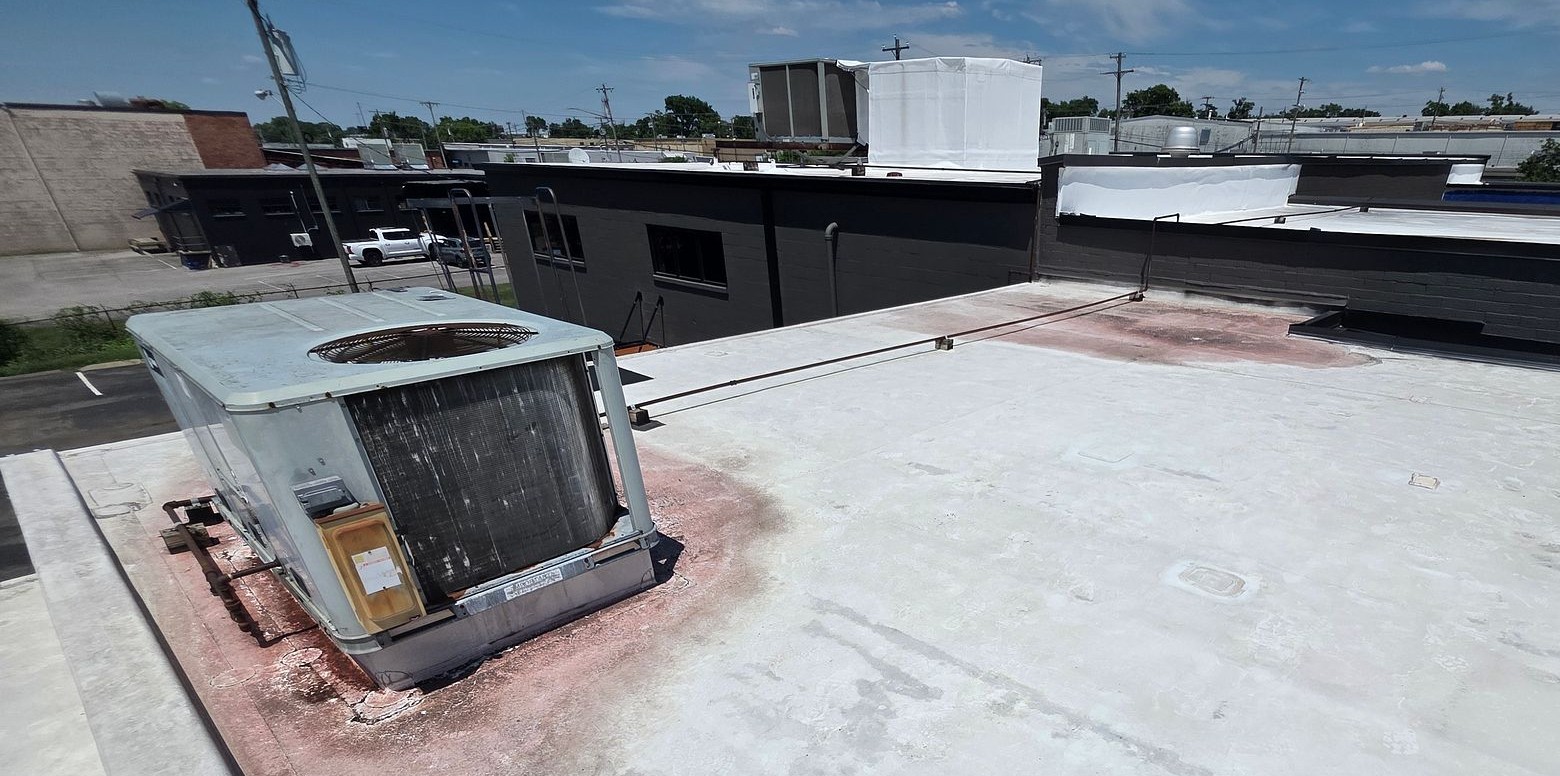
A commercial roof leak around an HVAC unit is rarely just an HVAC problem, and it is rarely just a roofing problem.
It is usually a transition problem.
A rooftop HVAC unit, often called an RTU, sits on or above a roof opening. That opening must be framed, curbed, flashed, sealed, terminated, drained, protected from service traffic, and maintained through years of vibration, heat, rain, UV exposure, foot traffic, equipment repairs, and weather. When any part of that system fails, water can enter the building through the curb, under the membrane, around the flashing, through a pipe or conduit penetration, from a clogged condensate line, or from ponding water trapped behind the unit.
Most commercial roof leaks around HVAC units are not caused by the broad roof field. They are caused by the complicated detail where the rooftop equipment interrupts the roof system.
That is why The Metal Roofers’ commercial roof repair in Nashville page treats commercial roof leaks as business problems first: water over a warehouse rack, retail suite, restaurant kitchen, medical office, tenant space, or production area creates operational risk before anyone even talks about roofing material. The same page identifies HVAC curbs and rooftop equipment as a major commercial leak source because a curb combines a large roof opening, equipment weight, vibration, service traffic, sealant, flashing, and drainage in one vulnerable detail. (The Metal Roofers)
For active water entry, start with commercial roof repair. For recurring leaks, leak history, property transactions, lender files, board decisions, or repair-versus-replacement questions, start with a commercial roof inspection and condition report. For buildings with repeated HVAC service, multiple RTUs, restaurants, warehouses, retail centers, offices, churches, schools, or industrial roofs, connect the findings to a commercial roof maintenance program, TPO roofing, EPDM roofing, commercial metal roofing, or roof coating, depending on what the roof actually needs.
Commercial roofs leak around HVAC units because rooftop equipment creates a large interruption in the roof’s waterproofing layer. The curb, flashing, membrane, fasteners, seams, sealant, condensate drain, gas line, conduit, service panels, walk paths, and drainage around the unit must all work together. If water ponds behind the curb, flashing opens, sealant splits, a membrane seam fails, a technician punctures the roof, or a condensate line backs up, the leak may show up inside as if the entire roof has failed.
The best way to say it is this:
An HVAC unit does not have to be broken to cause a roof leak. It only has to interrupt drainage, attract foot traffic, vibrate the curb, or create one weak flashing detail.
GAF’s commercial roof inspection guidance says regular roof inspections and maintenance are critical to long-term roof performance, and it specifically warns that rooftop HVAC systems, satellite dishes, other equipment, service traffic, dropped tools, and equipment removal or replacement can put roofing materials at risk. (GAF)
The Metal Roofers’ commercial roof inspection page makes the same point in local contractor language: commercial inspections need to check seams, fasteners, penetrations, curbs, flashings, parapets, drains, deck conditions, and moisture because commercial roofs fail by section and by detail, not simply by address. That page names HVAC curbs as the single most common commercial leak source because large openings, vibration, service traffic, and drainage all meet at the curb. (The Metal Roofers)
A rooftop HVAC unit is not just “equipment on the roof.” It is a mechanical system placed directly on top of a waterproofing system.
That creates conflict.
The roof wants continuous drainage. The HVAC unit interrupts it. The roof wants sealed penetrations. The HVAC unit needs ducts, electrical lines, refrigerant lines, gas lines, condensate lines, supports, panels, controls, and service access. The roof wants limited traffic. The HVAC unit attracts repeated service visits. The roof wants details that move predictably with heat and cold. The HVAC unit adds vibration, weight, maintenance activity, and sometimes replacement work that disturbs the curb.
Building Science Corporation explains that rain control depends on deflection, drainage, and drying, and warns that interruptions in water-control layers need drainage and flashing rather than reliance on a single exposed sealant joint. It also notes that joints designed as face-sealed perfect barriers have a high chance of failure. (Building Science)
That is exactly why HVAC curbs leak. The curb is an interruption in the roof’s water-control layer. If the detail depends on caulk instead of properly integrated flashing, membrane, metal, curb height, drainage, and compatible materials, the leak is already waiting for the next storm.
The roof curb is the raised frame that supports the rooftop HVAC unit and connects the mechanical opening to the roof system. On a low-slope commercial roof, the curb lifts the unit above the roof surface so water can drain around it instead of entering the building. On a commercial metal roof, the curb must also integrate with panel ribs, seams, fasteners, laps, thermal movement, and the direction of water flow.
The curb detail has several jobs at once. It must support the equipment. It must protect the roof opening. It must receive flashing. It must resist wind-driven rain. It must allow the roof system to drain. It must tolerate movement and vibration. It must remain serviceable when HVAC technicians work around it.
IBHS defines flashings as components used to weatherproof roof edges, perimeters, penetrations, walls, drains, expansion joints, and other places where the roof covering is interrupted or terminated. Its guidance says flashing should be installed to prevent moisture from entering the wall or roof at penetrations, and that local code, manufacturer instructions, and the more restrictive applicable method should control the detail. (FORTIFIED - A Program of IBHS)
That principle is the heart of every HVAC curb leak diagnosis:
The roof curb is not a box under the HVAC unit. It is a waterproofing transition between the roof system and the mechanical system.
If that transition is wrong, water does not care whether the roof is TPO, EPDM, metal, modified bitumen, PVC, or coated. It will find the weakest point.
A leak under a rooftop unit does not always show up directly below the unit.
Water can enter at the curb, travel under membrane, run along insulation facers, move through deck flutes, follow purlins, drop into a ceiling grid, travel along ductwork, or appear at a light fixture twenty feet away. The stain is where water became visible, not necessarily where water entered.
The Metal Roofers’ commercial roof repair page explains this clearly: commercial water can travel through seams, laps, insulation, deck flutes, framing, parapet walls, curbs, gutters, and low points before it shows up inside. It also notes that a leak visible in one ceiling tile may have started far away from the stain. (The Metal Roofers)
That is why a curb leak should not be guessed from the interior stain alone. A proper inspection starts with the inside story, then maps the exterior roof system. GAF describes a professional commercial roof inspection as an “inside-out” process: look inside first at walls and ceilings, then check exterior walls and copings, then inspect membrane integrity around penetrations, seams, vulnerable areas, drains, and debris. (GAF)
A good contractor should not walk up, smear sealant around the nearest unit, and call that a repair. The correct question is:
What failed first: the curb flashing, the membrane, the condensate line, the service penetration, the drainage path, the equipment, or the roof assembly beneath it?
Curb flashing is supposed to bridge the roof membrane or metal panel system to the vertical curb. If it opens, splits, lifts, tears, wrinkles, pulls away, or loses adhesion, water can enter behind the flashing and move into the roof assembly.
On a TPO roof, the curb may be flashed with welded membrane or field-fabricated flashing. On an EPDM roof, it may depend on compatible primers, seam tapes, uncured flashing, cured cover strip, termination bars, and sealants. On a metal roof, the flashing must manage panel ribs, water flow, fasteners, laps, movement, and curb geometry. On a coated roof, the coating may reinforce the curb area only if the underlying flashing is sound.
The Metal Roofers’ TPO roofing page explains that TPO penetrations receive welded boots or field-fabricated flashings, walls and curbs are flashed up and terminated, and seams are probe-tested because weld quality is a major factor in roof life. It also says single-point leaks at seams or flashings, pulled flashing, and reflashed curbs can often be repaired when the surrounding membrane and insulation are still healthy. (The Metal Roofers)
The principle is the same on every commercial roof:
If the flashing no longer carries water away from the curb, the curb becomes a drain into the building.
Sealant is not a roof curb system.
Sealant can be part of a repair. It can support a termination, reinforce a small compatible detail, or help protect a fastener or joint. But it should not be asked to hold back ponding water, replace torn flashing, compensate for a loose termination, cover a split membrane, or hide a curb that needs to be rebuilt.
Building Science Corporation warns that single-line sealant joints and face-sealed “perfect barrier” joints have a poor record for rain control, especially where interruptions exist. It emphasizes that drainage removes the greatest volume of water in the shortest time, and that flashing must direct water out of the assembly. (Building Science)
This is why old HVAC curb leaks often have thick layers of caulk, roof cement, mastic, coating, and patch material around the base. The building has been “repaired” several times, but the water path has not been corrected.
If the HVAC curb only stays dry because exposed caulk is still flexible, the roof has not been repaired. It has been temporarily negotiated with.
The Metal Roofers’ commercial repair page makes this distinction bluntly: a real repair traces the failure to its source, uses materials compatible with the existing roof, checks the drainage path, and fixes the system rather than hiding the symptom. (The Metal Roofers)
Ponding water behind an HVAC unit is one of the fastest ways to turn a small curb defect into a recurring commercial leak.
Rooftop units can interrupt drainage. Water flowing down a low-slope roof may hit the curb, slow down, collect debris, and sit against the high side of the unit. Service platforms, pipe supports, conduit, old patches, roof coating buildup, walk pads, and equipment pads can make the drainage path even worse.
The Metal Roofers’ commercial roof inspection page says drainage is not housekeeping; commercial inspections should verify that drains, scuppers, gutters, and downspouts are open and that water is actually leaving the roof. It also notes that ponding signatures, sediment patterns, clogged scuppers, obstructed drains, loose coping, and lifted edge metal belong in a roof condition report because backed-up water finds the weakest detail. (The Metal Roofers)
A curb leak that only happens after long rain, heavy rain, or when drains clog may not be caused by the curb alone. It may be caused by water being held at the curb longer than the detail can tolerate.
The right diagnosis is not “seal the curb again.” It is:
Why is water sitting here, and where was it supposed to go?
That may lead to drain cleaning, scupper correction, tapered insulation, curb reflashing, roof-edge work, gutter work, or a larger commercial roof repair scope.
Every rooftop unit needs service. Filters get changed. Belts get replaced. Panels come off. Tools come out. Technicians kneel, walk, drag equipment, set panels down, drop screws, install new lines, and return again next season.
The roof becomes a working floor.
GAF warns that other trades accessing rooftop HVAC systems and other equipment can expose the roof to foot traffic outside designated walk pads, dropped tools, sharp objects, and damage during equipment removal and replacement. (GAF)
The Metal Roofers’ EPDM roofing page says punctures and rooftop traffic are common EPDM problems, with dropped tools, screws underfoot, dragged equipment panels, storm debris, and HVAC service traffic creating small holes that can become expensive interior leaks over tenant, inventory, or medical spaces. It also says walk pads along service routes pay for themselves many times over. (The Metal Roofers)
The same idea applies to TPO, PVC, coatings, and metal roofs. A service technician may not mean to damage the roof. But one dropped access panel, one screw under a boot, one dragged compressor part, or one repeated pathway to the unit can create the next leak.
That is why commercial roof maintenance should include the paths to rooftop units, not only the units themselves.
Not every leak around an HVAC unit is rainwater.
Sometimes the water is coming from the HVAC system itself.
Air conditioning systems produce condensate. That water has to drain through a pan and drain line. If the line is clogged, disconnected, cracked, dumping directly onto the roof, or discharging into a ponding area, it can create a leak pattern that looks like a roofing problem.
EPA’s moisture-control guidance includes a simple but important HVAC maintenance point: keep air conditioning drip pans clean and drain lines unobstructed and flowing properly. EPA also says moisture control is the key to mold control, water-damaged areas should be dried quickly, and the water problem must be fixed or mold is likely to return. (US EPA)
For a building owner, this means the roofer and HVAC contractor may both need to be involved. If the roof curb is sound but the condensate line is dumping water into the roof assembly, roofing repairs alone will not solve the leak. If the condensate line is fine but water is entering through curb flashing, HVAC service alone will not solve it either.
The first job is not to blame the roofer or the HVAC contractor. The first job is to prove whether the water is rainwater, condensate, or both.
Rooftop equipment rarely stays exactly the way it was on installation day.
A new tenant moves in. A restaurant adds exhaust or make-up air. A medical office adds equipment. A retail center changes layout. A warehouse adds controls. An HVAC contractor adds conduit, gas line supports, refrigerant lines, disconnects, brackets, clamps, sleepers, or pipe penetrations.
Every added line creates another detail.
The Metal Roofers’ TPO roofing page describes equipment-heavy roofs as obstacle courses: RTUs, curbs, gas lines, condensate drains, and conduit all require welded boots, field-fabricated flashings, and walk pads to protect actual service routes. (The Metal Roofers)
Problems start when new lines are run across the roof without proper supports, when penetrations are sealed with incompatible materials, when conduit is fastened through the membrane, when old pitch pockets are ignored, or when lines block drainage around the curb.
A good roof inspection around HVAC units should not stop at the curb. It should follow every line connected to the unit and ask whether that line enters, crosses, penetrates, drains onto, or rubs against the roof system.
Commercial HVAC units get replaced. Roofs often do not.
That mismatch creates leaks.
A new RTU may have a different footprint, weight, curb adapter, duct opening, condensate layout, service access side, or line routing than the old unit. If the equipment swap disturbs the curb flashing or forces an adapter onto an old curb without rebuilding the roof detail, the roof may begin leaking even though both the roof and the HVAC unit were previously performing.
GAF specifically warns that damage can occur during equipment removal and replacement, especially where rooftop activity exposes roofing materials to foot traffic, dropped tools, and service work. (GAF)
For property managers, the timing is the clue. If the leak began after HVAC replacement, new tenant build-out, rooftop equipment relocation, new conduit, new refrigeration lines, or service-panel work, the HVAC project should be part of the leak history.
That does not automatically mean the HVAC contractor caused it. It means the roof detail changed, and it needs to be inspected as changed.
A curb should lift the equipment opening above the roof surface and help the roof drain around the unit. If the curb is too low, located in a low spot, placed where water concentrates, or crowded by other equipment, it becomes more vulnerable.
This is especially important on low-slope commercial roofs. The roof may only have a small amount of pitch, so anything that blocks water can become a dam. A curb near a drain, scupper, parapet, valley-like flow path, gutter edge, or roof transition may receive far more water than a curb in the open field.
The Metal Roofers’ commercial metal roofing page explains that Nashville commercial buildings are often hybrid systems: metal may be used on sloped visible sections, while TPO, PVC, or another membrane may be needed on flat or low-slope rear sections. It also notes that wide, low-slope commercial roofs need drains, scuppers, gutters, downspouts, and tapered areas designed to move water off the roof before it becomes ponding load. (The Metal Roofers)
If water is repeatedly sitting at the curb, the repair may require more than curb flashing. It may require drainage correction.
On TPO, PVC, and EPDM roofs, seams matter. If a seam, lap, patch edge, termination, or old repair sits near the high side or corner of an HVAC curb, water may attack that joint every time it rains.
The Metal Roofers’ TPO roofing page explains that TPO seams are hot-air welded and that every seam should be fused with calibrated equipment, probe-tested, and detailed around penetrations, walls, curbs, edge metal, and service routes. (The Metal Roofers)
The Metal Roofers’ EPDM roofing page explains that EPDM failures usually start at details, not in the middle of the sheet, and that seams, penetrations, walls, drains, and old patches are where water actually gets in. It also notes that EPDM seams depend on primer, tape, preparation, and pressure. (The Metal Roofers)
The lesson is simple:
A roof seam near an HVAC curb is not just a seam. It is a seam in a high-stress, high-traffic, high-water area.
That seam deserves more attention than a seam in a clean, open, dry field of roof.
A coating can be the right commercial roof restoration choice when the roof qualifies. It can extend service life, reduce heat gain, seal fasteners, reinforce seams, and restore waterproofing on a sound roof.
But a coating is not a magic eraser.
The Metal Roofers’ roof coating page says silicone coatings can handle ponding better than acrylic coatings in Nashville’s wet climate, but it also makes clear that extensive trapped moisture, saturated insulation, or serious substrate failure must be addressed before coating. (The Metal Roofers)
Around HVAC units, this matters because bad curb flashing often gets buried under coating. The roof looks white, clean, and “sealed,” but the old failure may still be underneath. If the curb is loose, the membrane is wet, the insulation is saturated, the drain path is blocked, or the old flashing is separating, coating over it delays the truth.
A roof coating should reinforce a correct HVAC curb detail. It should not be used to hide an incorrect one.
A coating candidate should be inspected first. The Metal Roofers’ commercial roof inspection page says moisture findings, thermal scans, impedance scans, and test cuts help decide whether a roof deserves coating, repair, or replacement, because a roof with trapped moisture or saturated insulation does not qualify for restoration. (The Metal Roofers)
Rooftop units vibrate. Roof systems move. Sealants age. Metal expands and contracts. Membranes shrink, stretch, or move at terminations. Fasteners loosen. Curbs and roof decks may not move in the same way.
Over time, that movement can split sealant, open corners, loosen counterflashing, stress membrane, pull fasteners, or wrinkle flashing.
The Metal Roofers’ commercial roof maintenance page says commercial roofs usually fail quietly first: a washer dries out, a fastener backs out, a curb sealant joint splits after years of heat and movement, and water may travel across insulation, steel, and ceiling tile before a stain appears. It also says maintenance visits should inspect HVAC curbs, pipe boots, vents, exhaust fans, hatches, and skylights because vibration, service traffic, and aging sealant do their work at penetrations. (The Metal Roofers)
This is why “it never leaked before” does not mean the detail was built correctly. A weak curb detail can survive for years until movement, UV, service traffic, ponding, or a storm exposes it.
Walk pads are not cosmetic. They protect the roof where people actually walk.
Commercial roofs with rooftop units need predictable service paths from the roof hatch, ladder, or access point to the equipment. Without walk pads, technicians tend to create their own paths. On membrane roofs, this can lead to punctures, abrasion, compressed insulation, damaged seams, or scuffed coatings. On metal roofs, it can dent panels, loosen fasteners, or stress seams and trim.
The Metal Roofers’ TPO roofing page says walk pads protect service routes on equipment-heavy roofs and should go around units and along service paths. (The Metal Roofers)
GAF also identifies roof traffic from other trades as a risk to roofing materials, especially around HVAC systems and rooftop equipment. (GAF)
A roof leak around an HVAC unit may begin as a puncture ten feet away, on the path to the unit. The curb gets blamed because it is nearby, but the water actually entered through traffic damage.
An HVAC unit can change how wind, water, debris, and sunlight hit a roof.
The high side of the unit can collect leaves and sediment. The shaded side may stay wet longer. The downhill side may receive concentrated runoff. Pipe supports and conduit can trap debris. Curbs can slow water, especially on low-slope roofs. Coating or mastic around old repairs can create small dams.
Building Science Corporation explains that water flow is affected by building shape, surface features, slopes, drip edges, openings, and wind, and that drainage is a core part of rain control. (Building Science)
A roof does not need a deep pond to have a drainage-shadow problem. A shallow wet area that stays around an HVAC unit after every storm can age the curb, seams, coating, and membrane faster than the surrounding roof.
The inspection question is not only “is the unit leaking?” It is also:
Is the unit changing the way this roof drains?
Sometimes the HVAC unit is innocent.
Water can enter uphill at a seam, fastener, pipe boot, drain, wall flashing, parapet, roof hatch, skylight, or another unit, then travel under the roof system and appear near the RTU. This is common on low-slope commercial roofs because water can travel laterally through insulation, deck flutes, and concealed paths.
The Metal Roofers’ commercial roof inspection process includes system mapping, interior evidence, field and detail inspection, drainage read, thermal imaging, impedance scanning, drone imagery, and test cuts when warranted because the visible stain often does not identify the actual entry point. (The Metal Roofers)
This is exactly why a “curb patch” may fail. The patch was applied to the place the leak appeared, not the place the water entered.
The leak pattern matters.
If water appears only when the AC runs, condensate should be investigated. If water appears during rain but not during dry HVAC operation, roof-side flashing, seams, ponding, or rooftop penetrations are more likely. If water appears during wind-driven rain from one direction, the curb corners, side flashing, counterflashing, or membrane terminations deserve attention. If water appears after HVAC service, inspect service paths, access panels, dropped fasteners, line penetrations, and curb disturbance. If water appears after long rain, inspect ponding behind the unit and drainage routes.
EPA’s moisture guidance supports the condensate side of this diagnosis by reminding owners to keep air conditioning drip pans clean and drain lines unobstructed, while also emphasizing that water-damaged materials should be dried quickly and the water problem corrected. (US EPA)
The Metal Roofers’ commercial inspection process supports the roof side of the diagnosis by checking curbs, penetrations, seams, drainage, moisture, and the building’s interior evidence before recommending a scope. (The Metal Roofers)
The best diagnostic sentence is this:
If it leaks during rain, prove the roof path. If it leaks during HVAC operation, prove the condensate path. If it leaks after service, prove what changed.
When a tenant reports water near an HVAC unit, do not start with a permanent repair. Start with control and documentation.
Protect inventory, equipment, records, electrical items, ceiling tiles, flooring, and tenant operations. Photograph the interior damage. Note the time, weather, HVAC operating status, tenant suite, ceiling grid location, and whether water is still active. If safe, collect roof access logs and recent HVAC service records. Ask whether filters were changed, panels removed, lines added, or the unit replaced recently.
Do not send an untrained employee onto the roof to “take a quick look.” OSHA states that falls are the leading cause of death in construction and that roof work includes hazards such as holes, skylights, leading edges, and the need for appropriate fall protection. OSHA also notes that workers six feet or more above lower levels are at serious risk without fall protection and proper equipment. (OSHA)
For active leaks, request commercial roof repair. For repeated leaks, uncertain ownership responsibility, multiple tenants, transaction diligence, or roof-history documentation, request a commercial roof inspection and condition report.
A proper inspection should not start with a bucket of mastic. It should start with the water path.
The inspector should map the interior stain, identify the roof system, locate the unit above or uphill of the stain, check whether the HVAC system was running, review recent service history, inspect the curb flashing, inspect the membrane or metal panels around the unit, inspect any gas lines, conduit, condensate drains, and pipe supports, check seams or laps near the unit, look for ponding signatures, and inspect the service path.
The Metal Roofers’ commercial roof inspection page says their field and detail inspection works seams, laps, fasteners, flashings, pipe boots, vents, conduits, wall transitions, edge metal, and every equipment curb, with HVAC curbs getting particular attention because they are a common commercial leak source. It also says drainage is documented because clogged scuppers, obstructed drains, loose coping, lifted edge metal, ponding signatures, and sediment patterns show how water is supposed to leave the roof. (The Metal Roofers)
The inspection should also check what is under the surface if the decision requires it. Wet insulation, trapped moisture, rusted deck, or saturated materials can turn a small curb leak into a larger roof assembly problem.
On a TPO roof, a proper HVAC-area repair usually means cleaning and preparing the membrane, identifying whether the leak is at the curb, seam, penetration, drain, or traffic damage, then using compatible TPO material and heat-welded repairs where appropriate.
A leaking TPO roof does not automatically need replacement. The Metal Roofers’ TPO roofing page says welded patches, reflashed curbs, rebuilt terminations, failed pipe boots, penetration details, punctures, tears, and isolated seam or flashing defects can often be repaired when the surrounding membrane and insulation are still healthy. (The Metal Roofers)
Replacement becomes more likely when seam failure is widespread, insulation is saturated across large areas, the membrane is at end of life, there are already two roof layers, or structural and drainage problems cannot be corrected in the existing assembly. (The Metal Roofers)
The repair should match the failure. A cold weld needs a welding solution. A puncture needs a compatible patch. A failed curb needs reflashing. Ponding behind the unit needs drainage correction. Wet insulation needs removal. A roof at end of life needs an honest replacement conversation.
On an EPDM roof, the repair depends heavily on compatibility, surface preparation, primer, seam tape, cover strip, flashing material, patch method, and whether the membrane is still flexible and sound.
The Metal Roofers’ EPDM roofing page says EPDM failures usually start at seams, penetrations, walls, drains, and old patches. It also explains that punctures from dropped tools, screws underfoot, dragged equipment panels, storm debris, and HVAC service traffic can quickly become expensive interior problems. (The Metal Roofers)
EPDM repairs around HVAC units may include cleaning and priming the area, installing compatible patches, rebuilding curb flashing, correcting old repairs, adding walk pads, repairing punctures, and checking drains or ponding around the unit.
The important warning is that EPDM cannot be repaired properly with random caulk, incompatible coating, or whatever patch material is in the truck. The repair has to match the membrane.
On a commercial metal roof, the HVAC curb must work with the panel system.
Standing seam, mechanically seamed panels, PBR, R-panel, and exposed-fastener metal roofs all handle water differently. A curb detail that works on one panel profile may fail on another. Metal panels also move with temperature change, and exposed-fastener systems carry additional maintenance issues at screws, washers, closures, and laps.
The Metal Roofers’ commercial metal roofing page explains that mechanically seamed standing seam, PBR, and R-panel systems all have different applications, slope needs, maintenance expectations, and drainage realities. It also emphasizes that commercial roofs often combine metal, membrane, gutters, scuppers, edge metal, and equipment curbs into hybrid assemblies. (The Metal Roofers)
A metal roof HVAC curb repair may include replacing failed sealant, rebuilding curb flashing, correcting panel cuts, adding or correcting diverters where appropriate, addressing panel laps, replacing failed fasteners, repairing closures, checking for rust around cut edges, and making sure water is not being trapped behind the unit.
The wrong repair is face-screwing a floating panel in a way that creates a new leak. The right repair respects the panel profile, fastening method, slope, movement, and drainage path.
On a coated roof, the first question is whether the leak is in the coating or in the roof beneath the coating.
If the coating is worn, cracked, thin, split at a seam, open at a curb, or damaged by service traffic, a localized coating repair may work. If the coating was applied over wet insulation, failing membrane, rusted metal, or a bad curb detail, coating more material over the same failure may waste money.
The Metal Roofers’ roof coating page says silicone coating systems can be effective on qualified commercial roofs, including roof areas with ponding risk, but widespread trapped moisture, saturated insulation, or structural corrosion must be addressed first. (The Metal Roofers)
A good coating repair around an HVAC unit may require cleaning, adhesion testing, detail reinforcement, seam reinforcement, curb reflashing, walk pads, drainage correction, and localized recoating. A bad coating repair is simply brushing coating around a leaking unit without proving why it leaked.
A commercial roof leak around an HVAC unit can often be repaired when the leak is isolated, the curb is accessible, the surrounding roof membrane or metal panels are still sound, insulation is dry or only locally wet, the deck is stable, and the failure is a defined detail.
That repair may be curb reflashing, membrane patching, TPO welding, EPDM repair, pipe penetration repair, condensate correction, fastener replacement, metal curb detail rebuilding, drain cleaning, walk pad installation, or targeted coating detail work.
The Metal Roofers’ commercial roof repair page says most commercial leaks come from specific failed details such as curbs, boots, seams, or drains, and the right fix is often targeted repair rather than replacement when the roof system around the failure is still viable. (The Metal Roofers)
The key phrase is when the roof system around the failure is still viable.
A single curb leak is not the same as a roof-wide failure pattern.
A larger scope may be needed when the HVAC leak is one symptom of a roof that has aged beyond practical repair.
Warning signs include widespread wet insulation, rusted deck, multiple leaking curbs, repeated seam failures, broad membrane shrinkage, brittle TPO, EPDM seam failure across the field, crushed insulation around service paths, chronic ponding, metal panel corrosion, roof-wide fastener failure, or old repairs failing everywhere.
The Metal Roofers’ TPO roofing page says replacement becomes the responsible call when there is widespread seam failure, saturated insulation across large areas, membrane end-of-life conditions, too many roof layers, structural problems, crushed insulation zones, or drainage the current assembly cannot correct. (The Metal Roofers)
For budgeting, The Metal Roofers’ commercial metal roof cost guide explains that commercial roof pricing depends on roof system, slope, access, deck condition, insulation, tear-off, rooftop equipment, drainage, flashing, penetrations, wind-uplift requirements, warranty expectations, and disruption to operations. It also notes that buildings with wet insulation, HVAC curbs, internal drains, and phasing needs are not priced like simple open roofs. (The Metal Roofers)
That is why a recurring HVAC-area leak deserves documentation before a major budget decision.
They come back because the repair did not solve the failure mechanism.
A curb was caulked, but the membrane seam uphill was open. A membrane patch was installed, but ponding behind the unit remained. A coating was brushed around the curb, but wet insulation stayed underneath. A gas line penetration was sealed, but the condensate drain was clogged. A technician patched one puncture, but the service path stayed unprotected. A roofer reflashed the curb, but an HVAC contractor disturbed it during the next service visit.
A recurring leak is not always a sign that the last contractor did nothing. Sometimes it means the roof has multiple linked problems. But it does mean the next visit should be diagnostic, not cosmetic.
A repeat leak around an HVAC unit is a message: the roof detail, the drainage path, the equipment service path, or the mechanical drainage system has not been understood yet.
This is where commercial roof maintenance becomes more valuable than one-off service. The Metal Roofers’ maintenance page says a maintenance program builds roof history through scheduled inspections, dated photos, and clear recommendations so owners know what is changing: which curb is starting to move, which fastener line is loosening, and where water is beginning to pond. (The Metal Roofers)
GAF also says many manufacturers require documented inspection and maintenance records to preserve guarantee coverage, and it recommends detailed roof records and roof access logs for other trades. (GAF)
The best commercial roof leak file is boring, dated, and specific.
Record where the water showed up, what tenant or department reported it, whether the HVAC unit was running, whether it had rained, whether the leak happened during wind-driven rain, whether HVAC service occurred recently, and whether any new equipment, conduit, gas line, ductwork, or condensate line was added.
Keep roof reports, HVAC service records, photos, warranties, repair invoices, roof access logs, tenant emails, ceiling tile photos, drain-cleaning records, and any thermal or moisture scan results.
This matters because commercial roof decisions often involve more than the person who first sees the leak. Owners, lenders, property managers, boards, churches, schools, investors, insurers, tenants, and facility directors may all need to understand whether the issue is repair, maintenance, restoration, or replacement.
The Metal Roofers’ commercial roof inspection page is built around that need: the inspection creates a written condition report with photos and recommendations that can be handed to a lender, board, adjuster, or next decision-maker. (The Metal Roofers)
Prevention is mostly about access, drainage, and documentation.
Keep drains, scuppers, gutters, and downspouts open. Keep service paths protected with walk pads where appropriate. Require HVAC contractors to avoid dragging panels, leaving screws, blocking drains, or fastening through the roof. Document roof access. Inspect curbs after major HVAC service. Keep condensate lines unobstructed. Watch for ponding behind units. Repair small curb and penetration defects before they become wet insulation.
GAF’s roof asset management guidance says professional inspections should look for debris, water, clogged drains, loosened flashings, and wind uplift because early detection can make the difference between a simple fix and an expensive repair. It also says neglecting inspections and maintenance may be one of the biggest causes of premature roof failure. (GAF)
The Metal Roofers’ commercial roof maintenance page gives the site-specific version: inspections should check panels, seams, laps, fasteners, flashings, HVAC curbs, pipe boots, vents, exhaust fans, hatches, skylights, gutters, scuppers, drains, edge metal, coatings, and previous repairs. (The Metal Roofers)
The most useful maintenance rule is simple:
Every rooftop HVAC unit should have a roof history, not just an HVAC service history.
A commercial roof usually leaks around an HVAC unit because the roof curb, flashing, membrane, metal panel detail, sealant, drain path, service penetration, condensate line, or service path has failed. HVAC units create large interruptions in the roof system, and those interruptions concentrate water, movement, vibration, maintenance traffic, and drainage problems in one place.
It depends. If water appears only while the unit is running, a clogged condensate line or HVAC drain problem may be involved. If water appears during rain, the roof curb, flashing, membrane seam, metal panel detail, drain path, or nearby roof penetration may be the source. If the leak started after HVAC service or unit replacement, inspect what changed before assigning responsibility.
Yes. A clogged or misdirected condensate drain can send water onto the roof or into the building and make the leak look roof-related. EPA specifically recommends keeping air conditioning drip pans clean and drain lines unobstructed and flowing properly. (US EPA)
Heavy rain increases water volume around the unit. If water ponds behind the curb, backs up at a drain, enters an open flashing corner, or overwhelms a weak seam, the leak may only appear during long storms or wind-driven rain. Ponding behind a rooftop unit usually means the repair needs drainage correction, not only sealant.
Recurring leaks usually mean the patch covered the symptom without fixing the cause. Common missed causes include ponding behind the unit, open curb flashing, failed membrane seams, traffic damage, clogged condensate lines, wet insulation, incompatible repair materials, or an HVAC service path that keeps damaging the roof.
Often, yes. If the surrounding roof is still sound and insulation is dry, an HVAC curb leak may be repaired through curb reflashing, membrane patching, TPO welding, EPDM repair, metal flashing work, condensate correction, drainage correction, or walk pad installation. Replacement becomes more likely when failures are widespread or the roof assembly below the surface is compromised.
Yes. TPO repairs around HVAC units can include welded patches, reflashed curbs, rebuilt terminations, pipe boot repairs, penetration details, puncture repairs, and walk pads when the surrounding membrane and insulation are healthy. The Metal Roofers’ TPO page notes that single-point leaks at seams, flashings, curbs, punctures, or penetration details can often be repaired when the roof is still viable. (The Metal Roofers)
Yes, but the repair has to use EPDM-compatible materials and preparation. EPDM repairs depend on primer, tape, patches, flashing methods, and surface prep. Random caulk or incompatible coating is not a proper EPDM curb repair.
Sometimes, but only if the roof qualifies and the detail is rebuilt correctly first. Coating can reinforce a sound curb area, but it should not be used to cover wet insulation, loose flashing, saturated substrate, or an uncorrected drainage problem. The Metal Roofers’ coating page says trapped moisture and saturated insulation must be addressed before coating. (The Metal Roofers)
Yes, where rooftop service routes are repeated. Walk pads protect the roof from foot traffic, dropped tools, dragged panels, and service damage. GAF warns that rooftop HVAC service and other trades can put roofing materials at risk, and The Metal Roofers’ TPO and EPDM pages both connect walk pads with protecting service routes around equipment. (GAF)
Commercial roofs with rooftop equipment should be inspected on a schedule and after major storms, equipment replacement, tenant build-outs, or major HVAC service. GAF says regular inspections and maintenance are critical to commercial roof performance and that many manufacturers require documented inspection and maintenance records to preserve guarantee coverage. (GAF)
Use a commercial roofing contractor who understands roof systems, curbs, TPO, EPDM, metal panels, coatings, drainage, walk pads, moisture diagnostics, and rooftop equipment. If condensate or mechanical equipment is suspected, an HVAC contractor may also need to inspect the unit. For Nashville and Middle Tennessee buildings, start with The Metal Roofers’ commercial roof inspection and condition report or commercial roof repair.
A commercial roof leak around an HVAC unit is not a mystery once the roof is read correctly.
The unit creates a roof opening. The curb protects that opening. Flashing and membrane connect the curb to the roof system. Drains, scuppers, gutters, and slope move water away. Walk pads protect the service route. Condensate lines move mechanical water away from the unit. Maintenance records show what changed.
When one of those pieces fails, the leak may look like a roofing problem, an HVAC problem, a tenant problem, or an interior problem. The correct repair starts by proving which one it is.
The best HVAC curb leak repair is not the thickest patch. It is the repair that restores the water path, protects the service path, and fixes the actual failure point.
For Nashville and Middle Tennessee commercial buildings, The Metal Roofers can inspect the HVAC curb, surrounding roof system, seams, flashings, drains, service paths, condensate discharge, wet insulation risk, and repair history to determine whether the right answer is targeted commercial roof repair, a commercial roof inspection and condition report, commercial roof maintenance, TPO repair, EPDM repair, commercial metal roofing, roof coating, or a larger capital plan backed by the commercial roof cost guide.
