Metal Roofing Alliance Member
TVA Preferred Partners Network
10,000+ Metal Roof Jobs
Nashville, TN
Licensed & Insured
BBB A+

Open 8am–8pm
(615) 649-5002Schedule Your
Appointment
Appointment
✦ Reviewed by The Metal Roofers Technical Team
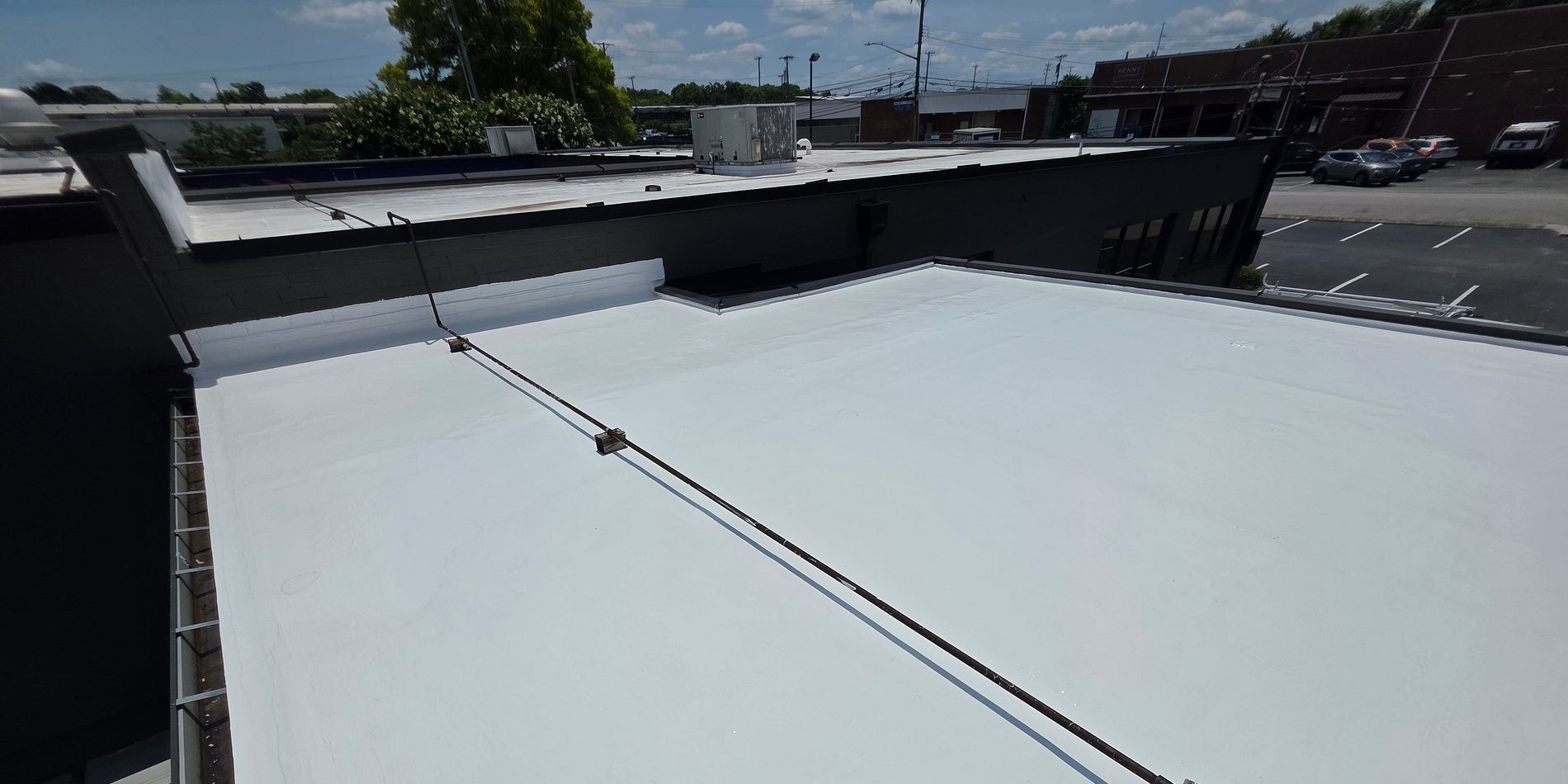
Commercial roof repairs in Nashville are generally deductible as repairs and maintenance, while a full roof replacement generally must be capitalized and recovered through depreciation. For most Nashville commercial building owners, the tax answer is not “yes or no,” but “which part of the project is a repair and which part is an improvement?” Under Treasury regulations, amounts paid for repairs and maintenance are generally deductible if they are not otherwise required to be capitalized. By contrast, amounts paid to better, adapt, or restore a building or building system generally must be capitalized and recovered through depreciation or another cost-recovery rule. The IRS’s own examples specifically say that replacing an entire roof is generally an improvement, while replacing only a worn roof membrane on an otherwise functioning building may, depending on the facts, avoid capitalization as a restoration.
That distinction matters because a deductible repair usually reduces taxable income this year, while a capitalized replacement is usually recovered over time. For federal tax purposes, nonresidential real property is generally depreciated over 39 years under GDS, while qualified improvement property is generally 15-year property if it meets the statutory definition. Roof work can also interact with Section 179, because IRS instructions confirm that certain improvements to nonresidential real property placed in service after the building was first placed in service, including roofs, can qualify as qualified Section 179 real property.
The current law landscape is also important. IRS guidance released after the One Big Beautiful Bill changed bonus depreciation so that certain qualified property acquired after January 19, 2025 can again receive 100% additional first-year depreciation, but bonus depreciation still generally applies only to property with a MACRS recovery period of 20 years or less. That means a typical 39-year commercial roof replacement is usually not bonus-eligible just because it is a roof replacement. However, some projects can be expensed under Section 179, and some interior buildout work may fall into QIP rather than roof replacement.
For Tennessee businesses, the state answer usually starts with the federal result and then asks whether Tennessee has decoupled or modified anything. Tennessee’s Department of Revenue says the excise tax computation starts with federal net income, and Tennessee currently states that federal Section 179 depreciation is deducted for Tennessee excise tax purposes to the same extent as on the federal return. Tennessee also says taxpayers may take federal bonus depreciation for assets purchased on or after January 1, 2023 for Tennessee excise tax purposes, while its 2025 franchise and excise instructions still require an addback for bonus depreciation on assets purchased on or before December 31, 2022.
For a Nashville owner of an office building, warehouse, retail center, church school building held in a taxable entity, mixed-use commercial building, or industrial property, the practical takeaway is simple: the invoice wording, scope of work, photos, consultant reports, moisture scans, and whether the building remained functional often determine the tax result. The IRS and AICPA materials both emphasize that facts and records drive the outcome.
The federal tax framework for commercial roofs runs through Internal Revenue Code Section 162, Treasury Regulation 1.162-4, and the capitalization rules of Section 263(a). That rule allows a current deduction for repairs and maintenance to tangible property if the amounts are not otherwise required to be capitalized. That means a roof expense is not automatically deductible just because it is called a “repair” on an invoice. The tax analysis always runs through the capitalization rules under Section 263(a) and the tangible property regulations.
The IRS’s business-expense guidance summarizes the rule in plain English. IRS Publication 535 explains that if an expenditure results in a betterment, restoration, or adaptation to a new or different use, it is generally capitalized. The same publication gives a roof-specific example: replacing an entire roof is listed as an improvement. It also says routine repair and maintenance costs that keep property in an ordinary, efficient operating condition are generally deductible.
For buildings, the regulations are more precise than many owners realize. In the improvement rules, a building is treated as a unit of property, but the regulations also break out certain building systems, including HVAC, plumbing, electrical, fire protection, security, and others, for separate analysis. The roof, however, is treated as part of the building structure, not as a separate building system. That matters because replacing a major component or substantial structural part of the building structure can trigger capitalization even if no separate building system is involved.
This is why the same roofing contractor can produce two very different tax outcomes on two otherwise similar Nashville buildings. A small leak repair on a functioning warehouse may be a current deduction. A tear-off and replacement of decking, insulation, membrane, coating, and trim on a midtown office may be a capital improvement. The tax issue is not the contractor’s label; it is the federal tax characterization of the work actually performed.
The IRS and Treasury use the BAR framework: betterment, adaptation, and restoration. If any one of those tests is met, the amount generally must be capitalized. Publication 535 and Treasury Regulation § 1.263(a)-3 both use that framework.
A betterment usually exists if the work fixes a pre-existing material defect, materially increases capacity or productivity, or materially increases strength, quality, or output. In roofing terms, moving from a shorter-life system to a materially superior one can be a betterment, especially if the project materially improves the building compared with its pre-project condition. The AICPA’s roof-cost guide uses examples like upgrading from asphalt shingles to clay tile as a likely betterment because it materially increases quality and expected performance.
An adaptation exists when the property is adapted to a new or different use. If a roof project is part of a larger change in how the property is used, such as a warehouse conversion, a major rooftop amenity conversion, or an addition that changes the structure’s use profile, the roof work may be drawn into capitalization even if some components look “repair-like” standing alone. The IRS’s regulations expressly state that adapting a building to a new or different use is an improvement.
A restoration is often the most important roof test. Treasury’s examples say that if a taxpayer replaces the entire roof, including decking, insulation, asphalt, and coatings, that replacement restores the building because the roof is both a major component and a substantial structural part of the building structure. That is the clearest roof-specific rule in the regulations, and it is why full commercial roof replacements are usually capitalized.
The same regulations also show the opposite result. In the IRS example involving a rubber roof membrane, the owner strips the original membrane and replaces it with a comparable new rubber membrane because the old membrane wore out and leaked, but the building remained functional. Treasury concludes that the replacement membrane does not by itself comprise a significant portion of the roof major component and does not comprise a substantial structural part of the building structure, so the expenditure is not required to be capitalized as a restoration under that specific theory. That example is one of the most important authorities for partial commercial roof work.
There are also three safe harbors that can matter at the margins. The de minimis safe harbor generally allows expensing of qualifying items up to $5,000 per invoice or item if the taxpayer has an applicable financial statement and written procedures, or $2,500 per invoice or item without an applicable financial statement if the other requirements are satisfied. The routine maintenance safe harbor can apply if the activity is recurring and the taxpayer reasonably expects to perform it more than once during the 10-year period after the building or building system was placed in service. The small taxpayer safe harbor for buildings can apply to qualifying taxpayers with average annual gross receipts of $10 million or less and eligible building property with unadjusted basis of $1 million or less, up to the lesser of 2% of basis or $10,000 of annual amounts paid on the building.
For many Nashville commercial owners, the key practical point is this: the tax law is evidence driven. The IRS practice unit on partial dispositions says the taxpayer bears the burden of showing what part of the building was disposed of and what records support that conclusion. The IRS recordkeeping guidance says your books must show income, deductions, and credits, and you must keep supporting documents such as invoices and related records.
Roof tax treatment depends on scope, since repairs that keep a roof working are generally deductible while betterments, adaptations, and restorations are generally capitalized. The scenarios below are a practical framework, not a substitute for CPA review. Nashville owners should read them as a first-pass screening tool before year-end planning or filing.
This is usually treated as a current deduction. These costs often keep the building in ordinary efficient operating condition and do not better, adapt, or restore the unit of property. The main authorities are § 1.162-4 and IRS Publication 535.
This is often treated as a repair, or at least not a restoration under the specific roof-membrane example, but the result is still facts-and-circumstances. Treasury’s Example 15 says replacement of the membrane alone is not a replacement of a major component or substantial structural part of the building structure. The main authority is Regulation § 1.263(a)-3, Example 15.
This is usually capitalized and depreciated. Treasury’s Example 14 says the entire roof is a major component and substantial structural part, so the expenditure is a restoration that must be capitalized. The main authority is Regulation § 1.263(a)-3, Example 14.
This is usually capitalized. Enlargement and adaptation to a new or different use are classic improvement triggers. The main authorities are IRS Publication 535 and Regulation § 1.263(a)-3.
This is usually capitalized with the related project. Indirect or related costs that directly benefit or are incurred by reason of an improvement generally follow the improvement. The main authorities are IRS Publication 535 and Regulation § 1.263(a)-3(g).
This is highly fact-specific. It may be deductible if it is closer to maintenance or preservation, but it may be capitalized if it materially upgrades, restores, or is part of a broader replacement. There is no simple IRS “coating rule” for all projects. The better question is whether the coating merely maintains the outer covering or instead materially improves life, quality, or scope. The membrane example and AICPA roofing guide support a facts-and-circumstances analysis rather than a blanket rule.
This is often capitalized. “Recover” is a roofing label, not a tax rule. If the project effectively restores a major component or is part of a larger improvement, capitalization is still likely. The main authorities are Regulation § 1.263(a)-3 and AICPA guidance.
The most useful question is not “Was there a tear-off?” It is “What part of the building structure was replaced, and did that replacement amount to a betterment, adaptation, or restoration?” The IRS does not let owners win or lose this issue based on industry jargon alone.
This is also where many owners miss the partial disposition election. If a full roof replacement must be capitalized, the IRS practice unit explains that a taxpayer may elect to recognize the disposition of a portion of a building, including structural components, by reporting the gain or loss on a timely filed original return for the year of the disposition. No separate election statement is required. That can matter because it may allow a write-off of the remaining adjusted basis in the old roof instead of leaving that basis buried in the building’s depreciation schedule.
The AICPA’s roofing guide reaches the same practical conclusion from a practitioner perspective: a roof system is a major component, but many projects replace only portions of the roofing assembly, so good facts, photos, and scope descriptions are essential. For Nashville owners managing portfolios of schools, churches, medical offices, or retail centers, that usually means retaining the proposal, the change orders, the manufacturer scope sheet, any core cut or moisture report, and pre- and post-work photos.
Capitalized roof work on a nonresidential building is depreciated over 39 years under GDS with the mid-month convention, or 40 years under ADS. IRS instructions for Form 4562 say nonresidential real property has a 39-year recovery period under GDS, and the mid-month convention applies. Publication 946 likewise states that nonresidential real property is 39 years under GDS and 40 years under ADS.
That long life is why owners naturally ask about Section 179. IRS instructions confirm that certain qualified real property can be treated as Section 179 property, including qualified improvement property and specified improvements to nonresidential real property placed in service after the building was first placed in service, including roofs, HVAC, fire protection and alarm systems, and security systems. The same instructions say that, for tax years beginning in 2025, the maximum Section 179 deduction in the current published instructions is $2,500,000, phased down when total qualifying property placed in service exceeds $4,000,000. Section 179 also interacts with a business-income limitation, and disallowed amounts can be carried forward.
Bonus depreciation is different. The current IRS guidance says the OBBB provides a permanent 100% additional first-year depreciation deduction for qualified property acquired after January 19, 2025, and the Form 4562 instructions say qualified property generally includes tangible property depreciated under MACRS with a recovery period of 20 years or less. That means a standard 39-year commercial roof replacement generally does not become bonus-eligible merely because bonus depreciation is back. Owners often confuse this point because Section 179 rules specifically name roofs, while bonus depreciation rules focus on recovery period and other eligibility requirements.
Qualified improvement property is a different category and often gets mixed up with roofs. Publication 946 and the Form 4562 instructions say QIP generally means an improvement to an interior portion of nonresidential real property placed in service after the building was first placed in service, excluding enlargement, elevators or escalators, and internal structural framework. The same IRS materials say QIP placed in service after 2017 is 15-year property. In plain terms, most roof replacements are not QIP because they are not interior improvements, but some related interior work done during a repositioning project could be.
Timing also matters. IRS accounting guidance says that under the cash method, expenses are generally deducted in the year paid, while under the accrual method, expenses are generally deducted in the year incurred. But that timing rule only helps if the cost is deductible in the first place. If the expenditure is a capital improvement, paying it in December does not turn it into a current repair. Instead, the cost becomes basis and is recovered under the applicable depreciation rules when placed in service.
For businesses that construct or produce significant improvements, there is one more layer: Section 263A. IRS instructions for Form 4562 say that if you are subject to the uniform capitalization rules, you may have to capitalize not only direct and indirect costs but also, in some cases, interest costs under Section 263A(f). Treasury’s interest-capitalization regulations also say improvements to designated real property generally constitute production of property, while repairs and maintenance described in § 1.162-4(a) are excluded from that treatment. In other words, if your Nashville project is a true capital improvement rather than a repair, financing costs may produce additional tax consequences beyond the roof invoice itself.
A repair or ordinary maintenance item is generally deducted in the year paid or incurred, depending on the taxpayer’s accounting method, if it is not otherwise required to be capitalized. The common code path is IRC § 162 and Regulation § 1.162-4. The typical recovery period is immediate because the expense is deducted currently.
A capitalized roof replacement is capitalized and depreciated. The taxpayer may also consider a partial disposition of the retired roof. The common code path is IRC § 263(a) and Regulation § 1.263(a)-3. The typical recovery period is usually 39 years under GDS for nonresidential real property, or 40 years under ADS.
Certain roof improvements may qualify for immediate expensing if the asset is qualified Section 179 real property and all other limits are met. The common code path is IRC § 179 and the Form 4562 instructions. The recovery is immediate to the extent allowed, with carryforward for disallowed amounts.
Interior nonresidential improvements that qualify as QIP are capitalized but treated as 15-year property under GDS. Bonus eligibility depends on applicable law and taxpayer facts. The common code path is IRC § 168(e)(6) and Publication 946.
Illustrative journal entries for commercial roof work are simplified book entries only, not tax reporting. Actual tax reporting may differ from financial statement treatment, especially where Section 179, bonus depreciation, or deferred taxes are involved.
The illustrative book entry is to debit Repairs & Maintenance and credit Cash or Accounts Payable. The likely tax treatment is a deduction under § 162 and Regulation § 1.162-4 if the work is not an improvement.
The illustrative book entry is to debit Building Improvements: Roof and credit Cash or Accounts Payable. The likely tax treatment is capitalization as a restoration and depreciation, often over 39 years for nonresidential real property unless another rule applies.
For book purposes, the entry may still look like a capital asset entry. For tax purposes, some or all of the cost may be expensed under Section 179 if eligibility and limits are met. This can create a book-tax difference.
The illustrative book entry may debit Insurance Receivable or Cash and credit Recovery or offset a loss, depending on the accounting framework. The tax result depends on adjusted basis, reimbursement, and whether gain is deferred under involuntary conversion rules.
Insurance changes the economics, but it does not erase the tax analysis. IRS Publication 547 says that for business or income-producing property, loss is generally measured from adjusted basis, reduced by salvage value and insurance or other reimbursement. The publication also states that if reimbursement exceeds adjusted basis, the taxpayer has a gain, and the taxpayer may have to recognize it or may be able to postpone it. The IRS’s involuntary conversion guidance similarly explains that an involuntary conversion occurs when property is destroyed or otherwise involuntarily disposed of and the owner receives money or other property, such as insurance proceeds.
That means a Nashville owner with hail, wind, tornado, or severe storm damage cannot simply assume the insurance-funded roof is “tax free” or “fully deductible.” If the old roof basis is low and insurance is high, there may be a gain issue. If the loss is uninsured or underinsured, there may be a business casualty loss. And if the replacement roof must be capitalized, the casualty event does not automatically turn the replacement into a current deduction. In fact, the AICPA roofing guide notes that if a casualty loss is properly deducted and basis reduced, the new roof cost must be capitalized.
Leasehold situations can be even trickier. IRS Publication 535 says that if a lessee adds buildings or makes permanent improvements to leased property, the lessee generally depreciates the improvement using MACRS over the appropriate recovery period rather than amortizing it over the remaining lease term. But the IRS practice unit warns that the lessee may not have a depreciable interest in the old building component owned by the lessor. The example given is direct: if the landlord owns the old HVAC and the tenant pays to replace it, the tenant cannot take a partial disposition on the landlord’s old HVAC because the tenant did not own that asset. The same ownership logic can apply to roof components on leased buildings.
Financing affects cash flow more than character. The tax classification of the roof still depends on whether the project is a repair or an improvement. For owners financing major fixed assets, SBA’s 504 loan program says it provides long-term, fixed-rate financing for major fixed assets, and SBA disaster assistance says physical damage loans can cover repairs and replacement of physical assets damaged in a declared disaster. If you finance a roof job, that does not by itself turn a capital improvement into a repair; it simply changes how the project is funded. Business interest expense may still be deductible, but the IRS says Section 163(j) can limit the amount deductible in a year, and Form 8990 is used to compute that limitation.
Energy incentives deserve a brief mention because owners often ask whether reflective roofs or insulation upgrades produce a separate deduction. The IRS still describes the Section 179D energy efficient commercial building deduction on its site, but the 2025 Form 7205 instructions state that the OBBB terminated the deduction for property the construction of which begins after June 30, 2026. So for projects already grandfathered or begun before that date, 179D may still matter. For later-starting projects, owners should not assume it is available.
The IRS does not prescribe a single perfect roof file, but it is clear that you must keep records that support your deductions, credits, basis, and depreciation. For roof projects, the documentation below is what usually makes the difference between a supportable repair position and a weak one. IRS recordkeeping guidance and the IRS practice unit on partial dispositions both strongly support this approach.
Keep the signed contract, proposal, and change orders showing the exact scope of work. Keep invoices broken out by membrane, insulation, deck, drains, flashings, penetrations, tear-off, crane, engineering, and temporary protection. Keep proof of payment with those records.
Keep pre-work inspection reports, infrared or moisture scans, core cuts, engineer or consultant reports, and photographs showing whether the building remained functional and what layers were replaced.
Keep insurance claim files, adjuster summaries, proof-of-loss submissions, and settlement statements, because reimbursement directly changes casualty and gain/loss calculations.
Keep fixed-asset ledgers, depreciation schedules, original placed-in-service dates, and prior capital project files, because those records are needed to evaluate partial dispositions and remaining basis.
Keep board minutes, owner approvals, or capital authorization memos that explain whether the work was ordinary maintenance, storm recovery, tenant improvement, repositioning, or part of a larger capital project. This is not an IRS-required formality, but it is often persuasive contemporaneous evidence. The value of contemporaneous records is consistent with IRS recordkeeping guidance and examiner practice.
Tennessee adds no special Nashville roof deduction, so the same federal repair-versus-improvement rules decide the tax treatment of a commercial roof project in Davidson County. For a Nashville building owner, the federal rules above are still the main event. There is no special “Nashville roof deduction” under federal law. What changes locally is the practical context: owners in Davidson County and the broader Middle Tennessee market often have projects caused by severe weather, hail, uplift, rooftop equipment traffic, deferred maintenance on older low-slope systems, and lease-driven replacement timing. Those facts matter because the IRS asks what happened to the building and whether the project is repair-like, casualty-related, or capital in nature.
At the Tennessee level, the Department of Revenue says the excise tax computation starts with net income reported on the federal return, with Tennessee-specific adjustments. Tennessee also states that federal Section 179 depreciation expense may be deducted for Tennessee excise tax purposes to the same extent as on the federal income tax return. For many Nashville LLCs taxed as corporations, S corporations, and partnerships subject to franchise and excise taxes, that means the federal roof classification usually drives the state starting point as well.
Bonus depreciation requires a more careful Tennessee check. Tennessee says taxpayers may take bonus depreciation deductions for assets purchased on or after January 1, 2023 for excise tax purposes if they take bonus at the federal level. But the 2025 Tennessee franchise and excise instructions still require an addback for certain bonus depreciation not permitted because of older Tennessee decoupling rules, and Tennessee has also issued a 2025 notice saying taxpayers cannot take bonus depreciation for qualified production property for Tennessee excise tax purposes. For a vanilla commercial roof job in Nashville, that qualified production property rule usually will not be the key issue. Still, larger industrial projects should be reviewed carefully.
Tennessee also imposes a franchise tax based on net worth and an excise tax based on taxable income. That does not change the repair-versus-capital analysis for the roof, but it does mean the state impact of an immediate deduction versus 39-year depreciation can be material for profitable local ownership entities.
If you own or manage a commercial building in Nashville and you are deciding how to treat a roof project, start with the actual scope of work. The tax analysis should begin with what was physically repaired, removed, replaced, restored, or upgraded, not with the contractor’s label.
If the project replaced the entire roof or a major structural part, the cost is usually capitalized as a restoration under Section 263(a). If the project only maintained the roof or replaced a limited outer layer, such as a membrane or comparable covering, analyze the work under the repair rules and the IRS roof-membrane example.
If the roof work was part of a larger expansion, repositioning, change in use, or other capital project, capitalization is usually more likely. If the work materially improved the roof’s quality, capacity, strength, or useful performance, capitalization is also usually more likely.
If the project does not clearly fall into a capital category, consider whether a safe harbor applies. The de minimis safe harbor, routine maintenance safe harbor, and small taxpayer safe harbor can matter, especially for smaller projects or recurring work.
If the project is capitalized, determine whether there is retired basis in the old roof that can be written off through a partial disposition election. Then evaluate whether Section 179 applies to the new roof improvement and model current expensing versus depreciation.
If insurance or a casualty event is involved, separately measure the reimbursement, adjusted basis, loss, gain, and possible Section 1033 deferral. After that, finalize the tax treatment and documentation file.
First, have your CPA or tax director read the full contract scope rather than the invoice total. The IRS and AICPA materials both show that the tax answer turns on what layers were replaced, whether the building stayed functional, and whether the roof work directly benefited another capital project.
Second, map the work into three buckets before year-end: clearly deductible repairs, clearly capital replacements, and gray-area items such as membrane-only work or coatings. Gray-area items are where documentation produces the highest return.
Third, if the project is capital, model Section 179 and partial disposition before filing. Section 179 can move the deduction forward for qualifying roofs, and a partial disposition may allow a write-off of the retired roof basis. Missing those elections or analyses can be expensive.
Fourth, if insurance is involved, do not stop at the contractor invoice. Reconcile the tax basis of the old roof, the reimbursed amount, the unreimbursed amount, and whether any gain deferral is available.
Ask these questions in writing and keep the answers in your tax file.
This question helps separate a limited membrane or outer-layer replacement from a full roof restoration. It also forces the analysis to focus on what was actually replaced.
This question matters because replacing a major component or substantial structural part of the building structure generally points toward capitalization.
If the answer is yes, the next question is how much can be expensed this year after the business-income limitation and other Section 179 constraints.
If the records are incomplete, ask what reasonable method can be used to establish basis.
This may apply to interior nonresidential improvements completed in the same job, but most roof replacements are not QIP because they are not interior improvements.
This question is especially important for larger improvement projects, financed projects, or projects that involve significant production or construction activity.
The federal result often drives the starting point, but Tennessee-specific rules can still affect the final state tax result.
Use the anchor text “commercial metal roof cost” to link to the Commercial Metal Roof Cost page.
Use the anchor text “commercial roof inspection” to link to the Commercial Roof Inspection page.
Use the anchor text “commercial roof replacement vs coating” to link to the Commercial Roof Replacement vs Coating page.
Use the anchor text “commercial roof repair” to link to the Commercial Roof Repair page.
Use the anchor text “commercial roof maintenance” to link to the Commercial Roof Maintenance page.
Usually no if it is a full replacement of the roof structure or a major part of it. Treasury’s roof example treats replacement of the entire roof as a capitalized restoration. A more limited membrane-only project may be different.
Often yes, at least potentially, because IRS instructions list roofs as qualified Section 179 real property when the improvement is made to nonresidential real property after the building was first placed in service. But all normal Section 179 limits still apply.
Not usually just because it is a roof. Bonus depreciation generally applies to qualified property with a MACRS recovery period of 20 years or less, while nonresidential real property is generally 39-year property.
Sometimes. A coating that functions more like maintenance or outer-layer preservation may support current deduction treatment, but a coating that materially improves the roof or is bundled into a broader capital project may need to be capitalized. The IRS has no universal “all coatings are deductible” rule; the outcome is fact-specific.
Possibly. If the new roof must be capitalized, you may be able to make a partial disposition election to write off the adjusted basis of the retired roof component, subject to record support and basis calculation.
Often as a starting point, yes. Tennessee says its excise tax starts with federal net income and that federal Section 179 depreciation is deducted for Tennessee excise tax purposes to the same extent as the federal return, subject to Tennessee-specific rules and adjustments.

Not sure when to replace your commercial roof? Learn three key factors that indicate it's time for a replacement
When a commercial roof starts showing wear, many assume replacement is the only fix, but that's not always the case.
5 best commercial metal roofing contractors in Nashville, with a deep dive on The Metal Roofers and how to choose the right crew for your building TN.