
Talk With A Metal Roof Expert
Call (615) 649-5002


.avif)
-min.avif)



.avif)
.avif)
.avif)
College Grove is not a typical suburban layout. Many houses are set back from the road, surrounded by pasture, tree lines, and long drives. Roofs are often fully exposed on at least one side. A house on a ridge above Horton Highway or Cox Road can feel every gust that comes through the valley, while a house tucked in a hollow along Flat Creek or Arno Allisona sits under trees that drop limbs, leaves, and debris into valleys year round.
You see several roof patterns here. Older farmhouses that have been expanded over time, with main gables, shed roofs, and porch roofs all layered together. Ranch style homes from earlier building waves, with wide hips or gables that face straight into prevailing wind. Newer estate homes and horse properties, with tall slopes, oversized gables, and attached garages or wings that create complex roof intersections.
Standard shingles can cover all of that. The problem is what happens after ten or fifteen years of College Grove wind, hail, and debris. Shingles start to curl and shed granules into the gutters. Valleys and lower roofs that take water from larger upper roofs develop chronic leak points. Any interior leak is more expensive here because it drops into custom spaces, wood ceilings, exposed beams, and high end cabinetry. Metal roofing gives you a longer term, more stable way to handle those forces while still keeping the house grounded in the landscape.
Most College Grove properties have more than one roof that matters. The main home, the working buildings, and the connector spaces all play a role in how the place looks and works.
The main home is where appearance and protection have to meet. For this roof we typically recommend standing seam or metal shingles. Standing seam suits homes where the roofline is a strong visual feature, such as modern farmhouses off College Grove Road, custom builds near Triune, or houses that sit above long drives with views across pasture. Metal shingles tend to fit restored farmhouses, traditional gable houses, and more classic country homes that need a traditional look with a longer lasting system behind it.
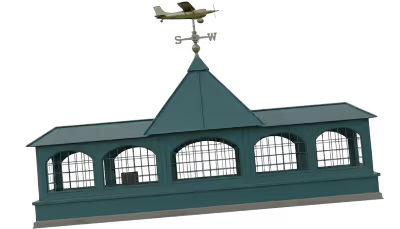
Working buildings include barns, horse arenas, tractor sheds, hay storage, and large shops. These structures need roofs that can handle foot traffic, ladders, the occasional bump from equipment, and large swings in temperature. Here, ribbed structural metal installed as a complete system almost always makes sense. We design these roofs with solid substrates or properly spaced purlins, underlayment where appropriate, closures at ribs, and trim that keeps wind driven rain out. That way you can move on those roofs when you are checking fans, antennas, or cupolas without worrying about cracking shingles underfoot.
Connector spaces and secondary roofs, such as breezeways between house and garage, long porches, lean to roofs off barns, pool houses, and detached guest spaces, should tie into the main roofing plan. When these smaller roofs are included in the metal layout instead of patched later with leftover shingles, water moves off the buildings more predictably and the whole property feels like one intentional design.
We start outside the house, looking at how your property sits in the land. A home near the top of a slope above Horton Highway sees very different wind than a home tucked into a low pocket near Flat Creek. We look at approach from the road, tree lines, fences, nearby barns, and how 840 or other open corridors might funnel storms across your place. We want to see the full picture before we make any decisions about panel profiles or colors.
On the roof and in the attic, we check how the current system has been performing. We walk the roof to look for loose shingles, soft spots, swollen decking, sagging lines, and multiple layers. From inside, we inspect the underside of the deck for staining, nail rust, and signs that water has been trying to find a way through. We pay close attention to valleys where upper roofs drain onto lower ones, porch tie ins that have been altered as additions were built, and chimney or wall flashings that have been coated multiple times instead of rebuilt. Those are the places that typically cause trouble.
We also ask how you use the property. Some College Grove owners commute into Nashville and need a roof that can handle storms while they are gone. Others run their work from home or the shop and need barns and outbuildings protected just as well as the house. You might have children moving between house and barn several times a day, older family living in an attached wing, or boarders using certain entry points. All of that shapes how we think about roof edges, porch coverage, and long term maintenance.
From this evaluation we put together a written plan that shows you:
You see your roof as a complete system designed for College Grove conditions, not just a price for metal panels.
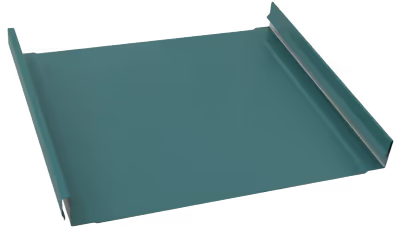
Standing seam is the long-panel, vertical rib profile most people picture when they think of high end metal roofing. Panels run from eave to ridge and lock together along raised seams that conceal fasteners. On College Grove homes with strong rooflines and open exposure, this system gives you a very durable, low maintenance shell that matches the scale of the building.
We frequently use standing seam on modern farmhouses and estate homes off College Grove Road, Arno Allisona Road, and Cox Road, and on houses that can be seen from 840 or from long approaches across pasture. For these roofs, we cut panels to fit each run, anchor them with concealed clips or fasteners that allow expansion and contraction, and close seams according to manufacturer guidelines for your slope and exposure. On shallower roofs, or on sections that see persistent slow-moving water, we may use mechanically locked seams that are folded and sealed more tightly.
Panel width, rib height, and color are selected with both engineering and appearance in mind. Narrower panels can make complex roofs look more refined, while wider panels can simplify the look of long, uninterrupted slopes. Colors in College Grove tend to work best when they echo natural tones, such as charcoal, weathered gray, bronze, or other muted shades that sit comfortably alongside pasture, gravel, woods, and stone.
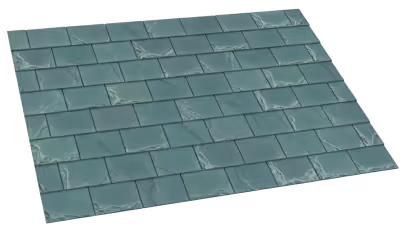
Metal shingles are stamped steel panels that interlock on all sides and imitate slate, shake, or dimensional shingles. They are an excellent solution when you want the performance of metal but need the house to read as a traditional country home from the drive or the road.
We often specify metal shingles on older farmhouses and more traditional gable or hip roof houses near the town center, Flat Creek, or long established lanes that still feel like classic College Grove. These roofs often have dormers, broken ridges, short valleys, and porch tie ins that benefit from the smaller shingle format. Metal shingles allow us to keep valley lines neat, keep cuts precise around chimneys and walls, and hold a consistent pattern across complicated geometry.
From a distance the roof looks like a very crisp, well installed shingle or slate roof. Up close, and in performance over time, it behaves like a metal system. It does not shed granules into the gutters, does not curl at edges, and is highly resistant to the algae staining that is common where tree cover and moisture linger.
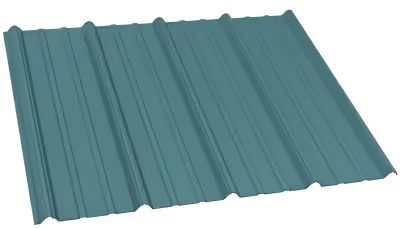
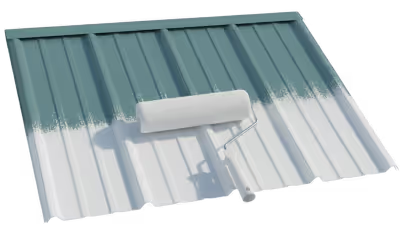
Ribbed metal panels with exposed fasteners are the workhorse of rural metal roofing. In College Grove they are usually the best choice for barns, arenas, workshops, sheds, and straightforward ranch houses that prioritize function and strength.
We install ribbed metal systems by making sure the structure is ready first. That means verifying that purlins or decking are correctly spaced, applying underlayment where condensation and air movement could cause issues, and using closure strips at eaves, ridges, and wall intersections so wind driven rain and pests cannot use the ribs as entry points. Screws are driven square, tightened enough to compress washers without crushing them, and kept in straight, aligned rows for both performance and appearance.
Trim is designed to move water off the building rather than simply cover cut edges. In a College Grove storm, wind can push water hard up against the building, so the way eave, rake, and valley trim is shaped makes a real difference. With this kind of installation, ribbed metal can serve for decades on barns and shops, and when coordinated with standing seam or metal shingles on the house, it keeps the property looking unified.
Weather in College Grove is defined by open exposure and fast changes. Storm lines that swing down from the northwest or sweep along 840 do not always slow down before they hit you. In open pasture or on hilltop sites, wind can hit full force. Hail events occasionally pass through, and seasons of heavy rain load gutters and valleys.
A properly designed metal roof handles these conditions differently than an asphalt roof. Metal panels resist hail impact better than thin shingles and do not rely on a layer of stone granules. The risk of accelerated wear from granule loss is removed. In wind, standing seam and interlocking metal shingles are attached mechanically to the deck or structure with defined patterns and edge details that are chosen to meet uplift requirements for your exposure.
If you are coming out of a storm claim on an existing roof and want to move to metal, we can inspect and document the current roof, coordinate on scope with your insurer where appropriate, and design a metal system that is not just a cover over a patch, but a long term assembly built for College Grove.
We know that a roofing project is not an abstract exercise. It happens around your daily life, your animals, your equipment, and your family. On a College Grove project we plan staging so that trucks, trailers, and material stacks do not block critical access, such as the barn lane, the main drive, or the area where trailers need to move.
During tear off we remove old roofing down to the deck. We keep debris contained with ground protection and catch methods, and we haul it away so it does not sit in your pasture or around your home. Any damaged decking is replaced or reinforced. We do not bury rotten wood under new metal.
Underlayment is installed across the roof, with extra attention paid to valleys that carry water from large upper roofs, edges that see wind driven rain, and areas where runoff hits lower roofs. Ventilation details are improved while everything is open, which may include opening soffit vents that were painted shut, increasing ridge vent capacity, or adding other exhaust methods consistent with your house design.
Metal panels or shingles are installed according to the planned layout. Seams are aligned, ends are cut cleanly, and joints land where they support water flow, not where they fight it. Flashings are integrated into the assembly instead of tacked on at the end. Once the roof is complete, we clean up nails and screws with magnets, clear gutters of roofing debris, remove ground protection, and walk the roof from the ground with you so you can see how it all ties together.
You finish with a metal roof that is built for your College Grove property and with documentation of materials and warranty terms.
How long will a metal roof last on my College Grove home
Installed on sound or repaired decking, with a proper underlayment system and a profile matched to your slope and exposure, a metal roof on a College Grove home can reasonably be planned around a forty to sixty year service window. Tree trimming, gutter cleaning, and periodic inspection are still important, but you are managing one long term roof instead of planning full replacement every couple of decades.
Will a metal roof look too modern for a farmhouse in College Grove
Not if it is chosen properly. On traditional farmhouses and older homes, metal shingles in slate or shake profiles or standing seam in muted tones can look completely natural. Many rural houses in Williamson County already use metal roofs that blend into the landscape rather than stand out. The key is aligning profile and color with the house style, not forcing a commercial look onto a country home.
Can you do my barns and my house at the same time
Yes. Many College Grove projects include a main house and one or more barns, shops, or detached garages. We can build a plan that roofs everything in one project, or phase the work house first and barns second, while keeping the metal profiles and colors consistent so the property looks unified.
What if my current roof has been patched many times and has structural issues
That is common with older roofs and homes that have been added onto. When we remove roofing down to the deck, we expose the real condition of the structure. We then replace damaged decking, re fasten weak areas, and address minor framing issues within the roofing scope. If we discover major structural problems that go beyond roofing, we show you with photos and discuss the proper path instead of covering them.
Will a metal roof be noisy during storms in the country
On a properly built residential roof assembly, with solid decking, underlayment, attic space or insulated cavities, and ceiling finishes, most homeowners do not find metal roofs to be excessively noisy. The very loud rain sound people describe usually comes from open framed barns where rain hits metal with air behind it and nothing else. In a College Grove home, the sound passes through several layers and is heard as a steady rain rather than a harsh echo.
Do you work with properties that have horses and other livestock
Yes. In College Grove that is normal. We plan our staging and daily work around your routines, including feeding times, turnout schedules, and access to barns and arenas. We communicate with you about which areas need to stay clear and which routes can be temporarily adjusted. The goal is to get the metal roof installed while respecting how your property operates.
If you are ready to stop patching the same spots and to start treating your roof as a long term part of your College Grove property, we can walk your land, design a metal roofing plan that fits, and install it in a way that makes sense for how you actually live and work here.