Metal Roofing Alliance Member
TVA Preferred Partners Network
10,000+ Metal Roof Jobs
Nashville, TN
Licensed & Insured
BBB A+

Open 8am–8pm
(615) 649-5002Schedule Your
Appointment
Appointment
✦ Reviewed by The Metal Roofers Technical Team
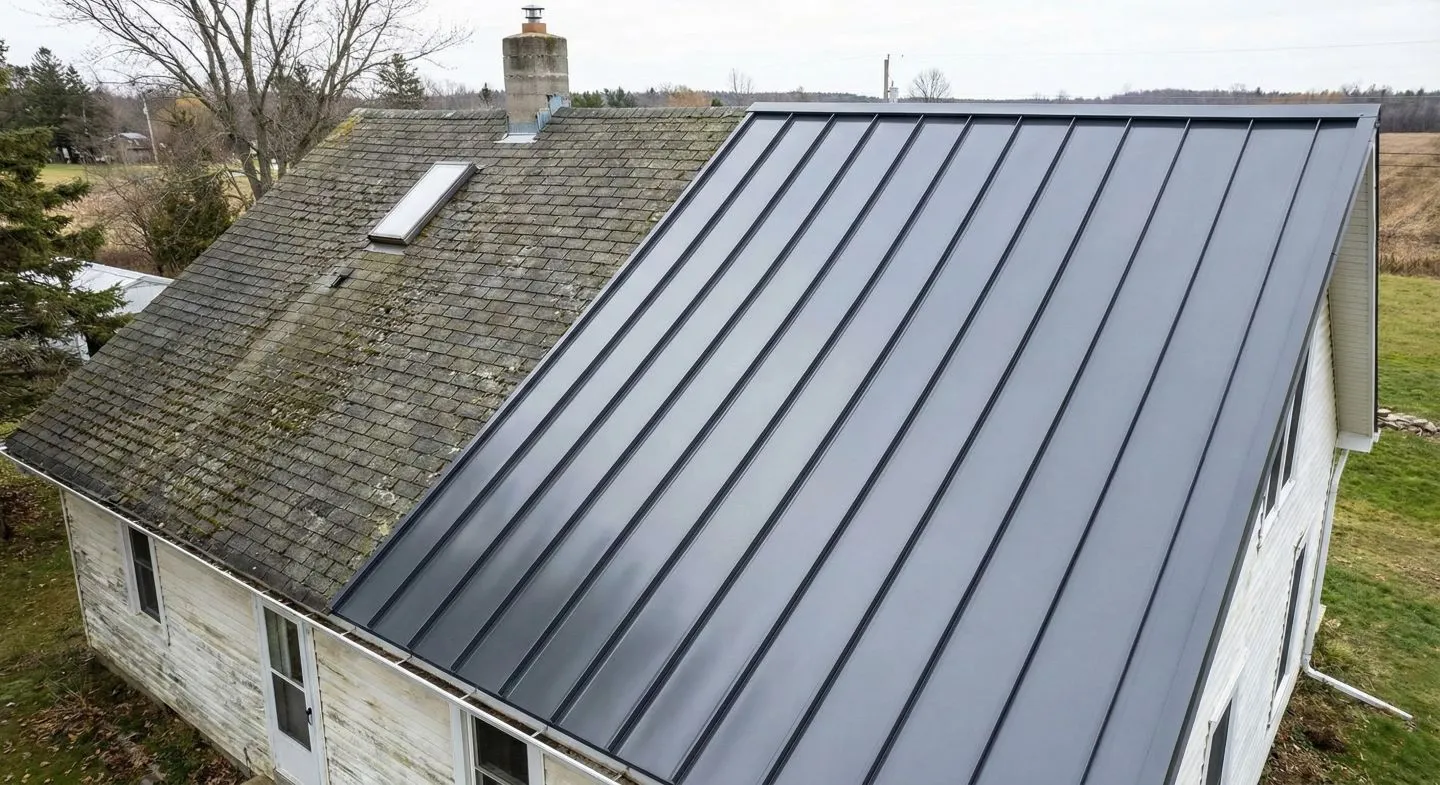
In Tennessee, our 2026 project data puts an exposed fastener metal roof at about $27,000 on average (typical range $14,980 to $48,520) and a standing seam metal roof at about $42,000 on average (typical range $22,600 to $69,575), once labor, tear-off, underlayment, and flashings are included. Our Nashville metal roof pricing guide breaks these numbers down by system, gauge, and material.
When it is time for a roof replacement in Middle Tennessee, homeowners face a high-impact decision: metal roofing or asphalt shingles. Both systems can be installed correctly and protect a home well, but the true cost difference is not just the first quote. It is also how long the roof lasts in Tennessee heat and storms, how often repairs come up, how energy performance affects monthly bills, and whether you are likely to pay for a second replacement later.
Below is a detailed, Tennessee-specific breakdown of pricing ranges, why metal costs more upfront, the variables that move your price up or down, and how metal and shingles compare over decades.
Tennessee's climate is not gentle on roofing systems. Long hot summers accelerate aging, humidity puts pressure on attic moisture control, and heavy rain plus wind-driven storms punish weak flashing details. That is why two roofs that "look fine" on day one can perform very differently 8 to 15 years later.
A good local cost comparison should include more than just "metal versus shingles." It should also include the system underneath (underlayment choices), how penetrations and valleys are flashed, and whether ventilation and insulation are set up to keep the roof deck dry over time.
As a practical starting point in Middle Tennessee:
Those ranges widen when you factor in roof pitch, complexity, and material tier.
Asphalt shingles stay popular in Tennessee because they offer solid protection at a lower upfront cost, and most homes can be reroofed quickly. But "asphalt shingles" is not one price. There are multiple grades, and the durability and appearance change with each step up.
For a 2,000 sq ft roof area (roof surface area, not floor plan), installed costs typically look like this:
3-tab asphalt shingles usually price around $8,500 to $10,200 total, or roughly $4.25 to $5.10 per sq ft including materials and installation. These are the most economical option and are often rated around 20 to 25 years, though Tennessee heat and storms can pull real-world lifespan toward the lower end if attic conditions are not ideal.
Architectural asphalt shingles usually price around $9,700 to $11,600 total, or roughly $4.85 to $5.80 per sq ft installed. This is the most common "upgrade" because the shingles are thicker, resist wind uplift better, and offer a more dimensional look. Typical ratings are 25 to 30 years.
Luxury or premium asphalt shingles commonly fall around $12,500 to $16,800 total, or roughly $6.25 to $8.40 per sq ft installed. These are heavier, more sculpted, and designed for a high-end appearance with longer warranties, often 30 to 35 years.
Asphalt shingles also win on speed. A typical shingle replacement is often 2 to 4 days depending on pitch, access, and how many details (valleys, skylights, chimneys) need custom flashing. That fast install is a big reason shingle pricing stays relatively contained.
Metal roofing is a higher initial investment because the materials are premium, the detailing is more exact, and the installation requires specialized skill. Within "metal roofing," there are big pricing differences depending on the metal type and system design.
Across our 2026 project data, the two most common steel systems came in like this:
Exposed fastener (screw-down) metal roofing, including galvanized and Galvalume-type coated steel panels, averaged about $27,000 installed, with a typical range of $14,980 to $48,520 depending on roof size, pitch, and trim detail. This is usually the most cost-effective entry into metal. When installed correctly with the right underlayment and flashings, typical lifespan is around 40 to 55 years.
Standing seam metal roofing averaged about $42,000 installed, with a typical range of $22,600 to $69,575. Standing seam costs more because it is a precision system, often with concealed fasteners or clips and a tighter detailing standard at transitions. Typical lifespan is commonly 50 to 60 years.
For premium materials on a 2,000 sq ft roof area, installed costs typically look like this:
Aluminum roofing often runs $24,000 to $37,000 total, or about $12.00 to $18.50 per sq ft installed. Aluminum costs more primarily due to material pricing, but it performs extremely well in humid environments and is lightweight. Typical lifespan is often 50 to 70 years.
Copper roofing commonly starts around $40,000 to $60,000+, often $20.00 to $30.00+ per sq ft installed depending on detailing. Copper is an architectural upgrade and can last 70 years or longer, but it is in a different category because both the material and craftsmanship costs are high.
Metal shingles can be a middle ground for homeowners who want a more traditional look but still want metal durability. Pricing often lands between architectural shingles and standing seam, but the final number depends heavily on the specific product and roof complexity.
National cost guides commonly put a metal roof in the U.S. at $10,000 to $30,000 installed, or roughly $7 to $14 per square foot, depending on the size of the house, the type of metal used, and the complexity of the roof design. Steel and aluminum sit at the common end of that spread, while premium options like copper and zinc carry a higher price point.
Our Tennessee project numbers run wider than the national picture, especially for standing seam, because local 2026 figures reflect complete systems: tear-off, deck repairs, high-temperature underlayment, custom trim, and flashing details rather than base panel pricing alone. Roof pitch, panel style, insulation and underlayment quality, and local labor rates all move the final number.
Metal roofs cost more upfront for specific, practical reasons tied to how the system is built and installed.
Metal uses higher-cost materials, but the bigger driver is usually installation precision. Standing seam, in particular, requires accurate panel layout, consistent fastening patterns, and careful flashing at every roof-to-wall, chimney, or penetration. Metal also needs a stronger detail plan for thermal movement, because panels expand and contract through Tennessee's heat cycles.
In other words, you are paying for a roof that is designed to be stable across decades of seasonal change, not just a roof that looks good on the day it is finished.
Even if two homes are the same size, their roof replacement prices can be far apart. The final number is heavily shaped by roof geometry, pitch, how much tear-off is required, and the quality of the underlayment and flashing package.
Roof area directly drives materials and labor hours. A practical way to think about it is by roof area bands:
A roof in the 1,000 to 1,500 sq ft range often lands around $4,250 to $8,250 for shingles and $12,000 to $27,000 for metal.
A roof in the 1,500 to 2,000 sq ft range often lands around $6,400 to $11,000 for shingles and $18,000 to $36,000 for metal.
A roof in the 2,000 to 2,500 sq ft range often lands around $8,500 to $13,750 for shingles and $24,000 to $45,000 for metal.
Pitch and complexity are the "silent multipliers." A steep roof commonly increases installation costs by about 15% to 30% for both systems because staging is slower, safety setup is heavier, and crews simply cannot move as fast.
Complex designs with multiple valleys, dormers, skylights, chimneys, and intersecting roof lines add time and increase material waste. This is especially noticeable on metal, where every transition requires clean detailing and custom trim work.
With asphalt, moving from 3-tab to architectural to luxury shifts both performance and cost. With metal, moving from basic steel to standing seam to aluminum to copper shifts cost quickly, largely because material price rises and install detailing becomes more demanding.
Labor is often where the gap between shingles and metal becomes obvious. Metal roof labor commonly runs around $3.00 to $6.00 per sq ft because the install is more exacting, and standing seam demands precision at every step. Asphalt shingle labor is commonly around $2.00 to $4.00 per sq ft because the system is faster and less specialized to install.
Tear-off and disposal commonly runs $1.00 to $3.00 per sq ft, depending on how many layers are present and how difficult disposal logistics are. Metal can sometimes be installed over existing shingles, but many contractors still prefer a clean deck, especially if decking condition is unknown or if the goal is best long-term performance and warranty clarity.
Underlayment is not a small detail. It is your secondary water barrier. Metal roofs often use upgraded synthetic underlayments, commonly around $0.75 to $1.50 per sq ft depending on the product and whether high-temperature performance is needed. Asphalt roofs often use felt or synthetic underlayment, commonly around $0.50 to $1.00 per sq ft, with upgrades sometimes used at eaves and valleys.
Attic insulation also matters for both systems. A roof system performs best when the attic stays dry and temperature swings are controlled, because that reduces condensation risk and slows material aging.
The real comparison is total ownership cost, not just install cost.
If an architectural asphalt roof lasts about 25 years, most homeowners will replace it twice over a 50-year span. When you add a second tear-off, a second install, and the repairs that happen between, lifetime costs often stack up.
A standing seam metal roof is often a 50-year roof, meaning one install can cover the same ownership window.
A simple long-horizon comparison looks like this:
Architectural asphalt shingles: lifespan about 25 years, roughly 2 replacements in 50 years, total lifetime cost often around $22,000 to $33,000 depending on repairs and inflation.
Exposed fastener metal: one install averaging about $27,000 in our 2026 project data can cover most of that same window, which puts its lifetime cost at or below the asphalt path for many homes.
Standing seam metal: lifespan about 50 years, typically 1 replacement in 50 years, averaging about $42,000 installed in 2026 project data. That is more than the asphalt lifetime range in raw dollars, but it is one roof, one disruption, and one set of details, with stronger storm performance across those decades.
Asphalt shingles can last well, but they are more vulnerable to hail bruising, wind-driven damage, and gradual granule loss under intense sun. Metal roofs resist wind, fire, and rot, and they do not degrade under UV exposure in the same way shingles do. The big caveat is that metal performance depends heavily on correct flashing and correct detailing at penetrations. A great metal panel cannot save a sloppy chimney transition.
In hot Tennessee summers, the roof can heavily influence attic temperature and HVAC workload.
The U.S. Department of Energy explains that cool roofs are designed to reflect more sunlight and absorb less solar energy, lowering roof temperature and heat transfer into the building. The Department of Energy's Energy.gov
For air-conditioned residential buildings, the EPA notes that a cool roof's reflectance can reduce peak cooling demand by about 11% to 27%. EPA
And cool-roof research summaries commonly cite reductions in annual air-conditioning energy use of up to about 15% on single-story buildings under the right conditions. heatisland.lbl.gov
Savings vary with insulation, ventilation, duct leakage, roof color and coating, and how much sun exposure the home gets, but reflective roofing can be a real contributor in Tennessee's long cooling season.
Asphalt shingles tend to need more frequent spot repairs over time, especially after wind and hail events. Repairs are usually straightforward, but the frequency is higher.
Metal roofs generally require less routine repair when installed correctly. Periodic inspections still matter, especially around penetrations and sealant transitions, but major repairs are less common unless details were done poorly during installation.
Both roofs can support resale, but the ROI differs.
The 2025 JLC Cost vs. Value Report's national averages list "Roofing Replacement | Asphalt Shingles" at 68% cost recouped and "Roofing Replacement | Metal" at 50% cost recouped. Journal of Light Construction
That does not mean metal is a bad investment. It means metal's value is often realized more through long-term ownership benefits, durability, and reduced replacement cycles, not purely through immediate resale recoup.
Asphalt shingles usually cost less upfront, commonly $8,500 to $15,000 installed.
Metal roofing typically costs more upfront: in 2026 project data, exposed fastener averages about $27,000 (range $14,980 to $48,520) and standing seam averages about $42,000 (range $22,600 to $69,575) installed.
Asphalt commonly lasts 20 to 30 years, while metal commonly lasts 40 to 70+ years depending on system and installation quality.
Asphalt usually needs more repairs over time, metal usually needs fewer.
Metal often improves heat reflectance and can support lower cooling demand, especially with the right color, coating, and attic setup.
Asphalt is popular for real reasons: the entry cost is lower, installation is fast, most contractors can install it competitively, repairs are easy, and there is a wide range of colors and styles that fit nearly any home.
Metal's big advantages are longevity, storm resistance, and reduced replacement cycles. A properly installed metal roof can be a "buy it once" roof for many homeowners. It also tends to be lower maintenance, and reflective roof options can contribute to a cooler attic and reduced HVAC strain in Tennessee summers.
No roofing material fixes bad detailing. Proper installation determines whether the roof performs like a system or behaves like a patchwork of parts.
Professional crews follow manufacturer requirements, handle flashing correctly, and build the underlayment and ventilation plan for the home, not just the roof surface. That is what protects the investment, especially in Tennessee's heavy rain and heat cycles. If you want numbers for your specific roof, request a free estimate.

What do metal shingles cost in Nashville? Installed price ranges, cost per roofing square, and what drives a Tennessee roof quote.
Explore flexible metal roof financing options: loans, payment plans, and more to fit any budget. Fast approvals and terms up to 15 years available.
How steel and aluminum tariffs may affect metal roof prices for Tennessee homeowners, commercial buildings, and Nashville roofing projects.